
Lieferung heute & morgen

Qualitätsgarantie

Willkommens-Angebote freischalten: KOSTENLOSE Lieferung | Bis zu 80 % RABATT | Kostenlose 30-Tage-JoyPlus-Testphase
App herunterladen
A storage jar with a wooden lid combines visible kitchen organisation with reusable storage. Rice, pasta, flour, sugar, coffee, tea and biscuits can all be stored neatly, without the contents disappearing inside opaque packaging. However, it is worth taking a close look at the product details: not every jar with a wooden or bamboo lid is suitable for the same foods, cupboard heights or cleaning routines.
Sealing a storage jar airtight requires a suitable sealing ring and a clean, dry rim. A wooden lid alone does not automatically make a glass container airtight. For products with a silicone seal, check that the seal is firmly in place and that the lid sits evenly.
Even an airtight seal cannot replace dry storage. If, for example, warm flour or damp sugar is added, condensation may form. Dry foods should therefore be allowed to cool completely, and the lid should be dry before closing the jar.
Glass is often dishwasher-safe, whereas wooden lids usually are not. Water, heat and harsh cleaning products can damage the surface of pine or acacia wood. For many models, the following is therefore recommended:
If you are looking for particularly easy cleaning, choose a model whose glass body is clearly stated to be dishwasher-safe. This does not automatically apply to the lid.
Choosing a square storage jar can make efficient use of cupboard space. However, the actual external dimensions, including the lid, are what matter. A tall 1.5-litre jar may be impractical on a kitchen shelf, while a smaller 0.4-litre model may be better suited to spices, tea or baking ingredients.
Before buying, measure the width, depth and height of the intended shelf or compartment. It is also helpful to leave room for removing the jar, especially from tall shelves.
A glass storage container should be suitable for its intended use. Borosilicate glass is used in several of the products listed here and is specified as a material for glass containers for dry foods. Nevertheless, always follow the relevant manufacturer’s instructions: a storage jar for dry foods should not automatically be used for hot food, in the oven or in the microwave.
Look out for the following information:
A jar with a bamboo lid or a jar with an acacia wood lid can create different visual accents. For functionality, the seal is particularly important. Silicone rings or silicone seals help provide a secure closure; clamp jars also have a stainless steel clip.
Before placing your order, check the following:
The right size depends on the food and how often you use it:
The stated capacity describes the volume of the container, not necessarily the quantity of a particular food in kilograms. Flour and sugar, for example, have a different density from rice.
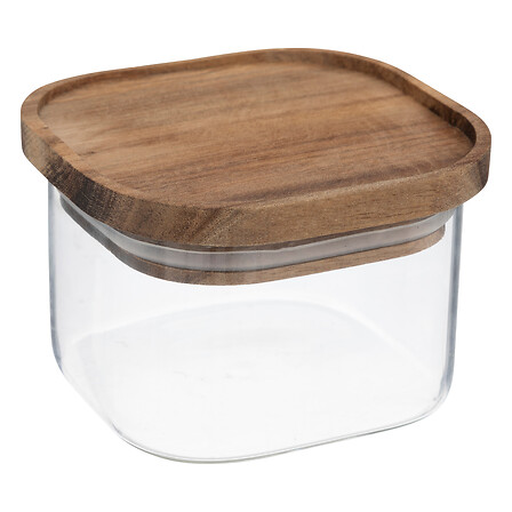
Why this product suits this profile: The 0.4-litre format is suitable for smaller quantities and limited storage space. The square borosilicate glass body is combined with an acacia wood lid.
The product details specify a hermetic seal and expressly point out that the glass rim should be clean and dry. The lid is not suitable for the dishwasher.
0.4-litre capacity, square dimensions of 11 × 11 × 7.4 cm and acacia wood as the lid material.
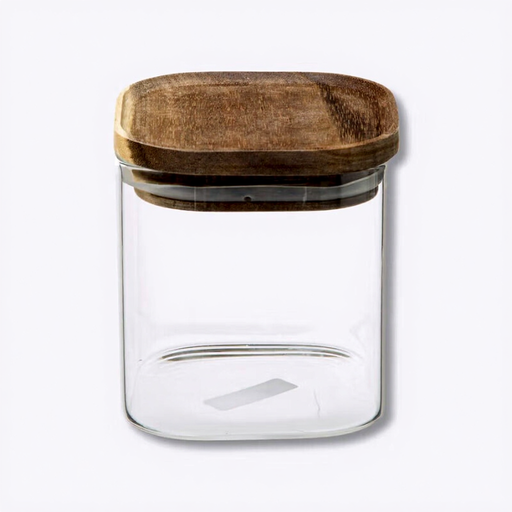
Why this product suits this profile: The 0.6-litre jar is aimed at households looking for a compact kitchen storage jar with stated suitability for food contact.
The details clearly distinguish between the glass, acacia wood and silicone components. It is also stated that the product is not dishwasher-safe.
0.6-litre usable capacity, glass container with acacia wood lid and stated suitability for indoor use.
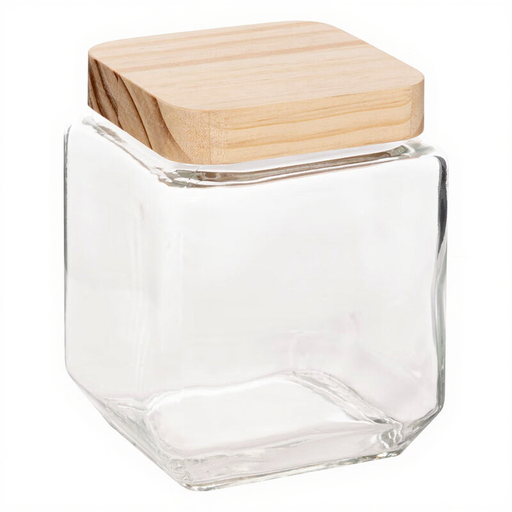
Why this product suits this profile: With a capacity of 1.25 litres, this storage jar is designed for households that regularly stock up on rice, pasta, flour or sugar and want to keep the contents visible.
The product description specifies a silicone seal and an airtight interior. The pine lid should be kept dry and cleaned only with a damp cloth.
1.25-litre capacity, square shape and a glass body stated to be dishwasher-safe.
For sustainable food storage, service life matters. Check the jar for cracks, chips or damaged seals before every use. Damaged containers should no longer be used for food.
Also bear the following in mind:
A glass container for dry foods is a reusable alternative to disposable packaging. However, its practical benefits depend on whether the size, seal and cleaning requirements suit your everyday routine.
We have put together a complete, regularly updated list of products that fully meet these strict selection criteria and the safety regulations applicable in the EU.
That depends on its design. A wooden lid with a silicone or rubber seal can provide an airtight closure. Check the specific product description and make sure that the glass rim and seal are clean and dry.
With proper use, a glass container can be reused for a long time. Its actual service life depends on drops, scratches, thermal shock and how the lid is cared for. Wooden and silicone components may require different care or replacement intervals from the glass body.
Depending on the product, the glass body may be dishwasher-safe; the acacia wood lid generally is not automatically suitable for dishwasher use. Before cleaning, check the manufacturer’s instructions and wash the wooden lid separately by hand.