
Lieferung heute & morgen

Qualitätsgarantie

Willkommens-Angebote freischalten: KOSTENLOSE Lieferung | Bis zu 80 % RABATT | Kostenlose 30-Tage-JoyPlus-Testphase
App herunterladen
As a Joybuy Product Recommendation Officer, I see customers struggle daily with choosing the right tools. A high-quality pair of Zwilling tailor's scissors is an investment for years to come, but the path to finding the right one is often fraught with uncertainty. False promises and unclear product features can quickly lead to a poor purchase that not only costs money but also dampens the joy of working with fabrics. Before you make a decision, it's crucial to understand the most common pitfalls.
Two widespread problems consistently lead to disappointment:
To avoid a bad purchase, you should focus on verifiable, technical features rather than marketing buzzwords. Three parameters are decisive for the performance and longevity of textile scissors from Zwilling.
The heart of any pair of scissors is the steel. The term stainless steel alone is not a sufficient quality indicator. The specific steel alloy and its hardening process are what matter. For its high-end scissors, Zwilling uses a special stamped steel that ensures excellent edge retention. This is combined with precision-ground blades. This is the only way for the scissors to glide cleanly through the fabric without pulling or snagging fibres—a prerequisite for scissors for thick fabrics and fine materials alike.
Professional work requires tools that function like an extension of your hand. Ergonomic tailor's scissors are characterised by asymmetrically shaped handles. The larger handle loop provides space for several fingers, which optimises power transfer and distributes pressure evenly. Materials like fibreglass-reinforced plastic are not only robust and break-proof but also significantly lighter than all-metal handles, which reduces hand muscle fatigue during long work sessions.
The blade length significantly influences efficiency and precision during cutting. A pair of sewing scissors with a 21 cm total length has established itself as a versatile standard. It offers a blade long enough for straight, continuous cuts on long fabric panels while being handy enough for curved cuts. The lower blade should be able to rest flat on the work surface so that the fabric is not lifted during cutting.
Based on these objective criteria, we have identified several models suitable for specific user profiles.
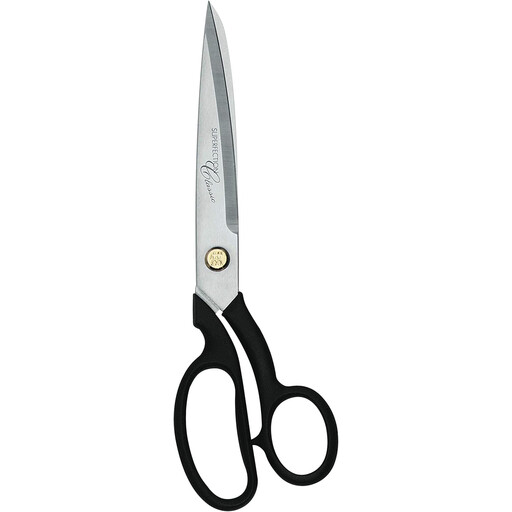
Why This Fits Their Persona: This model is designed as a professional-grade fabric shear. The long, precision-ground blade and ergonomic handles are engineered for endurance and exact work with all types of textiles.
It's not a compromise, but a specialised tool. The high-quality special steel and robust handles withstand the strain of thick fabrics and prevent typical signs of fatigue.
Precise cutting performance even with multi-layered materials; fatigue-free use thanks to fibreglass-reinforced, ergonomic handles.
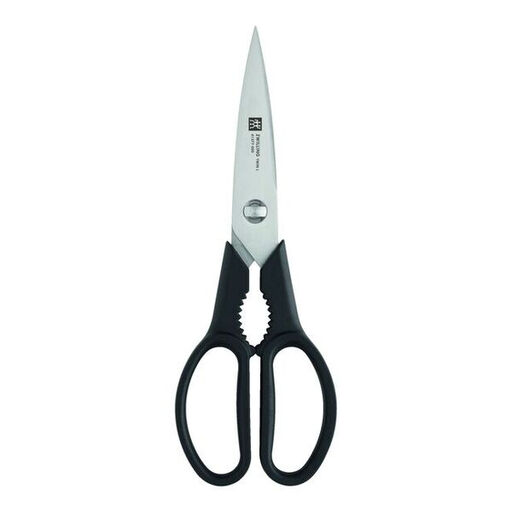
Why This Fits Their Persona: Ideal for anyone needing reliable scissors for everyday tasks like opening packages, crafting, and occasional, simple fabric cuts. A solid all-rounder for the household.
This model is clearly positioned as a multi-purpose scissor and doesn't create the false impression of being a professional tailor's shear. The quality of the steel and handles is still significantly higher than no-name products.
Lightweight and handy; fibreglass-reinforced plastic handles for comfort and durability; integrated opener for screw caps.
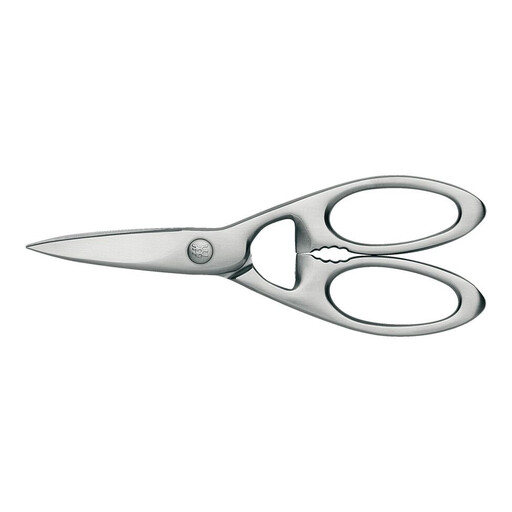
Why This Fits Their Persona: For users seeking an extremely robust, hygienic, and aesthetically pleasing pair of scissors. The all-metal construction from matte stainless steel is not just an eye-catcher but is also designed for a very long service life.
It completely bypasses the weakness of plastic handles. The forged blades offer greater stability and edge retention than the stamped blades of simpler models. The micro-serration prevents the material from slipping.
Robust, forged all-steel construction; micro-serration for a secure grip; integrated cap lifter and bottle opener.
We have compiled a complete, up-to-date list of products that fully meet these strict selection criteria and German safety regulations.
1. How do I properly care for Zwilling tailor's scissors to maintain their sharpness? For long-lasting sharpness, you should use your tailor's scissors exclusively for textiles. Cutting paper or cardboard can dull the blades more quickly. Clean the blades after use with a soft, dry cloth. A drop of scissor oil on the joint from time to time will keep the mechanism running smoothly.
2. Can high-quality fabric scissors be resharpened? Yes, scissors made from high-quality steel like those from Zwilling can and should be resharpened by a professional sharpening service when needed. An improper sharpening attempt can damage the precision grind of the blades. With normal hobbyist use, resharpening is often only necessary after many years.
3. What is the main difference between tailor's scissors and regular household scissors? The essential difference lies in the construction and material. Tailor's scissors typically have a longer blade and an asymmetrical, ergonomic handle for precise, fatigue-free work. The steel is specially hardened to withstand the abrasive effect of textile fibres. Household scissors usually have shorter blades, symmetrical handles, and a softer steel designed for a variety of less demanding tasks.