
Lieferung heute & morgen

Qualitätsgarantie

Willkommens-Angebote freischalten: KOSTENLOSE Lieferung | Bis zu 80 % RABATT | Kostenlose 30-Tage-JoyPlus-Testphase
App herunterladen
A 65W USB-C charger can power a smartphone, tablet and compatible laptop with a single mains adapter. In practice, however, choosing the right model can often lead to costly mistakes: the wattage shown on the product does not always indicate the power available at every port, multiple ports often share the total output, and a suitable cable is not necessarily included.
This buying guide from the Joybuy Product Recommendation Officer explains which technical specifications matter before you buy and which 65W fast charger is best suited to different usage scenarios.
With a multi-port USB charger, 65W usually refers to the maximum total output. When several devices are connected, the charger distributes the available power between them. A laptop may therefore receive less than 65W while a smartphone or headphones are charging at the same time.
So be sure to check two specifications:
A USB-C port initially describes only the connector type. To charge a compatible laptop quickly, you will generally need a Power Delivery charger, often with USB Power Delivery 3.0. The charger, device and cable must also work together.
A USB-C power adapter without sufficient PD support may charge a smartphone, but could charge a laptop much more slowly or fail to start charging altogether.
USB-A remains useful for older cables, headphones and power banks. If you mainly use newer smartphones, tablets or laptops, however, two or more USB-C ports are likely to be more useful. The key factor is therefore not simply the number of ports, but the combination of USB-C and USB-A, the spacing between ports and the available output.
65W is enough for many USB-C laptops, tablets and smartphones, provided the device supports this level of power. The charger does not automatically deliver 65W to every device: the actual power draw is determined by the connected device and the charging protocol.
Check the following before buying:
A 65W charger can therefore serve as both a phone charger and a laptop charger, provided the technical profiles are compatible.
A GaN charger uses gallium nitride components instead of conventional silicon technology. Product specifications often associate this design with a more compact form factor and lower heat generation. Even so, the precise dimensions, weight and ventilation are still important when choosing a charger.
A compact plug-in charger is ideal for carrying in a travel bag. A charging station with a separate mains cable, on the other hand, can be positioned more flexibly on a desk. Also check whether the housing blocks neighbouring sockets.
Look out for:
Not every product includes a charging cable. For a laptop, use a USB-C cable designed to handle the required power. Damaged or frayed cables should never be connected to a high-powered charger.
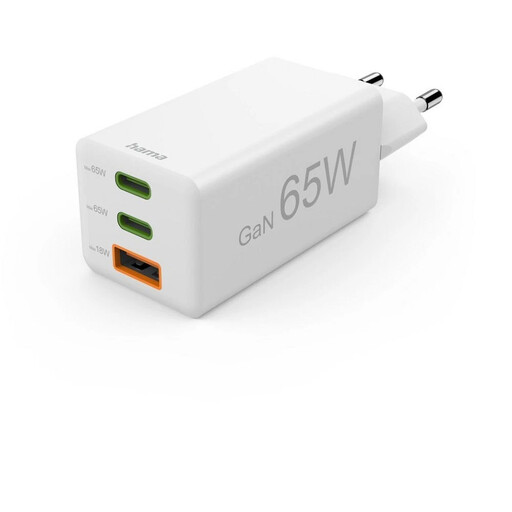
Why this product suits this profile: Three ports support both current USB-C devices and older USB-A cables. The compact GaN housing is designed for use at home, in the office and while travelling.
The specifications state a total output of 65W, with two USB-C ports plus USB-A. When several devices are connected, the power distribution still needs to be taken into account.
2× USB-C, 1× USB-A, Power Delivery, Qualcomm Quick Charge 2.0/3.0 and 100–240V input.
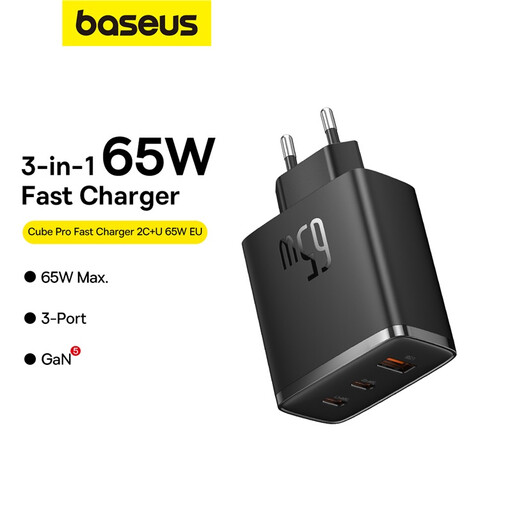
Why this product suits this profile: This model combines 2× USB-C and 1× USB-A with clearly specified output profiles of up to 65W through a single USB-C port.
The specification distinguishes between single-port and USB-A output. This makes it easier to plan realistic usage with several devices.
GaN technology, 110–240V input, USB-C output of up to 20V/3,25A and compact dimensions of approximately 5,4 × 3,2 × 7,76cm.
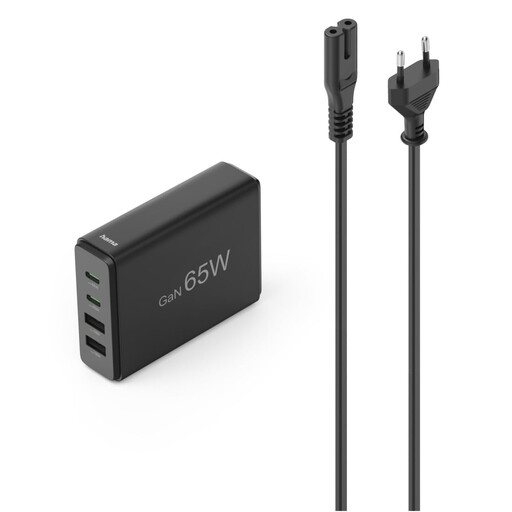
Why this product suits this profile: Four ports and a 1,5m mains cable make it suitable for a permanent charging point on a desk or for several people in the household.
The product data specifies a total output of 65W, along with 2× USB-C and 2× USB-A. When four devices are connected, the available power is shared between them.
4 ports, GaN technology, 1,5m cable, PD on USB-C and QC support on USB-A.
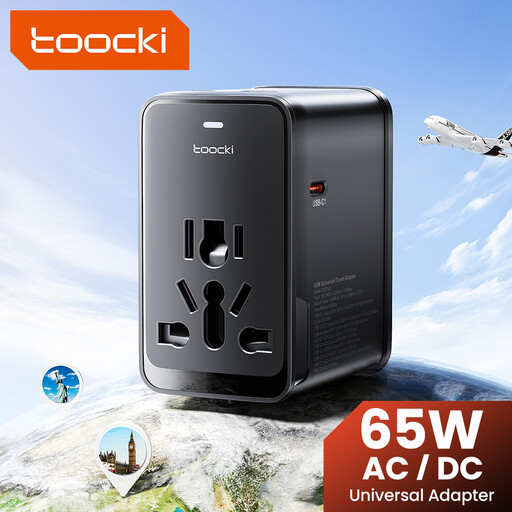
Why this product suits this profile: The combination of an international travel adapter, 3× USB-C and 1× USB-A is designed for travelling with a range of devices.
The adapter reduces the need to carry several travel chargers. Before use, check the destination country, plug type and power distribution.
65W PD, 3× USB-C, 1× USB-A and support for EU, UK, US and AUS plug types.
We have put together a complete, regularly updated list of products that fully meet these strict selection criteria and the safety regulations applicable in the EU.
That depends on the laptop model and its charging profile. Many compact USB-C laptops can be powered with 45W to 65W. Check the manufacturer’s specifications and use a USB-C cable rated for the required power. When several devices are connected, the available output may decrease.
This depends on the number of ports and the charger’s internal power distribution. A 2-port model can power two devices, while a 4-port charging station can power up to four. However, the number of ports does not mean that every device will charge at full power simultaneously.
No. This figure describes the maximum output, not constant consumption. Actual energy use depends on the connected devices, their charge level and the charger’s efficiency. Once fully charged, the device will generally reduce its power consumption; nevertheless, the charger should be unplugged when you are away for an extended period.