
Lieferung heute & morgen

Qualitätsgarantie

Willkommens-Angebote freischalten: KOSTENLOSE Lieferung | Bis zu 80 % RABATT | Kostenlose 30-Tage-JoyPlus-Testphase
App herunterladen
A blackout roller blind without drilling is particularly practical for rented apartments, children’s rooms and frequently used balcony or patio doors. Depending on the model, installation is carried out using clamp brackets, adhesive mounts or suction cups. This keeps walls and window frames largely free from damage.
However, the choice should not be based solely on colour or price. Key considerations include the actual fabric width, compatibility with the window frame and the desired level of light transmission. The following guidance helps you avoid common buying mistakes.
For many roller blinds, the stated measurement includes the brackets. This means the actual fabric is narrower. According to the product specifications, the fabric width of the WOLTU blackout roller blind is approximately 4 cm narrower than the overall width. If you measure only the glass width, gaps allowing light in from the sides may result.
For comprehensive privacy and sun protection, the overall width ordered should generally be around 4 cm wider than the glass width. You should also check whether window handles or protruding fittings could interfere with installation.
A thermal roller blind without drilling can influence light and heat penetration through its coated backing. Its effectiveness nevertheless depends on the window size, orientation, exposure to sunlight and existing glazing. Statements such as “100% blackout” or “thermal protection” should be understood as manufacturer claims and should not be equated with a guaranteed room temperature.
A silver-coated backing can reflect sunlight. In winter, a closed roller blind may also reduce direct air exchange at the windowpane. For a noticeable effect, the blind should fit as closely as possible in front of the glass.
A clamp-fix roller blind is attached to the opening window sash. However, the permissible frame thickness varies depending on the model. According to the product information, WOLTU blackout roller blinds are designed for frame thicknesses of 16 to 22 mm. The WOLTU honeycomb pleated blind is specified for 10 to 23 mm.
Before ordering, you should therefore measure the following:
A privacy roller blind is suitable for bedrooms, bathrooms and rooms facing the street. Light-filtering fabrics let daylight into the room but do not create complete blackout conditions. According to the product description, the light-grey Dream-Seeker pleated blind is opaque while still allowing light through. It is therefore better suited to living rooms or home offices where a soft, diffused light is desired.
For bedrooms and children’s rooms, roller blinds with a dense, coated backing are generally a better choice. Even so, side gaps can occur if the blind is narrower than the glass surface.
A cordless roller blind reduces loose cords around the window. The WOLTU roller blind is operated using a handle on the lower aluminium rail. This eliminates a dangling control cord that children or pets could reach. Nevertheless, children should be kept away from small parts during installation. For models with a pull cord, the cord must be securely fastened and regularly checked to ensure it remains firmly in place.
Polyester is widely used for roller blinds because the fabric can be easy to wipe clean and retain its shape. According to the manufacturer, the WOLTU blackout roller blind is made from 200 g/m² polyester and is OEKO-TEX certified. This means that the relevant textile certification is stated; it should not, however, be interpreted as a medical or health-related claim.
For the products mentioned, a damp cloth is sufficient for cleaning. Coated fabrics should not be treated with harsh products or soaked thoroughly.

Why it is a good fit: For rented apartments and standard windows where tool-free clamp installation and a neutral colour are preferred.
The product information specifies the compatible frame range of 16–22 mm and points out that the fabric is narrower than the overall width.
200 g/m² polyester, clamp or screw installation, silver-coated backing and cordless operation.
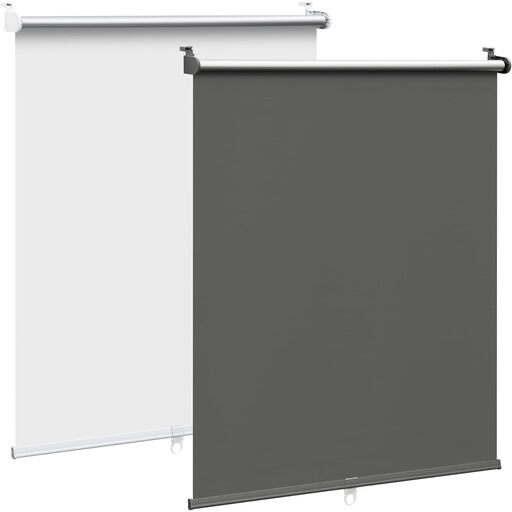
Why it is a good fit: For bedrooms and living spaces where a darker aesthetic as well as light and privacy protection are desired.
The specified fabric width and required frame range are expressly taken into account before installation.
Anthracite 200 g/m² polyester fabric, reportedly 100% blackout according to the manufacturer, thermal coating and quiet handle operation.

Why it is a good fit: For rooms requiring stronger sun and privacy protection, as well as for windows and doors with a compatible frame.
The permissible frame range of 10–23 mm and the note regarding protruding handles make it easier to check compatibility.
Honeycomb structure, clamp-fix installation, upper and lower handles, and moisture-repellent polyester according to the product information.
For a roller blind for windows and doors, the mounting surface should be clean, dry and as level as possible. Adhesive mounts only adhere reliably once dust and grease have been removed. Clamp brackets must not be placed under excessive tension and must be compatible with the frame.
According to the installation instructions, the retaining strap on WOLTU blackout roller blinds should not be removed until after installation. Otherwise, the spring mechanism may be affected. The honeycomb pleated blind is designed for indoor use and is not suitable for roof windows. According to the description, another WOLTU pleated blind with suction cups can be attached to smooth surfaces such as glass or tiles, but not to textured walls.
If you are looking for an alternative to a sun protection roller blind for windows, you can also choose a pleated blind without drilling. This can often be positioned from either the top or bottom, providing flexible coverage. Depending on the fabric, however, it may offer less effective blackout performance.
Browse the full selection to find a range of sizes, colours and mounting solutions for protecting windows and doors.
First, measure the width of the glass and then check the specifications for the product in question. If the fabric width is smaller than the overall width, a wider model may be required. For many of the products mentioned here, adding approximately 4 cm to the glass width is recommended. The frame thickness must be checked separately.
Its service life depends on the materials, spring mechanism, installation and daily use. Without a product-specific assessment, it is not possible to provide a reliable fixed lifespan. Careful operation, secure installation and cleaning with a damp cloth can help extend its usable life.
The roller blind itself does not require electricity. According to the manufacturer, a heat-insulating roller blind can influence direct sunlight and heat entering the room. Whether this reduces heating or cooling costs depends on the building’s characteristics, ventilation habits and how the room is used.