
Lieferung heute & morgen

Qualitätsgarantie

Willkommens-Angebote freischalten: KOSTENLOSE Lieferung | Bis zu 80 % RABATT | Kostenlose 30-Tage-JoyPlus-Testphase
App herunterladen
A weak or dead car battery is more than just an annoyance—it can derail your plans and lead to unexpected costs, especially during the cold months. However, the market for battery chargers is confusing and filled with technical jargon that makes an informed decision difficult. Many vehicle owners invest in devices that are unsuitable for their needs, oversized for their battery, or simply incompatible with their vehicle's technology.
As your Joybuy Product Recommendation Officer, I'm here to help you understand the crucial features and avoid common purchasing pitfalls. This guide focuses on the objective criteria you should check before buying a charger or a jump starter power bank.
Before we dive into the technical details, it's important to know the most common mistakes that lead to an unsuitable purchase.
To avoid a bad purchase, you should focus on three core parameters. These determine whether a device is suitable for your vehicle and your usage habits.
The charging current, measured in Amperes (A), indicates how quickly a charger recharges the battery. A common rule of thumb is that the charging current should be about 10% of the battery's capacity in Amp-hours (Ah).
A charging current that is too high can cause the battery to overheat and shorten its life, while a current that is too low will lead to extremely long charging times for large batteries.
The chemical composition of modern batteries requires specific charging algorithms. It is essential to check which types the charger is designed for:
Define your primary use case:
Here are some product recommendations tailored to different user profiles and their specific requirements.
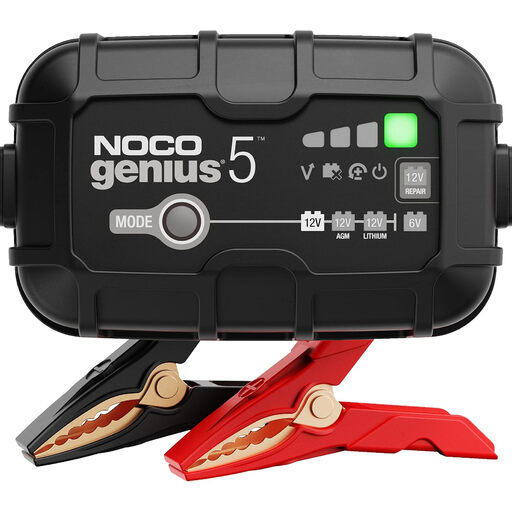
Why This Fits Their Persona: A well-balanced solution for most standard cars and motorcycles. It offers all the necessary charging and maintenance functions for seasonal or occasional use without being overwhelming with unnecessary extras. Ideal for conditioning the battery before winter or reviving it after a long period of inactivity.
With a 5-Amp charging current, it is correctly sized for the most common battery capacities. It is explicitly suitable for AGM and Lithium (LiFePO4) batteries, thus preventing damage from incompatibility.
Features an integrated thermal sensor to adjust the charging cycle and a desulfation mode to restore battery performance.
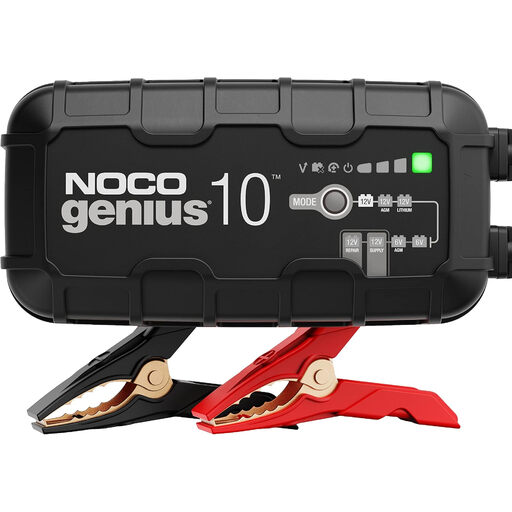
Why This Fits Their Persona: Anyone who owns an SUV, van, RV, or boat needs more power. This device is designed for large batteries up to 230 Ah and offers advanced features for demanding users who perform regular maintenance.
The 10-Amp charging current is suitable for large capacities, avoiding inefficiently long charging times. Its comprehensive compatibility with all common battery types, including lithium, makes it a future-proof investment.
Offers a special repair mode to restore deeply discharged batteries (down to 1 volt) and a "Force Mode" for batteries with 0 volts of charge.
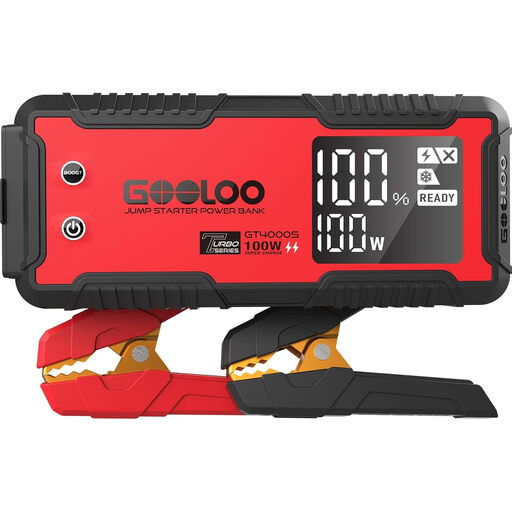
Why This Fits Their Persona: For anyone who doesn't want to depend on a power outlet. This device is a powerful jump starter power bank that fits in the glove compartment and can start even large gasoline and diesel engines in an emergency. It also doubles as a power bank for laptops and smartphones.
This product clears up the confusion: it is purely a jump starter for emergencies, not a charger for maintenance. Its enormous power of 4000A peak current is designed for this specific purpose and is not comparable to a battery charger.
Supports 100W two-way fast charging, allowing the device itself to be fully recharged in about 1.2 hours. A 3.2-inch display clearly shows its status.
For users who are deeply engaged with modern battery technologies, we have curated a selection of high-performance, long-lasting batteries that meet strict selection criteria.
The charging time depends on the battery's capacity (Ah), its state of discharge, and the charger's current (A). As a rough estimate, you can divide the battery's capacity by the charging current and add about 10–20% for the final balancing phase. For example, a 60 Ah battery that is 50% discharged (requiring 30 Ah) will take about 6–7 hours with a 5A charger.
Yes, modern smart chargers with a maintenance function are designed for exactly this purpose. They monitor the battery voltage and only supply a small current when necessary. This prevents overcharging and keeps the battery in optimal condition for months, making it ideal for winter storage of motorcycles, convertibles, or boats.
A car battery charger plugs into a wall outlet and slowly, gently charges a battery over several hours. Its goal is a full and healthy charge. A jump starter power bank is a portable battery that delivers a very high burst of current for a few seconds to start an engine. It is an emergency solution for on-the-go situations and is not intended for fully charging a battery.