
Lieferung heute & morgen

Qualitätsgarantie

Willkommens-Angebote freischalten: KOSTENLOSE Lieferung | Bis zu 80 % RABATT | Kostenlose 30-Tage-JoyPlus-Testphase
App herunterladen
A new children's bookshelf is meant to bring tidiness and a love for reading into the kids' room. But the selection is vast, and not every model delivers on its promise. Often, what seems like a helpful solution quickly proves to be impractical or even a safety hazard. As your Joybuy Product Recommendation Officer, I'm here to help you separate the wheat from the chaff and make an informed decision.
Before you invest, you should be aware of the three most common pitfalls that await when buying a bookshelf for a child's room:
A well-considered purchase not only saves you frustration but also creates a safe and stimulating environment for your child.
To avoid these pitfalls, focus on three core aspects when choosing a bookshelf for the kids' room. These objective parameters are more important than any marketing message.
Your child's safety is the top priority. A good storage shelf for children must have two fundamental safety features:
The material determines not only the furniture's durability but also its impact on health.
A shelf is only a true asset if it can be used independently by the child.
Based on the objective criteria above, we have identified several models suitable for different needs and room situations.
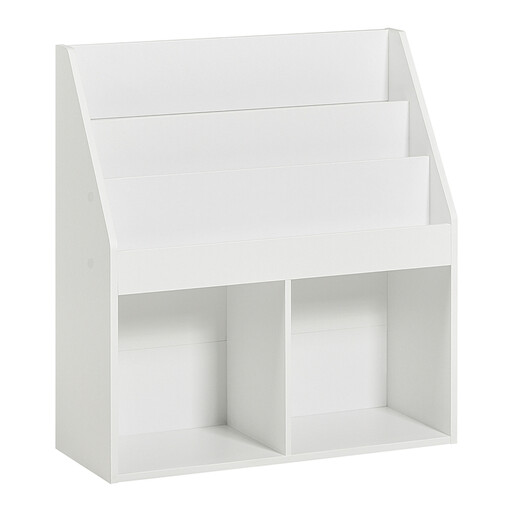
Why it's a good fit: This shelf combines the principles of a Montessori shelf with classic storage space. The upper compartments display books with their covers facing forward, encouraging children to read. The lower, open compartments provide space for toys or larger books.
It solves the "Design Dead-End" by offering a child-friendly height (80 cm, according to the manufacturer) and a flexible compartment layout for various book and toy sizes.
Combines book display with storage space. According to the manufacturer, it has a high total load capacity of up to 60 kg, indicating a sturdy construction.
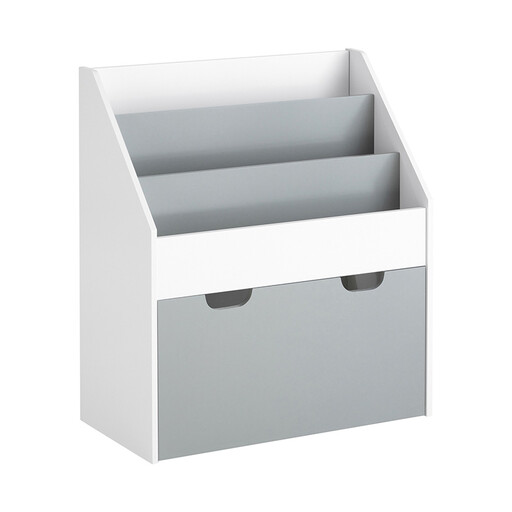
Why it's a good fit: This 2-in-1 solution is perfect for anyone wanting to efficiently store both books and toys. The large, mobile toy box at the bottom is easy to pull out and encourages independent clean-up.
It prevents the need to buy multiple, mismatched pieces of furniture. Its child-friendly height of 70 cm and softened corners and edges directly address safety and functional requirements.
Features an integrated, removable toy box on castors for maximum flexibility. The material is declared by the manufacturer as MDF (E1), and an anti-tip kit is included according to the product description.
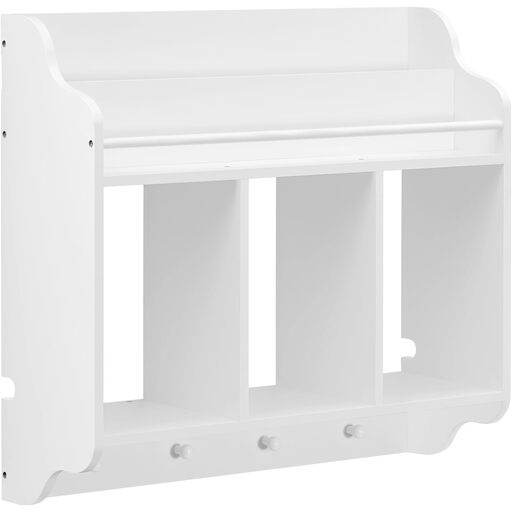
Why it's a good fit: This wall shelf for the kids' room is the solution for small spaces as it doesn't take up any floor area. It still offers versatile storage for books and figurines and even includes hooks for bags or jackets.
It bypasses the "Stability Trap" of freestanding shelves because it must be securely mounted to the wall for safe use. The rounded corners are another key safety feature.
Maximum space-saving thanks to wall mounting. Added functionality with four hooks and a top ledge that prevents items from falling off.
We've compiled a complete, up-to-date list of products that meet these strict selection criteria and safety requirements.
Most quality children's shelves come with an anti-tip kit. This typically consists of one or two brackets or a sturdy strap, along with the necessary screws. Follow the manufacturer's assembly instructions precisely. Ensure you use the correct wall anchors for your wall type (e.g., concrete, drywall), which often need to be purchased separately. Attaching the restraint to the top third of the shelf provides the greatest stability.
The term refers to a piece of furniture that follows the educational principles of Maria Montessori. At its core, the goal is to foster a child's independence. A Montessori shelf is therefore low-profile and designed so that children can access their books and toys without adult assistance. A characteristic feature is the forward-facing display of books, where the cover is visible to spark the child's visual interest.
Pay close attention to the manufacturer's product descriptions. Specifications like E1-grade MDF indicate that legal emission limits are met. The use of water-based finishes is also a positive sign. Trustworthy manufacturers are generally transparent about the materials they use and their classifications.