
Lieferung heute & morgen

Qualitätsgarantie

Willkommens-Angebote freischalten: KOSTENLOSE Lieferung | Bis zu 80 % RABATT | Kostenlose 30-Tage-JoyPlus-Testphase
App herunterladen
A cordless car polisher makes it easier to detail your vehicle without a mains cable. Depending on its design, it can be used on paintwork, alloy wheels, plastic trim and hard-to-reach areas. However, a high speed, large battery capacity or extensive range of accessories won’t necessarily make a tool the right choice for you.
When buying a cordless car polisher, watch out for these three common marketing traps:
A rotary polisher turns the backing plate directly around an axis. It can be useful for spot jobs and targeted paint correction, but it needs to be handled with care. Take particular care around edges and bodywork contours, and use light pressure.
A dual-action car polisher also moves the backing plate in an eccentric orbit. This spreads the polishing action over a wider area, making it easier for many beginners to control when applying wax, finishing or carrying out light paint correction. Models with a switchable system offer both types of movement, but are usually more complex in design.
Speed is given in revolutions per minute (RPM). A wide speed range is only useful if you can adjust it in small enough increments. Wax and sealants are generally applied at a lower speed than some polishing tasks. Always start on a low setting and test the product on a small area first.
For dual-action machines, the orbit also matters. Common options include 3 mm, 5 mm, 8 mm and 12 mm. A larger orbit changes how the machine works, but it doesn’t replace the need for a suitable polish and pad.
Look out for:
For headlight polishing and small areas of paintwork, a mini polisher with a small backing plate is often easier to handle. A 125 mm backing plate can be more efficient on doors, bonnets and roofs. Don’t polish without taking suitable precautions: clean the vehicle’s surface, mask off surrounding areas and regularly remove polish residue from the pad.
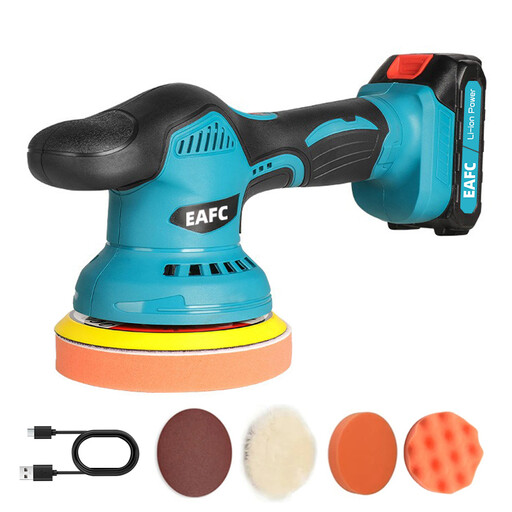
Why it suits this type of user: This cordless polisher has a 125 mm backing plate and is aimed at users who want to work on larger areas of paintwork and prefer straightforward speed settings.
Eight settings between 2,800 and 5,500 RPM let you adjust the speed instead of always using the maximum setting.
125 mm backing plate, dual-action movement and polishing pads included.
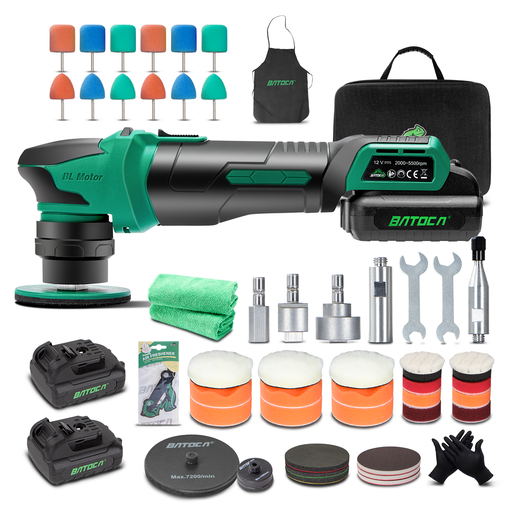
Why it suits this type of user: This machine combines rotary and dual-action modes with two 12 V, 2.5 Ah batteries, making it suitable for a wide range of detailing jobs.
You can switch between systems by changing the drive units, so you’re not limited to a single type of movement.
Brushless motor, four speed settings and 25 mm/75 mm fittings.
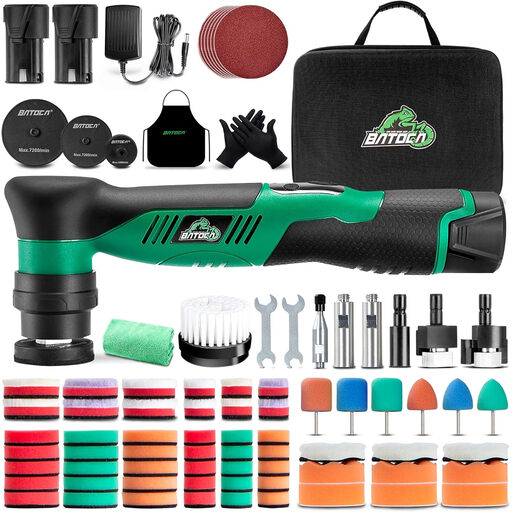
Why it suits this type of user: With 25 mm, 50 mm and 75 mm backing plates, this set is designed for emblems, edges, alloy wheels, headlights and other small areas.
Six settings from 2,000 to 5,500 RPM and interchangeable drive units let you choose a suitable speed and movement for different detailing jobs.
Three backing plate sizes and two 12 V/2.0 Ah batteries, according to BATOCA’s product information.
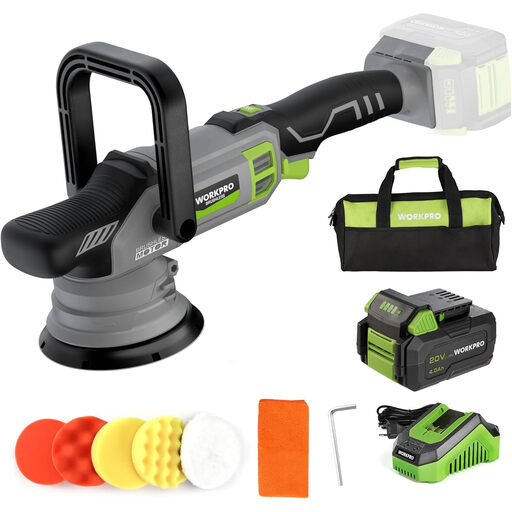
Why it suits this type of user: The 20 V, 4.0 Ah battery and dual-action movement make this a good option for users who want to tackle larger projects without a mains cable.
Seven speed settings and a safety switch help you adjust the tool and work with control.
Brushless motor, 2,000–5,000 RPM and storage bag, according to WORKPRO’s product information.
We’ve put together a complete, regularly updated list of products that meet these strict selection criteria and fully comply with the safety regulations in force in the EU.
Runtime depends on the load, speed and battery capacity. According to BATOCA’s product information, the S5 runs for up to around 30 minutes with a 2.0 Ah battery when idling. The BATOCA S2 is quoted at around 60 minutes. These figures are guidelines and don’t necessarily reflect polishing under load.
A dual-action polisher with several low-speed settings and a widely available pad fitting can make it easier to get started. Mini polishers are easier to handle for small areas, while a 125 mm backing plate covers more ground on larger surfaces. Whichever model you choose, practise on a small area first.
As well as the purchase price, you’ll need to budget for polish, pads, replacement batteries and possibly a new charging adapter. Wash and dry interchangeable pads thoroughly. If you use the polisher regularly, a second battery may be more useful than a machine with a higher maximum speed.