
Lieferung heute & morgen

Qualitätsgarantie

Willkommens-Angebote freischalten: KOSTENLOSE Lieferung | Bis zu 80 % RABATT | Kostenlose 30-Tage-JoyPlus-Testphase
App herunterladen
For any precision fastening task—whether on a car, motorcycle, or bicycle—applying the correct tightening torque is critical. The wrong value can lead to damaged components, loose connections, and serious safety risks. A digital torque wrench promises a solution with its precise settings and clear feedback. However, the market is saturated with models whose advertised features don't always live up to real-world expectations. Before you make a purchase, it's essential to understand the common pitfalls that can lead to a bad buy.
Two common problems often lead to frustration and unnecessary expense:
This guide will show you which technical specifications truly matter and how to find a digital torque tool that reliably gets the job done.
To find a suitable model, don't be swayed by marketing promises; focus on verifiable technical data instead. The following three criteria are decisive for the function and longevity of an electronic torque wrench.
Accuracy, often stated as a percentage deviation (e.g., ±2%), is the core feature. High accuracy is essential. Pay attention to whether the specified tolerance applies to both clockwise and counter-clockwise rotation. Professional models provide a defined accuracy for clockwise rotation, as this is the primary tightening direction. For example, a tolerance of ±2% means that for a target value of 100 Nm, the actually applied torque will be between 98 Nm and 102 Nm. For safety-critical components, such a tolerance range is an industry standard.
The required torque range depends directly on the application. Fasteners on torque wrench for bicycles components, like stems or carbon parts, often require only 5 to 20 Newton-metres (Nm). For automotive work, such as changing wheels or working on suspension components, values from 120 Nm to over 200 Nm are common.
The drive size, specified in inches, determines which sockets will fit:
Choose a model whose torque range matches your most frequent tasks. The most precise measurements are generally achieved in the middle third of the specified range.
A modern electronic torque wrench should offer more than just a beep. Models with an LED display, an audible signal, and additional vibration provide three layers of feedback. This haptic feedback is particularly advantageous in noisy environments or in hard-to-see areas, as you can feel when the target torque is reached, even if you can't hear or see it. An easy-to-read, backlit display that shows the torque value in real-time and supports various units (Nm, ft.lb, in.lb, kg.cm) significantly enhances usability.
Instead of making a one-size-fits-all recommendation, we have matched models based on specific user profiles and the objective criteria mentioned above.

Why It's a Match: With its 1/4-inch drive and a torque range of 1-20 Nm, this tool is perfect for precision work on modern bicycles, especially on sensitive carbon components, as well as for fine mechanical tasks on vehicles.
The triple alert system—vibration, sound, and LED light—ensures you never exceed the target torque, even in a distracting environment. The stated accuracy of ±2% (clockwise) provides the necessary reliability for delicate components.
Features 10 memory presets for frequently used values and a Peak/Track mode for process control. The ergonomic grip and low weight make it easy to handle.
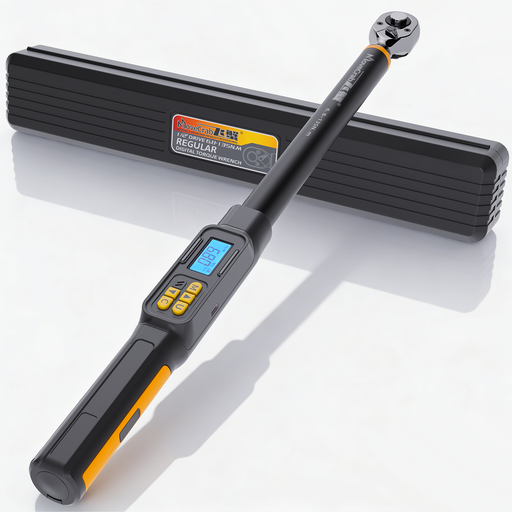
Why It's a Match: The 1/2-inch drive and versatile range up to 135 Nm make this tool the ideal choice for most common automotive jobs, from seasonal tyre changes to repairs on brakes and suspension.
The multi-modal alert system (vibration, sound, light) ensures reliable feedback, even when working with gloves and ambient noise during a tyre change. The digital display allows for precise setting and control.
Offers high accuracy of ±2% and the ability to store up to 500 measurements in Peak mode. This is useful for documentation or for verifying your work.
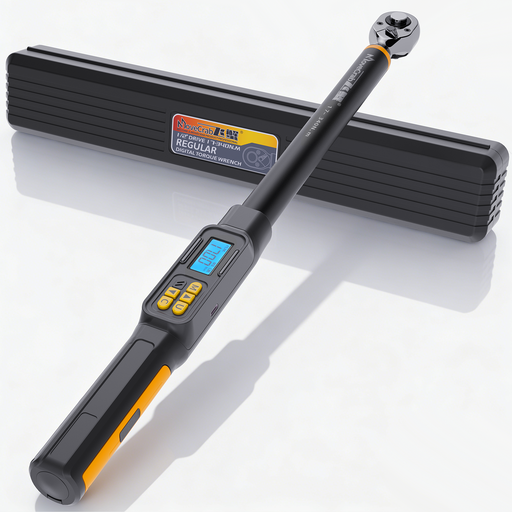
Why It's a Match: With a massive torque range up to 340 Nm, this tool is designed for demanding jobs on commercial vehicles, agricultural machinery, or for work on cylinder head bolts and central chassis components.
At high torque values, reliable signaling is essential. The triple alert system prevents over-tightening, which at these force levels can lead to immediate material failure. The robust construction is designed for continuous professional use.
The wide torque range covers a multitude of heavy-duty applications, eliminating the need for multiple specialized tools. The memory function for measurements and presets increases efficiency for repetitive tasks.
We've compiled a comprehensive, up-to-date list of products that meet these strict selection criteria.
There's no one-size-fits-all answer, but most manufacturers recommend professional calibration every 12 months or after approximately 5,000 load cycles. A check is also advisable if the tool has been subjected to a significant impact or if you have doubts about its accuracy. For home use with infrequent operation, the intervals can be longer.
These two modes are standard on high-quality digital torque wrenches.
Most digital torque wrenches have a reversible ratchet head and can technically be used for loosening. However, the torque measurement and guaranteed accuracy are typically specified only for clockwise rotation (tightening). Loosening seized bolts often requires a high breakaway torque that can damage the sensitive measuring sensor. It is therefore recommended to use a conventional, robust ratchet or an impact wrench for loosening.