
Lieferung heute & morgen

Qualitätsgarantie

Willkommens-Angebote freischalten: KOSTENLOSE Lieferung | Bis zu 80 % RABATT | Kostenlose 30-Tage-JoyPlus-Testphase
App herunterladen
A digital torque wrench can make it easier to tighten threaded connections with precision. However, an LED display or a claim of “high accuracy” should not be the sole deciding factors. The most important criteria are the torque range, drive size, measurement direction and warning system.
Anyone looking for a model for a bicycle, motorcycle or car will often encounter similar product promises. Some specifications are genuinely useful, while others are presented without essential context. The following guidance helps you avoid common purchasing mistakes.
A 1/2-inch torque wrench with a range of 17–340 Nm is designed for wheel nuts and larger vehicle fasteners. It is not suitable for delicate bicycle components. If a tool is regularly used near the lower end of its measurement range, it may not be appropriate for the intended application.
For bicycle and smaller motorcycle work, models with a lower range are more suitable, such as 0.6–12 Nm, 1–20 Nm or 1.5–30 Nm. For medium-duty automotive work, a 3/8-inch torque wrench with a range of 4.2–85 Nm can offer greater versatility.
The specification torque wrench ±2% accuracy should always be considered in relation to the measurement range, measurement direction and intended use. For the Movecrab models presented here, the product information states this accuracy for tightening in the clockwise direction.
This does not mean that every application is automatically covered by the ±2% specification. Before purchasing, users should check whether the target value falls within the appropriate range and whether the tool is suitable for the required direction and working method.
A torque wrench with an LED display can make the current reading easy to see. A model with a vibration alert, audible signal and visual warning provides several indications when the preset value is reached. In a noisy workshop, vibration can be particularly helpful, while an LED display may be useful when hearing is impaired or ambient noise is high.
Nevertheless, force should be applied steadily and stopped immediately once the target value is reached. An alarm cannot protect against an incorrect setting, damaged threads or an unsuitable socket.
First, match the tool to its typical use:
The specifications provided by the vehicle, component or fastener manufacturer remain decisive. The tool’s maximum range must not be exceeded. According to the product information, applying more than 120% of the maximum value may damage the device or affect its accuracy.
The drive size determines which sockets can be used directly:
An adapter can expand compatibility, but it does not change the torque wrench’s measurement range. Always check that the socket, drive and target torque are compatible.
An electronic torque wrench should be able to display the required unit. According to the product information, the models listed offer Nm, in.lb, ft.lb and kgf.cm. This helps reduce conversion errors when technical specifications are provided in different units.
Preset values can also be useful in practice. According to the manufacturer, the Movecrab models offer ten memory positions. Track mode displays the current value, while Peak mode stores the highest value recorded during use. For workshop procedures that require documentation, users should also check whether the stored data meets their specific requirements.

Why This Fits Their Persona: According to the product description, the low-to-medium range is suitable for bicycle, motorcycle and smaller repair tasks at home.
The range is designed for lower torque values, avoiding the unsuitable choice of a large 1/2-inch tool for delicate components.
According to the product information: ±2% clockwise accuracy, LED, vibration and audible alerts, plus four selectable units.
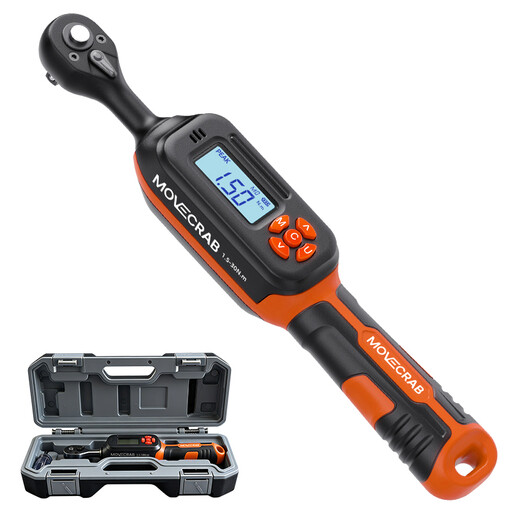
Why This Fits Their Persona: Suitable for users seeking a compact electronic torque wrench with an extended low-range capability and multiple operating modes.
The combination of Track and Peak modes clearly distinguishes between the current reading and the recorded peak value.
According to the product information: ten preset values, storage for up to 500 records and a triple warning system.
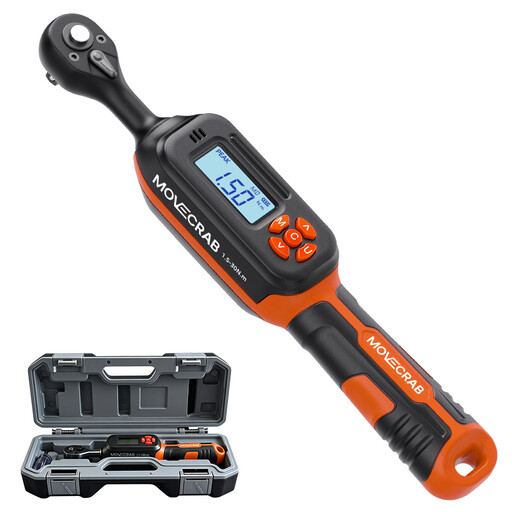
Why This Fits Their Persona: The 3/8-inch format is intended for medium-duty work on motorcycles, vehicles and technical assemblies.
The medium range bridges the gap between compact 1/4-inch models and tools designed for high wheel or suspension torque values.
According to the product information: ±2% clockwise accuracy, reversible ratchet head, and visual, audible and haptic alerts.
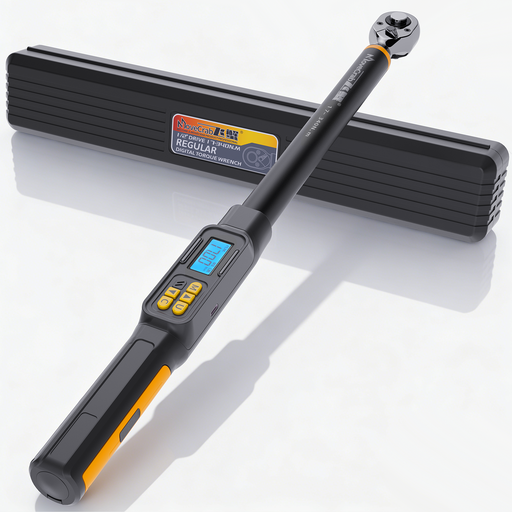
Why This Fits Their Persona: The high torque range is designed for larger sockets and selected automotive applications that require a 1/2-inch drive.
The 17–340 Nm range is clearly intended for higher torque values, avoiding confusion with a precision tool for bicycle components.
According to the product information: 1/2-inch ratchet head, four selectable units and a triple alarm when the target value is reached.
We have compiled a complete, real-time list of products that fully satisfy these strict selection criteria and UK safety regulations.
Before first use, insert the batteries, check the display and select the desired unit. Then set the target value directly or via a memory position. Apply force steadily and use the ratchet head’s direction lever only for the intended direction of rotation.
For a longer service life, the product information recommends the following:
For bicycles, a 1/4-inch model with a low torque range is usually the best choice. Depending on the component, 0.6–12 Nm, 1–20 Nm or 1.5–30 Nm may be suitable. The torque specifications for the individual components are the deciding factor.
Service life depends on workload, storage conditions, battery care and regular inspection. Overloading, moisture, impacts and improper cleaning can impair measurement performance. Without information about frequency of use and maintenance, it is not possible to provide a reliable service-life estimate.
Power consumption depends on the battery type, display brightness and frequency of use. During extended storage, the device should be switched off and stored in accordance with the operating instructions. Before use, check that the display and warning signals are working correctly.