For a crusty loaf when you’re entertaining, choose a food slicer with a serrated blade, provided the carriage travel and cutting thickness suit your bread. If you slice frequently, a model with a permanent place on your worktop may be a good option. If you’d rather put it away afterwards, check whether a compact or folding design has a support surface that works for you. Also compare the food holder, how easy it is to clean safely and the model’s specified operating time, using the manufacturer’s information.
Who this guide is for
Hosts serving crusty bread
If you want to slice a whole loaf as evenly as possible for several guests, check that the blade type, carriage travel and operating time suit your bread and how you plan to slice it. Graef and ritterwerk provide specific model details, while the F.A.Z. Kaufkompass reviews individual models separately.
Occasional users short on space
If you want to put the slicer away after a meal, check the support surface and bread guide as well as the design, to make sure they suit your usual loaf. Severin describes the AS 3912 as having a folding base plate.
Users who prioritise safe handling
If guiding the bread and cleaning the slicer matter to you, check the food holder, switch and access to the blade on the specific model. ritterwerk advises unplugging the E 16 before cleaning, while Graef lists a safety switch-on lock for the Classic C20.
What to look for when buying
For a whole loaf with a hard crust, the blade and guide dimensions need to be right. Worktop space, ease of use and any other foods you plan to slice may also influence your choice.
| Consideration |
What to check when buying |
Who it matters most to |
| Slicing crusty bread evenly |
Serrated blade and suitability for bread; check the loaf width against the support surface and carriage travel. |
If you want to slice a whole loaf into even pieces for guests, pay particular attention to the blade and guide. Around 42 % of consumers say slicing bread is their main concern. |
| Safe operation and cleaning |
Check the food holder and switch; follow the instructions on unplugging the appliance before cleaning. |
If handling the blade and cleaning are important to you, check the operating instructions for the specific model. Around 25 % of consumers prioritise safe operation and cleaning. |
| Space and storage |
Compare the dimensions when in use and when stored; check that the support surface and guide suit your loaf. |
If you only entertain occasionally and want to put the slicer away afterwards, its design matters too. Around 17 % of consumers prioritise easy storage. |
| Other slicing tasks and upkeep |
Check which foods you plan to slice and whether a replacement blade is compatible with the model. |
If you want to use the appliance for other foods after dinner, compare its stated uses and the availability of suitable replacement parts. Around 16 % of consumers prioritise other slicing tasks and upkeep. |
Common buying mistakes
-
Choosing by wattage alone instead of considering the blade and loaf guide
Details such as blade type, cutting thickness and carriage travel relate to specific models and describe different aspects of slicing. The F.A.Z. Kaufkompass discusses the Graef G52 when slicing crusty bread; this does not prove that every other model is equally suitable.
Check the blade type, the dimensions of your loaf and the guide on the specific appliance. Also compare your preferred slice thickness and the recommended operating time with the manufacturer’s information.
-
Buying a folding slicer without measuring your loaf
The folding base plate on the Severin AS 3912 makes it easier to store, but that doesn’t mean every loaf will fit on it properly.
Measure your usual loaf and compare its width with the support surface and carriage of the model you’re considering.
-
Assuming continuous use or blade compatibility
ritterwerk specifies a short-time operating period of 5 minutes for both the E 16 and E 18. A replacement blade is not automatically compatible with every variant either; Graef explicitly lists its replacement serrated blade for CLASSIC models such as the C20 and C20EU.
If you’re planning to slice several loaves, follow the operating limit in the instructions. Check replacement parts against the full model name and the stated compatibility.
Key brands to consider
Graef
The Classic C20 and G52 are different models, each with its own manufacturer information and test results.
- For the Classic C20, Graef specifies a 170 mm serrated blade and a cutting thickness adjustment from 0 to 20 mm. The manufacturer also says it can be used on hard crusts.
- The C20 specifications do not establish that all Graef slicers have the same features. The positive assessment of the G52 comes separately from the F.A.Z. Kaufkompass test.
ritter
The E 16 is an alternative with a serrated blade; with the E 18, you guide the food with your left hand.
- ritterwerk specifies a 17-cm blade and a cutting thickness of up to around 20 mm for the E 16. According to the manufacturer, the E 18 also has a 17-cm blade.
- For the E 18, ritterwerk specifies a cutting thickness of up to around 14 mm. According to the manufacturer, both the E 16 and E 18 have a short-time operating period of 5 minutes.
Severin
The AS 3912 is designed for those who want a slicer that can be stored away; the AS 3917 is a different model for bread and cold cuts.
- Severin describes the AS 3912’s base plate as foldable and specifies a cutting thickness of 0 to 15 mm. For the AS 3917, the manufacturer specifies 0 to 23 mm.
- The AS 3917’s wider adjustment range does not, without comparative testing, mean it will perform better on hard crusts.
DOMO
The F.A.Z. Kaufkompass picked the MS171 as a more affordable recommendation.
- The F.A.Z. Kaufkompass editorial team lists the MS171 as an option for buyers looking for a more affordable recommendation.
- In its test, the editorial team notes that its slicing results are not as good as those of its other recommendations. This assessment applies to the MS171, not to other DOMO models in general.
Food slicers at Joybuy
The Joybuy products below are electric food slicers described as suitable for bread; several models fold away. Check the dimensions and specifications of each one before deciding whether it suits your loaf.
 No image available
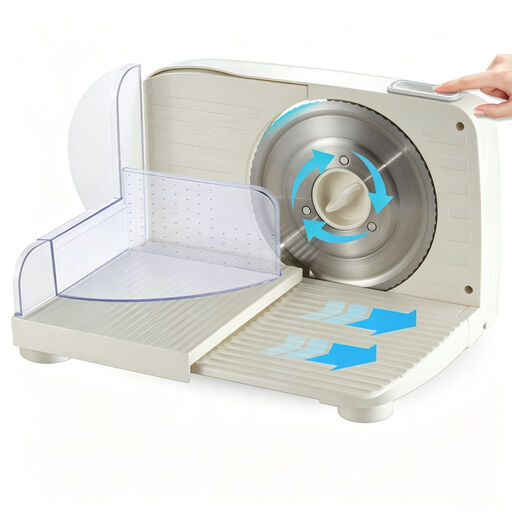
Folding electric food slicer, 0–15 mm
The product description lists bread among the foods it can slice and says the folding design is intended for users who want to put the appliance away.
Cutting thickness: 0–15 mm. Also listed are a stainless steel blade, a food holder and a safety guard.
View at Joybuy
 No image available
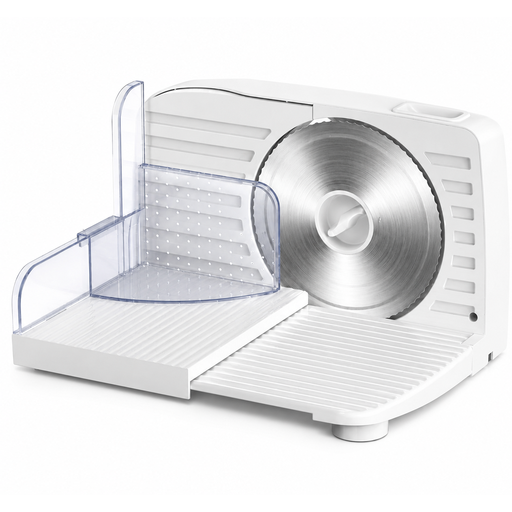
Electric food slicer, 250 W, 17-cm serrated blade
The product description lists bread among the foods it can slice and says it has a folding design. Check that the support surface and guide suit the width of your loaf.
Serrated blade: 17 cm. Cutting thickness: 0–15 mm. Two blades and 250 W are also listed.
View at Joybuy
 No image available
Electric food slicer, 250 W, two 17-cm blades
The description lists bread among the foods it can slice and says it has a compact, folding design. It also mentions finger protection and non-slip feet.
One blade is described as serrated; according to the product description, both blades have a diameter of 17 cm. Cutting thickness: 0–15 mm; power: 250 W.
View at Joybuy
 No image available
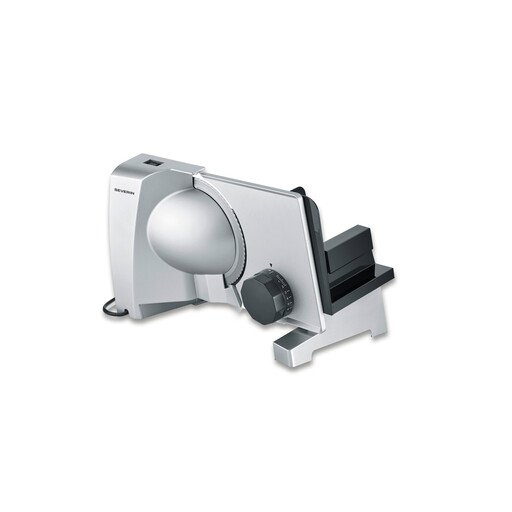
Severin AS 3917
Severin describes the AS 3917 as suitable for bread and cold cuts. Compare its adjustment range with your preferred slice thickness.
Cutting thickness: 0–23 mm. The product name also lists 130 W and a metal housing; the manufacturer specifies a hardened stainless steel blade.
View at Joybuy
 No image available
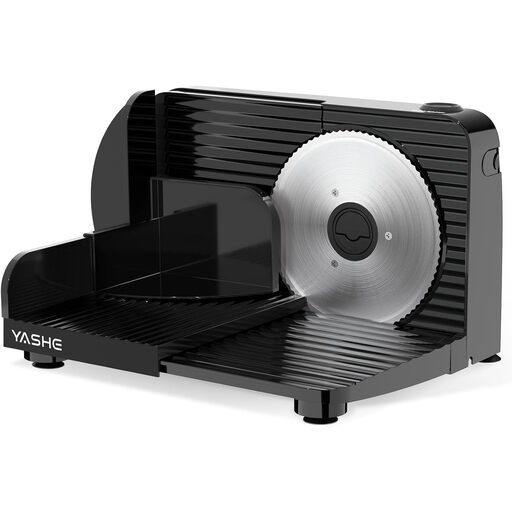
YASHE SL-5801D23B3
The product description lists bread among the foods it can slice and says the folding design makes it easy to put away after use.
Serrated stainless steel blade: 17 cm. Cutting thickness: 0–15 mm; power: 180 W.
View at Joybuy
Frequently asked questions
What blade type and cutting thickness should I look for when slicing crusty bread?
Look for a serrated blade described as suitable for bread, and check that the adjustment range covers your preferred slice thickness. Graef specifies 0–20 mm for the Classic C20; ritterwerk gives a maximum of around 20 mm for the E 16. These specifications apply to those models and are not a recommendation for every type of bread.
What should I bear in mind before slicing and when cleaning?
Set up the appliance according to its instructions and unplug it before cleaning if the instructions say to do so. ritterwerk says to unplug the E 16 when it is unattended and before assembling, dismantling or cleaning it. Follow the relevant instructions for other models.
Who is responsible if there’s a fault: the retailer or the manufacturer?
Your statutory rights generally apply against the retailer. A manufacturer’s guarantee is separate and voluntary. The Verbraucherzentrale explains the difference. If you’re buying a replacement blade, also check its stated compatibility with your model.
What should I check on an electrical appliance and its instructions in Germany?
The Bundesnetzagentur lists several checks as part of its market surveillance, including correct CE marking, identifiable manufacturer details and German-language instructions with the necessary usage and safety information. These checks are not an individual approval or safety certification of a particular product listing.
Can I put an old electric food slicer in my household bin?
No. The Umweltbundesamt advises that old electrical appliances should be collected separately. Suggested return points include local recycling centres and retailers.


