
Lieferung heute & morgen

Qualitätsgarantie

Willkommens-Angebote freischalten: KOSTENLOSE Lieferung | Bis zu 80 % RABATT | Kostenlose 30-Tage-JoyPlus-Testphase
App herunterladen
Food storage boxes are designed to keep things organised, protect food and perform reliably in everyday use. In practice, however, shortcomings often only become apparent after purchase: a lid does not seal properly, a box does not fit in the available fridge compartment, or the material is unsuitable for use in the microwave or dishwasher.
This buying guide from the Joybuy Product Recommendation Officer helps you avoid common buying mistakes. It focuses on clear criteria such as material, capacity, closure, temperature range and cleaning options.
An airtight storage container can reduce the exchange of air and moisture. However, this does not necessarily mean that it is suitable for transporting soups or other liquids. A full perimeter seal, a sturdy lid and, where applicable, fastening clips are the key factors.
When choosing food storage containers, check whether the product is intended only for dry goods or also for liquid food. Before transporting liquids, it is also advisable to carry out a quick leak test over the sink.
Many plastic food storage boxes can be placed in the freezer, but are not automatically microwave-safe. With suitable models, the lid often has to be removed. Glass containers may withstand higher temperatures, but can be sensitive to sudden temperature changes. Stainless steel is generally not suitable for microwave use.
Always follow the information provided for the individual product. The Mepal Cirqula Multi Bowl, for example, is designed for use in the microwave and freezer, but only without the lid in the microwave and up to a stated maximum temperature of 110 °C.
A large capacity is only practical if the box fits in your cupboard, fridge or freezer. Tall containers can be difficult to store in some fridge compartments, while wide models may block access to other food.
For dry goods, stackable storage boxes with clearly visible contents are often more practical than one oversized container. For meal prep, several shallower sizes are a better choice because portions cool more quickly and are easier to remove.
The seal is a key wear component in airtight storage containers. Check whether it can be removed and cleaned easily. A lid with clip fasteners can provide additional security during transport. For dry goods such as flour, rice or muesli, a hinged lid with a full perimeter seal is practical, while soups and sauces require a particularly secure closure.
The capacity should suit the intended use:
Do not compare millilitre capacities alone; consider the length, width and height as well. For food storage boxes designed for the fridge and freezer in particular, the external shape determines how practical they are in everyday use.
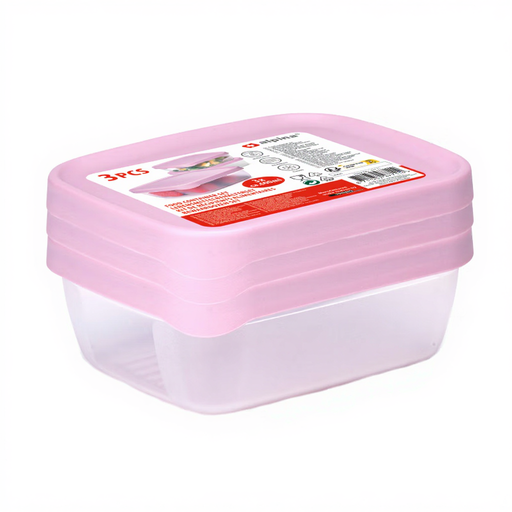
Why this product suits this profile: The set includes three boxes in different sizes and one universal lid. The transparent design makes it easy to check the contents and covers a range of kitchen tasks.
The product details clearly state information about sealing, temperature and cleaning. This makes it possible to check before use whether the box is suitable for the intended purpose.
Three sizes, one matching lid and a BPA-free plastic specification according to the product description.
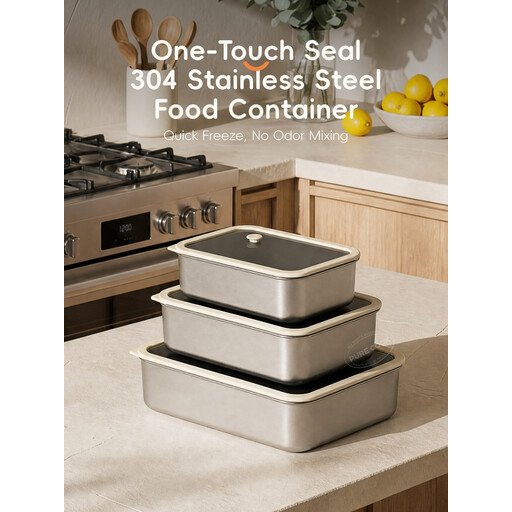
Why this product suits this profile: The set combines 304 stainless steel containers with borosilicate glass lids and silicone rings. Three sizes of 1,000, 1,800 and 3,000 ml cover a range of portion sizes.
The material combination is clearly stated. Stainless steel is not intended for microwave use; this limitation helps prevent incorrect use.
304 stainless steel, glass lids, three capacities, and containers that can be stacked or nested.
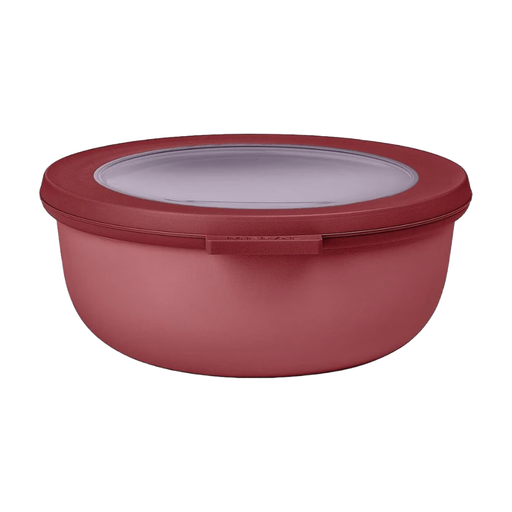
Why this product suits this profile: The bowl is designed for use in the fridge and freezer, for serving and for reheating in the microwave without the lid. Its format is suitable for individual portions and meal prep.
The usage limits are clearly stated: microwave use without the lid, freezer-safe and a maximum temperature of 110 °C.
750 ml capacity, dishwasher-safe, BPA-free according to the product details, and suitable for stacking and nesting.
We have put together a complete, regularly updated list of products that fully meet these strict selection criteria and the safety regulations applicable in the EU.
To keep food storage boxes usable for as long as possible, follow these tips:
For meal prep, several stackable boxes in suitable portion sizes are a practical choice. Plastic models are lightweight, glass makes it easy to see the contents, and stainless steel is well suited to transport. A secure lid, enough space in the fridge and clear information about microwave use are all important.
Not necessarily. An airtight seal can reduce air exchange, but it does not guarantee that every model is leakproof. For soups and sauces, choose a container designed for this purpose, with a secure closure and correctly fitted seal.
Their lifespan depends on the material, cleaning, exposure to temperature and how they are handled. Seals can wear out before the container itself. Check regularly that the lid, closure and seal are still undamaged. If you notice deformation, cracks or a persistent odour, replacing the container is advisable.