
Lieferung heute & morgen

Qualitätsgarantie

Willkommens-Angebote freischalten: KOSTENLOSE Lieferung | Bis zu 80 % RABATT | Kostenlose 30-Tage-JoyPlus-Testphase
App herunterladen
Food storage containers should keep things organised, preserve the freshness of your meals and be suitable for as many uses as possible. In practice, however, not every storage container fits in every fridge, and not every plastic container is suitable for liquids, the microwave or the freezer. If you focus only on capacity or eye-catching product descriptions, you can quickly end up buying something that does not meet your needs.
A food storage container can only be reliably suitable for soups, sauces or marinades when the lid, seal and closure system work together. A simple push-fit lid does not automatically provide secure protection during transport. With leak-proof food storage containers, silicone seals, multiple locking clips and specific manufacturer information about leak resistance are therefore important points to check.
An airtight storage container is not intended for every application either. A tight-fitting lid can be useful for dry foods, but when storing hot meals you must also follow guidance on pressure build-up and temperature.
Plastic, glass and stainless steel have different properties. A plastic box may be suitable for dry foods and fridge storage, but it cannot automatically be used in the oven. With glass food containers, the container is often heat-resistant, while the plastic lid must be removed before heating.
The change in temperature is particularly important: cold glass from the freezer should not be placed directly into a preheated oven. Thermal shock can damage the material. Always follow the instructions provided by the relevant manufacturer.
A large capacity may sound practical, but it can leave too little usable space in the fridge. Low, rectangular containers are often a better fit for narrow compartments than large round tubs. Fridge organisers are also frequently used side by side or on pull-out shelves rather than stacked. Before buying, you should therefore check the internal dimensions of the compartment, the clearance from the door and the position of the handles.
For individual portions, snacks or side dishes, around 500 to 800 ml is often a convenient size. Meal prep boxes for complete meals require more space, depending on the portion size. Sets with different sizes can be useful for family households, while uniform, stackable storage containers help save space in the pantry.
The volume in litres is not the only important factor; the external dimensions matter too. For example, a 1.65-litre box may measure 13.1 × 20.7 × 9.3 cm. Details like these help you assess whether it will actually fit in your fridge, drawer or bag.
Look for separate information covering the fridge, freezer, microwave, oven, dishwasher and, where applicable, air fryer. “Dishwasher-safe”, for example, says nothing about whether a product is suitable for use in the oven.
A removable sealing ring can usually be cleaned more thoroughly than a permanently fitted system. With boxes containing several compartments, you should check whether the dividers are permanently sealed or whether liquids can mix between the sections.
Divided boxes are practical for dry foods. The Samba Compartmentalised Plastic Box 1.5L has four internal compartments, a transparent PP body and side clips. According to the product information, it is suitable for dry foods, but not for liquids and is not stackable. This makes it more suitable for small ingredients or keeping separate supplies apart than as a universal food storage container.
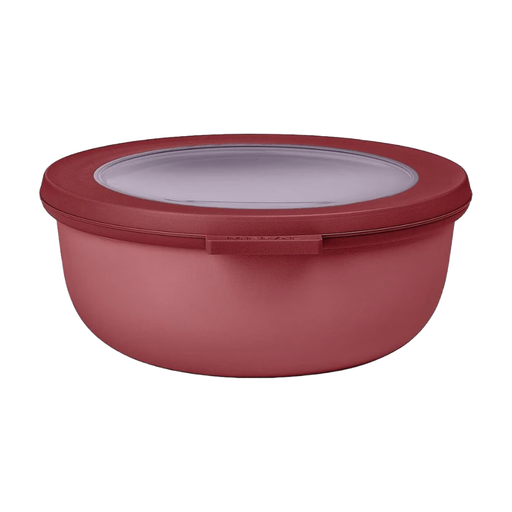
Why this product suits the profile: The 750 ml bowl is suitable for typical portions, leftovers and side dishes. It is designed for use in the fridge and freezer and can be used in the microwave without the lid.
The usage limits are clearly stated: microwave use is permitted only without the lid and up to a maximum of 110 °C. This avoids the common confusion between storage and heating functions.
Airtight lid, stackable and nestable design, plus dishwasher suitability according to the product information.
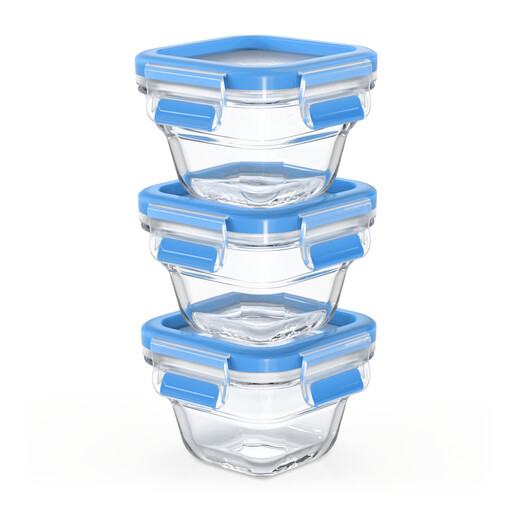
Why this product suits the profile: The three-piece set includes glass containers measuring 180 ml each, ideal for small portions, side dishes or prepared ingredients. According to the product information, they are designed for use in the fridge, freezer, microwave and oven without the lids.
The lid restriction is stated explicitly. Cold glass should also not be moved straight into a hot oven, as this can cause thermal shock.
Stacking rim, reinforced glass edge and, according to the product description, a dishwasher-safe and leak-proof design.
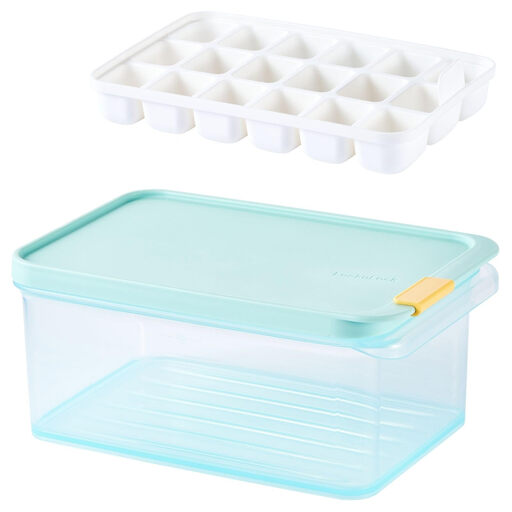
Why this product suits the profile: With a capacity of 1.65 litres, a divider option and a stackable rectangular design, this box is suitable for meal prep, larger portions and storing supplies in the freezer.
Its uses are clearly defined: it is suitable for the microwave and freezer, but not for a conventional oven or direct heat from a hob. This prevents incorrect assumptions about its temperature range.
PP construction, BPA-free material specification, airtight and leak-proof closure, plus dishwasher and freezer suitability according to the product data.
We have put together a complete, regularly updated list of products that fully meet these strict selection criteria and the safety regulations applicable in the EU.
For meal prep, rectangular, stackable boxes with a capacity of around 750 ml to over one litre are practical. Compartments can be useful for keeping side dishes separate. It is also important to have clear approval for freezer and microwave use, as well as a lid that closes securely during transport.
That depends on how you intend to use them. Glass is transparent and, where suitably approved, can withstand higher temperatures, but it is heavier and more prone to breakage. Plastic boxes are lighter and practical for transport or freezer storage. The key factors are material quality, the seal, temperature limits and the intended applications.
There is no fixed lifespan that applies in every case. Frequent dishwasher cycles, discolouration, deformation and damaged seals can reduce their usability. Boxes with cracks, brittle plastic or lids that no longer close properly should be replaced. The manufacturer’s care instructions have a significant impact on their durability.