
Lieferung heute & morgen

Qualitätsgarantie

Willkommens-Angebote freischalten: KOSTENLOSE Lieferung | Bis zu 80 % RABATT | Kostenlose 30-Tage-JoyPlus-Testphase
App herunterladen
A heat pump tumble dryer can take a lot of work off your hands, does not require a vent hose and can therefore be installed more flexibly. However, appliances vary considerably in energy consumption, programme duration, noise levels, maintenance requirements and features. If you focus only on capacity or a low purchase price, you may overlook important running costs and practical limitations.
The description “energy-efficient tumble dryer” says little without specific figures. The key points are the energy efficiency class and consumption per 100 drying cycles shown on the EU energy label. A 10 kg appliance may use more electricity per cycle than an 8 kg model, but it offers more room for bedding or larger loads of laundry.
You should therefore compare:
Even low consumption per cycle does not automatically mean low overall costs if the appliance is regularly overloaded or several cycles are required.
Short programmes are generally intended for smaller loads or specific fabrics. For example, the LG RT10X7B is advertised with a rapid programme and short running time, while a complete cycle with a high load can take considerably longer. A tumble dryer comparison should therefore always clarify which load size the stated time applies to.
For families, programmes for cotton, towels, bedding and mixed fabrics are often more important than a single short programme.
A self-cleaning tumble dryer reduces the amount of manual work required at the condenser, but it does not replace cleaning the lint filter. Depending on how it is installed, the condensate tank must also be emptied regularly. A dirty filter can impair drying performance and extend the running time.
An 8 kg heat pump tumble dryer is suitable for many medium-sized households and regular standard loads. A 9 kg heat pump tumble dryer provides extra capacity for families, towels and bedding. A 10 kg heat pump tumble dryer makes sense if you frequently dry large loads of laundry or bulky fabrics.
Important: The kilogram figure refers to dry laundry. If the drum is continually overloaded, drying times, creasing and noise levels may increase.
A sensor control system, or moisture sensor, monitors the condition of the laundry and ends the programme as soon as the selected drying level is reached. This can help prevent over-drying and is more practical for different load sizes than a programme controlled solely by time.
Look for selectable drying levels such as:
A quiet tumble dryer is particularly important if the appliance is installed in a flat, near a bedroom or in an open-plan utility area. Decibel ratings should be compared directly: in the selection below, for example, they range from 59 dB for the Bosch WQB246D41 to 64 dB for the Bomann WPT 7154.
Also check the height, width and depth, including the space required when the door is open. A reversible door can make installation easier. For electrical safety, a properly earthed socket is required; extension leads and multiway adaptors are not intended for use according to the relevant safety instructions.
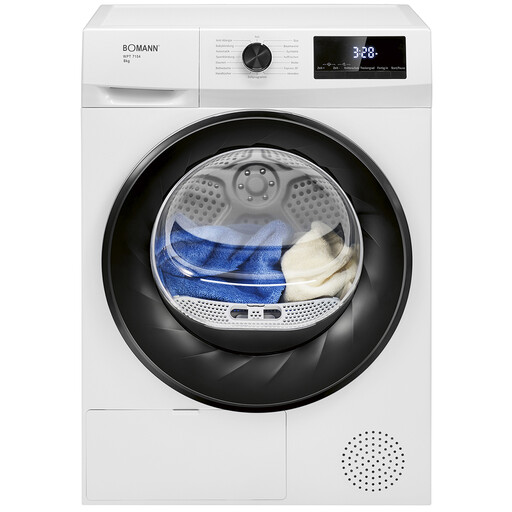
Why this product suits the profile: This model offers an 8 kg capacity, 15 programmes and does not require a water connection. It is therefore suitable for standard laundry in medium-sized households and flexible installation locations.
The figures of 119 kWh per 100 operating cycles and 64 dB make consumption and noise levels easy to assess.
15 programmes, crease-protection function, child lock and supplied condensate drain hose.
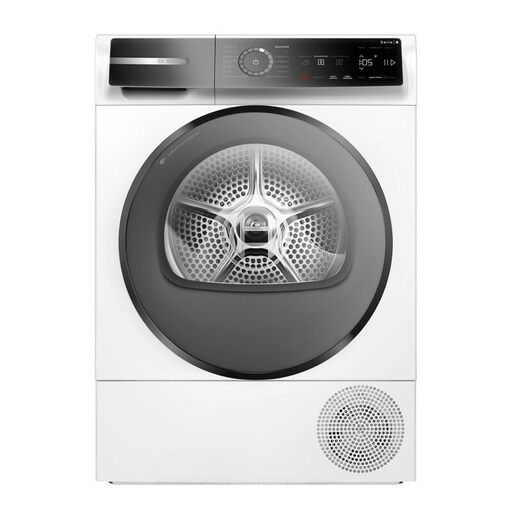
Why this product suits the profile: A 9 kg capacity, 59 dB, self-cleaning condenser and moisture sensor combine large loads with documented convenience features.
The EcoSilence Drive specification is supported by the stated noise level of 59 dB, rather than relying solely on the word “quiet”.
AutoDry, SmartDry, Home Connect, add-laundry function and self-cleaning condenser.
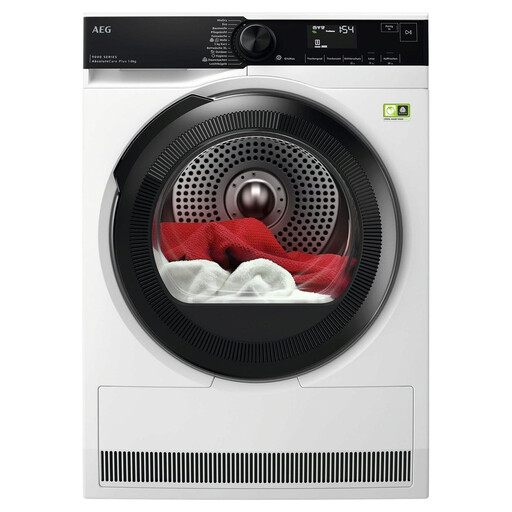
Why this product suits the profile: The programme selection includes wool, silk, hygiene, mixed fabrics and sportswear, among others. This is a good match for households with a variety of fabric types.
The sensor control, reverse-tumbling drum and EcoFlow filter specifications show how the drying cycle and maintenance are supported in practical terms.
8 kg capacity, energy efficiency class B, MixDry, ProSense, Woolmark Blue certification according to the product information and crease-protection function.
We have put together a complete, regularly updated list of products that fully meet these strict selection criteria and the safety regulations applicable in the EU.
Place the appliance on a level, stable surface and adjust the feet. There should be sufficient clearance around the housing for ventilation. Remove all transport packaging before using the appliance for the first time. Sort laundry according to the care labels and do not exceed the stated maximum load.
For reliable operation, we recommend:
No. Moisture is collected as condensate. Depending on the model, the water is collected in a tank or drained through a hose. A standard earthed power socket is required.
It is not possible to state a fixed service life for every appliance. It depends, among other things, on how often it is used, the load size, cleaning and maintenance. Regular filter care, correct installation and following the care instructions can help support trouble-free operation.
You can estimate the running electricity costs as follows: Consumption per 100 cycles ÷ 100 × electricity price per kilowatt-hour × number of cycles. Use the consumption figure from the EU energy label and your current electricity tariff. Actual costs may vary depending on the programme, load size and residual moisture in the laundry.