
Lieferung heute & morgen

Qualitätsgarantie

Willkommens-Angebote freischalten: KOSTENLOSE Lieferung | Bis zu 80 % RABATT | Kostenlose 30-Tage-JoyPlus-Testphase
App herunterladen
A garage needs to store tools, tyres, supplies and garden equipment without every square metre becoming cluttered. Heavy-duty shelving for the garage can provide plenty of storage space. However, product descriptions such as “extra strong” or “industrial” don’t automatically mean a unit is right for you. What matters is clear information about load capacity, dimensions, assembly and anti-tip protection.
A figure such as 600 kg load capacity usually refers to the combined capacity of all the shelves under a static load. It doesn’t mean that a single shelf can hold 600 kg. For example, the JOYFURNOS shelving unit rated at 600 kg is listed as holding up to 120 kg per shelf.
You should also distribute the load evenly. Heavy machinery or toolboxes placed in one spot can put more strain on a shelf than several items spread evenly across it.
A 200 cm-high shelving unit needs more than just enough headroom. Garage doors, ceiling lights, pipes and sloping ceilings can all make it difficult to position. So check the following:
A narrow metal shelving unit for the garage may be enough for tins, small parts and toolboxes. For bulky equipment, wider shelves and greater depth are more practical.
A tool-free shelving unit is usually quicker to assemble, but careful installation is still essential. An anti-tip restraint is especially important for tall units or shelves carrying heavy loads at the top. The JOYFURNOS models mentioned in the product information each include an anti-tip kit and should be secured to the wall before use.
Wear work gloves during assembly, and check that the wall, plugs and fixings are suitable for the surface. A concrete wall has different requirements from a plastered brick wall or a stud wall.
Look for three separate details:
“Static” means the load is stationary. It doesn’t automatically cover moving heavy boxes or placing them down with force. With 600 kg heavy-duty shelving, the actual stored load should also remain below the stated maximums. It’s sensible to leave a safety margin, especially if the way you use the unit might change later.
A steel frame provides a sturdy structure, but the shelves also affect how the unit can be used. The models mentioned here have MDF shelves and frames made from steel, galvanised steel or powder-coated steel.
Depending on the room conditions, this combination is suitable for a dry garage, cellar or workshop. In areas that are regularly damp, check the manufacturer’s advice. The black 600 kg model is specifically stated as unsuitable for very damp environments.
A shelving unit with adjustable shelves is easier to adapt to paint tins, tool cases and storage boxes. On the 600 kg model, the shelves can be moved in 5 cm increments. This makes it easier to arrange the unit when you’re storing items of different heights.
Some models can also be split into two separate units. For example, a tall shelving unit could become a lower storage unit, or be arranged as a combination of shelving and a work surface. Check the assembly instructions and stability guidance before splitting the unit.
The models below differ mainly in their dimensions, load capacity and colour. The details are based on the respective product information and apply to static loads.
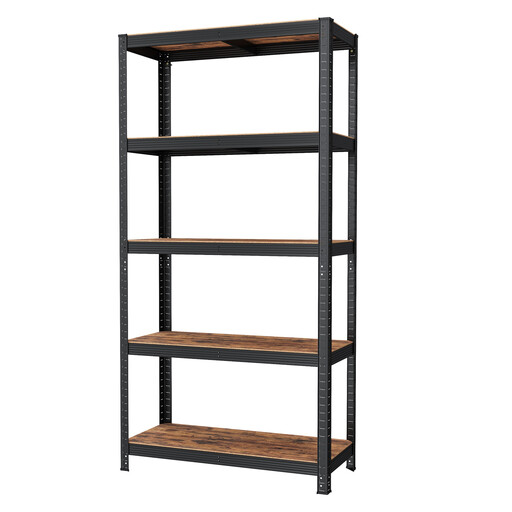
Why it suits this profile: Measuring 30 × 75 × 150 cm, it’s a good fit for smaller garages, cellars or utility rooms where you need compact storage with five shelves.
The load capacity is specified both per shelf and for the whole unit: up to 130 kg per shelf and 650 kg in total. An anti-tip kit is included.
Steel frame, five shelves, tool-free assembly and the option to split the unit into two separate sections.
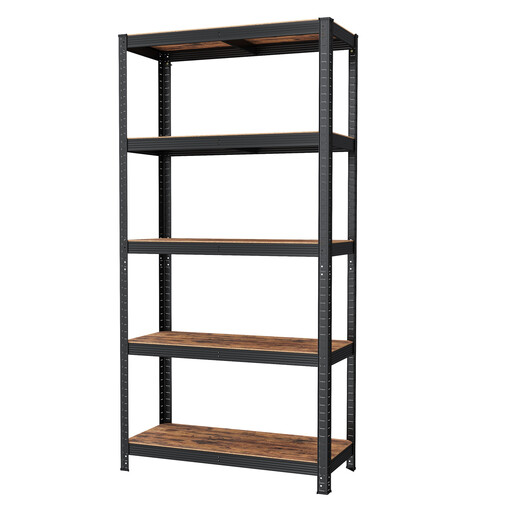
Why it suits this profile: Measuring 40 × 90 × 180 cm, it holds up to 175 kg per shelf, giving you a clearly specified load capacity for tools, supplies and heavier equipment.
The product details specify the shelf load, total load and dimensions separately. An anti-tip kit is also included, but the unit still needs to be secured to the wall before use.
Powder-coated steel frame, adjustable shelves and a split design that can be configured as two separate storage units or work surfaces.
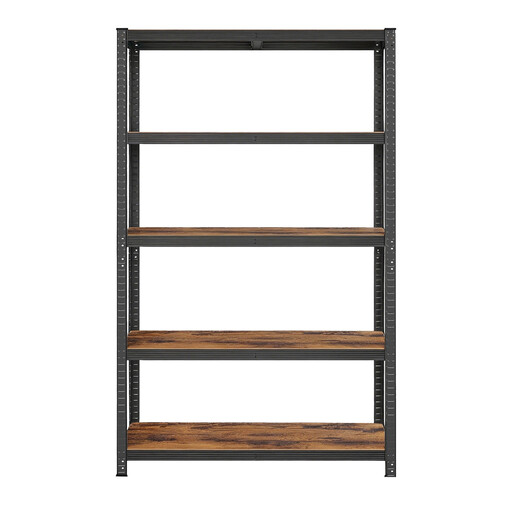
Why it suits this profile: Measuring 60 × 120 × 200 cm, it’s designed for spacious garages, workshops or sheds where you need wide, deep storage surfaces.
Its larger footprint comes with a clearly specified load of 150 kg per shelf and 750 kg in total. An anti-tip kit is included.
Five adjustable shelves, a split design and a steel frame for organising larger tools or storage boxes.
For smaller indoor spaces, a slim storage unit may be more practical than a traditional workshop shelving unit. The 5five Tasso Column Storage Unit measures 33 × 28 × 168 cm and combines bamboo, steel, MDF and chipboard. Weighing 18.29 kg, it’s designed for indoor storage, but shouldn’t be compared with the heavy-duty load capacity of the steel shelving units mentioned above.
We’ve put together a complete, regularly updated list of products that meet these strict selection criteria and fully comply with the safety regulations in force in the EU.
Place the unit on a level, sturdy surface and make sure it’s straight after assembly. Tall shelving units should be secured to the wall using the supplied anti-tip kit. The wall plugs must be suitable for the wall material. Store heavier items on the lower shelves wherever possible.
Its lifespan depends on factors including the room conditions, load, assembly and maintenance. In dry rooms, you can help protect a steel shelving unit from moisture. Regularly check the joints, shelves and fixing points. Rust, bent components or unstable connections are signs that you should reduce the load and inspect the unit.
The price depends on the size, materials, number of shelves, load capacity and assembly method. A compact cellar shelving unit will usually be priced differently from a wide garage shelving unit with a high load capacity. So compare more than just the total price: check the number of shelves, usable dimensions, static load capacity and any included fixings.