
Lieferung heute & morgen

Qualitätsgarantie

Willkommens-Angebote freischalten: KOSTENLOSE Lieferung | Bis zu 80 % RABATT | Kostenlose 30-Tage-JoyPlus-Testphase
App herunterladen
A disorganized basement, a cluttered garage, or a chaotic workshop—it's a familiar problem. A heavy-duty shelf promises a quick solution, but the market is flooded with options that promise more than they can deliver. As a Joybuy Product Recommendation Officer, I see every day which products truly deliver and where the common pitfalls lie. Before you invest, you should know the three most common mistakes that lead to wobbly structures and wasted money.
Many buyers are swayed by marketing promises, only to find out a few months later that their new shelf can't handle the demands. Pay attention to these points to make an informed decision.
To avoid the mistakes mentioned above, focus on three verifiable criteria. These determine whether a garage shelf or basement shelf will reliably do its job for years to come.
The specified load capacity per shelf is the most important indicator. For storing household supplies or light boxes, 80–100 kg per shelf is sufficient. For a workshop shelf that will hold engine parts, heavy tools, or large paint containers, you should consider models with at least 120 kg per shelf or more. Pay attention to the material thickness of the steel frame. A robust frame is the foundation for a high-capacity shelf.
The frame of a good heavy-duty shelf is made of steel. There are two common variants here:
For the shelves themselves, metal boards are the most robust but also the most expensive choice. MDF boards are a cost-effective alternative but should only be used in dry rooms.
Modern interlocking systems allow for tool-free assembly. Look for product descriptions that highlight a precise locking mechanism for the connections. Another sign of quality is the ability to assemble the unit flexibly—for example, as one tall shelf or as two half-height units that can serve as a workbench. An included anti-tip kit for wall mounting is an essential safety feature.
Based on these objective criteria, we have identified a few models that are particularly well-suited for specific user profiles.
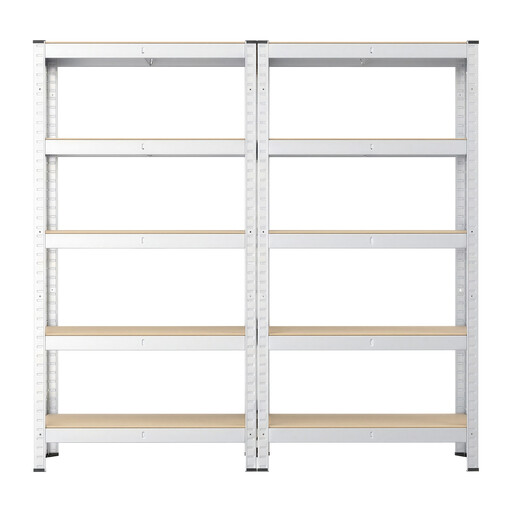
Why it fits: This set provides an excellent foundation for cost-effectively organizing an entire basement or garage wall. With two complete shelving units, you get plenty of storage space for a manageable budget.
The specified load capacity of 130 kg per shelf is a realistic figure for general storage purposes, avoiding the trap of exaggerated marketing claims. The steel frame provides the necessary core stability.
The value for money is excellent, thanks to the inclusion of two complete shelving units. The option to assemble them as workbenches adds to their flexibility.
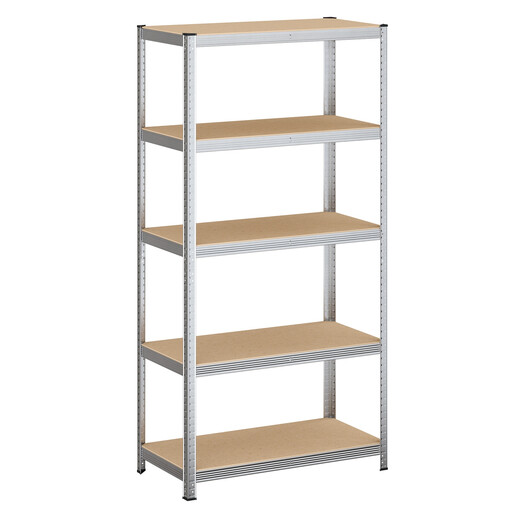
Why it fits: Ideal for the workshop or garage where heavy and bulky items are stored. The 50 cm depth provides ample space for large toolboxes, machinery, or car tires.
This shelf avoids the pitfall of unsuitable materials with a robust galvanized steel frame that resists corrosion even in cooler workshops. The 120 kg load capacity per shelf is designed for heavy loads.
The shelf depth of 50 cm is a crucial advantage over standard shelves (often only 30-40 cm) and allows for the storage of bulky goods.
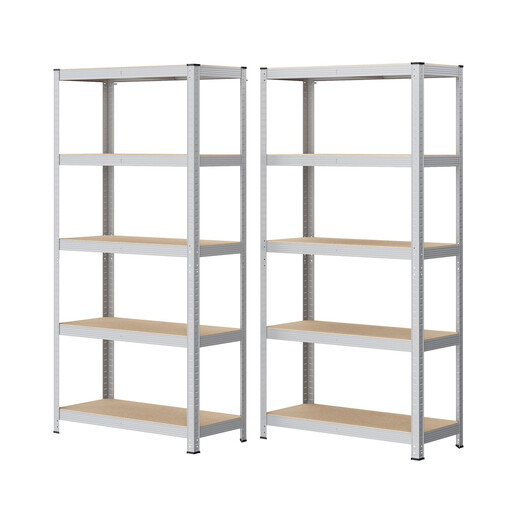
Why it fits: Perfect for anyone who needs maximum flexibility. This set can be configured as two tall shelving units or four half-height workbenches to adapt to different room heights or usage requirements.
The well-designed interlocking system is explicitly made for stable division into two units, thus avoiding the pitfall of unstable constructions. The high load capacity of 175 kg per shelf offers enormous reserves.
The high total load capacity of 875 kg and the extreme versatility make this set a long-term, adaptable investment for growing needs.
We have compiled a complete, up-to-date list of products that fully meet these strict selection criteria and safety regulations.
1. How do you ensure the stability of a heavy-duty shelf? Stability depends on three factors: a level surface, correct assembly of all connecting parts, and using the included anti-tip kit to secure it to the wall. The latter is especially important to prevent tipping from uneven loads or in the presence of playing children.
2. What does the specified load capacity per shelf mean for a basement shelf? The load capacity per shelf indicates the maximum weight a single shelf can support when the load is evenly distributed. Avoid concentrating the entire weight on a single point in the middle of the board. Distribute heavy items over as wide an area as possible.
3. Can you assemble a boltless metal shelving unit by yourself? While it's theoretically possible to assemble it alone, it is much easier and safer with a second person. In particular, placing the top half of the shelf requires a second person to keep the structure steady. Always wear work gloves during assembly, as the edges of the metal parts can be sharp.