Bread bakers short on worktop space
If you slice homemade bread and need the same space for cooking afterwards, consider the operating dimensions and folded dimensions separately.


If you need your worktop back for cooking after slicing bread, a folding food slicer could be a good option. Measure both the space you’ll need while slicing and the space available for storage. If you can leave the appliance out, the blade, adjustable slice thickness and bread guide are key points to compare. A compact footprint alone doesn’t tell you whether your loaf will fit on the carriage.
If you slice homemade bread and need the same space for cooking afterwards, consider the operating dimensions and folded dimensions separately.
If you slice loaves regularly and have room to leave an appliance out, the blade, adjustable slice thickness and bread guide are important considerations.
If you also want to slice smaller pieces under control and clean the appliance afterwards, check the food holder, controls and instructions for the specific model.
A good fit if: you need to clear the worktop after slicing. ritterwerk lists the ritter icaro 7 as 10.0 cm wide when folded.
Trade-off: folded dimensions don’t show how much space the slicer needs in use. The carriage movement and storage space also need to work for you.
A good fit if: you can keep a dedicated space free and want your food slicer close to hand. According to Graef, the Graef SKS100 has a serrated blade with a 170 mm diameter and continuously adjustable slice thickness from 0–20 mm.
Trade-off: even a countertop model described as compact needs room for the loaf and carriage while you’re slicing.
| What matters | What to check when buying | Who should pay particular attention |
|---|---|---|
| Bread and slice thickness | Compare the blade type, stated slice thickness and support surface for the specific model. | If you want slices of different thicknesses, you’ll also need to check whether your loaf will fit on the carriage. Around 31% of consumers put bread and slice thickness first. |
| Use and storage space | Check the operating dimensions, folded dimensions, carriage travel and intended storage location separately. | If you need room to cook after slicing, both uses of the space matter. Around 25% of consumers prioritise space for using and storing the appliance. |
| Controls and safety | Check the food holder, switch, stability and model-specific guidance on children and cleaning. | If you also want to guide smaller pieces safely, pay attention to the controls on the specific model. Around 25% of consumers prioritise controlled operation and safety. |
| Cleaning and ongoing costs | Check whether the blade and carriage can be removed, the cleaning instructions, and the terms for spare parts and the guarantee. | If regular cleaning and long-term use matter to you, check the appliance’s care instructions too. Around 19% of consumers put maintenance and ongoing costs first. |
Folded dimensions show how much space an appliance takes up in storage, not in use. For the ritter icaro 7, ritterwerk lists a width of 24.0 cm in use and carriage travel of around 20 cm, compared with a folded width of 10.0 cm.
Measure the space for slicing and storage separately, and allow for the carriage movement.
The wattage alone won’t tell you whether an appliance is right for your bread. The F.A.Z. buying guide also highlights a sturdy build and sharp blades for hard-crust bread.
Compare results only for the exact model, and check the blade type and how the loaf is guided too.
On ETA’s product page for the Tempo 1094 90000, ‘foldable’ appears alongside the technical specification ‘folding function: No’. So don’t rely on a single product description when working out how much storage space you’ll need.
Ask for confirmation of the folding mechanism and dimensions of the exact version on offer.
Models worth comparing include the foldable icaro 7 and markant 7, as well as the slim, non-folding compact 1.
The SKS100 is a countertop option for bread and other suitable foods.
The AS 3912 is a folding alternative if you want to clear your worktop after use.
The MA 3585 is a countertop option with a universal serrated blade for bread and other suitable foods.
The Tempo 1094 90000 is an electric option listed as suitable for bread.
The following electric food slicers are described as suitable for bread. If space is tight, check that the design, dimensions and carriage movement of the specific model work for your worktop and storage space.
 No image available
Described as suitable for bread; the foldable design may suit a worktop you want to clear after slicing.
Stated slice thickness: 0–15 mm; stainless steel blade. According to the product description, not suitable for frozen foods or bones.
 No image available
Described as suitable for bread; the foldable design may suit a kitchen where you want to clear the worktop after slicing.
Stated slice thickness: 0–15 mm; 17 cm diameter stainless steel blade.
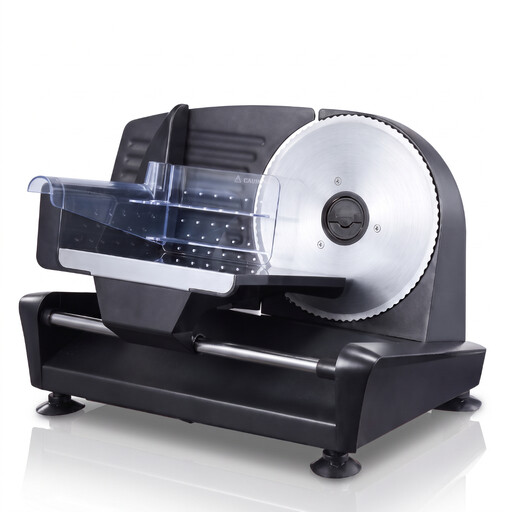 No image available
Described as suitable for bread; adjustable slice thickness lets you choose a setting within the stated range.
Stated slice thickness: 0–15 mm; two stainless steel blades, each with a 19 cm diameter.
 No image available
Described as suitable for bread; the removable carriage may be useful for regular cleaning.
The product name specifies a metal construction and a removable carriage.
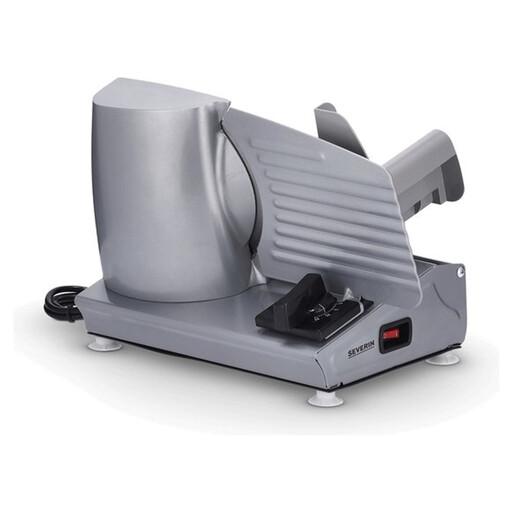 No image available
Described as suitable for bread; before buying, check that the design and dimensions work for your kitchen.
The product name lists a stainless steel blade and a ham-slicing blade included in the box.
Check whether bread is listed as a food it can slice, which blade is fitted, and whether the slice thickness, support and carriage movement are suitable for your loaf. Graef lists a 170 mm serrated blade and a slice thickness range of 0–20 mm for the SKS100; that alone doesn’t confirm it’s suitable for the size of your particular loaf.
Follow the instructions for the specific appliance. The Graef instructions for the SKS100 series say to unplug the appliance before taking it apart and cleaning it. This doesn’t tell you whether other models are dishwasher-safe.
No. In its information dated 28 September 2026, Germany’s consumer advice centre distinguishes between statutory rights when goods are faulty and a voluntary guarantee. Check the guarantee terms for the specific offer separately.
The Federal Network Agency describes CE marking as a declaration made by the manufacturer on its own responsibility, not a mark of origin or an independent test result. It lists checking the marking and the required German-language accompanying documents as tasks for retailers. CE marking alone doesn’t prove how well an appliance slices.
Don’t put an old appliance in your household rubbish. Germany’s Federal Environment Ministry lists taking it to a recycling centre and returning it to a retailer, subject to legal requirements. Whether a retailer has to take it back depends, among other things, on whether you’re buying an equivalent new appliance.