Households with different mealtimes
You want to slice only the portions you need from your homemade loaf, and store the rest appropriately.


For homemade bread that you slice into small portions throughout the day, choose a food slicer with a blade suitable for bread and the right range of slicing thicknesses. Check the manufacturer’s specifications for the specific model. If you need to put the appliance away between uses, a foldable model may suit you better than one that can stay on the worktop. If you’d rather not slice bread fresh each time, the German Federal Centre for Nutrition recommends freezing it as fresh as possible and already sliced; you’ll need enough freezer space for this.
You want to slice only the portions you need from your homemade loaf, and store the rest appropriately.
You only need an electric slicer for short periods and want to be able to put it away afterwards.
As well as how it slices bread, you’re looking for an appliance that suits your household and has easy-to-access parts for cleaning.
| What to consider | What to check before buying | Who will find this particularly important? |
|---|---|---|
| Bread crust and slice thickness | Blade type and suitability for bread; adjustable slicing thickness in millimetres. | I want a blade that can handle bread crust and lets me choose the slice thickness I want. Around 33% of consumers prioritise slicing bread and slice thickness. |
| Worktop space and storage | Dimensions when set up and folded; a stable base and enough room for the carriage while slicing. | If I need to put the appliance away after short periods of use, its folded dimensions and stability while slicing matter to me. Around 27% of consumers prioritise storage and set-up. |
| Safe operation | Type of switch and any safety lock; carriage and instructions for disconnecting the appliance from the mains. | When using the appliance repeatedly, I want the switch and carriage to be easy to operate correctly, and I’ll follow the instructions. Around 20% of consumers put safe operation first. |
| Cleaning and saving bread for later | Which parts can be removed and which cleaning instructions apply to the model; plan separately how to store any leftover bread. | When there’s time between meals, I want to be able to remove crumbs easily and decide whether to slice and freeze bread in advance. Around 20% of consumers prioritise care and food storage. |
ritter points out that a smooth blade for ham and cold meats isn’t suitable for bread. Check which type of blade comes with the specific model.
If the blade supplied isn’t suitable for bread, you may need a compatible serrated blade. Check in advance whether a suitable replacement blade is compatible with the model.
A small footprint when folded doesn’t tell you how much room you’ll need to set up the appliance safely and move the carriage.
Compare the set-up dimensions and the space needed for the carriage with your worktop and the loaves you usually bake.
The German consumer advice centre distinguishes between statutory rights and a voluntary guarantee. Each may have different terms and points of contact.
Check the guarantee terms for the specific model and how to contact the seller if something is faulty.
The Classic C20 is a freestanding model with a serrated blade and stepless adjustment from 0–20 mm. These features apply to this specific model, not every appliance from the brand.
The markant 01 and E 16 have different designs: the markant 01 folds away, while the E 16 is an angled metal model. ritter recommends a serrated blade for bread.
The foldable AS 3912 and the AS 3917, with its removable blade and support table, offer different features.
The F.A.Z. Kaufkompass included the MS171 in its test selection as a lower-priced recommendation. This assessment applies to the model tested, not the entire DOMO range.
The Joybuy products below are electric food slicers for bread with adjustable slicing thickness. Check the blade type and features of each model to make sure they suit your needs.
 No image available
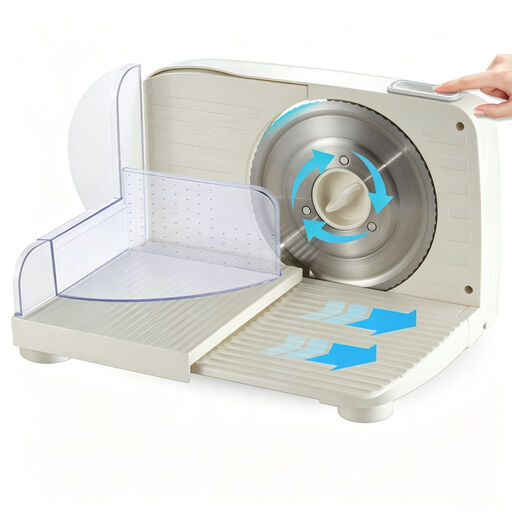
For bread when you want to vary the slice thickness; the foldable design is useful if you want to store the appliance between uses.
The product name specifies a slicing thickness of 0–15 mm and a stainless steel blade. According to the description, the appliance isn’t designed for slicing frozen food or bones.
 No image available
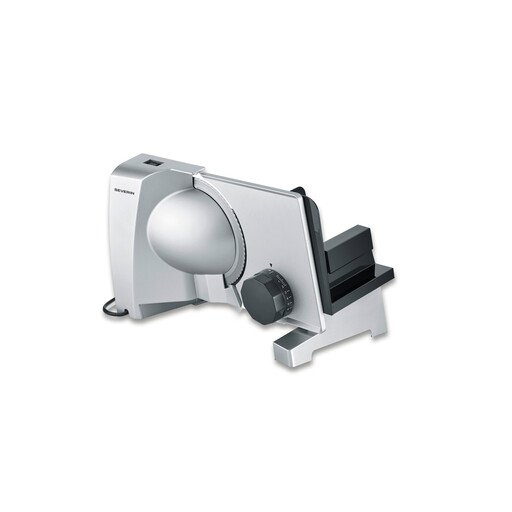
An option if you want to vary the slicing thickness for bread; check which type of blade is intended for your loaves before buying.
The product name specifies 250 W and an adjustment range of 0–15 mm. According to the description, the appliance is for domestic use; keep it away from water and supervise children nearby.
 No image available
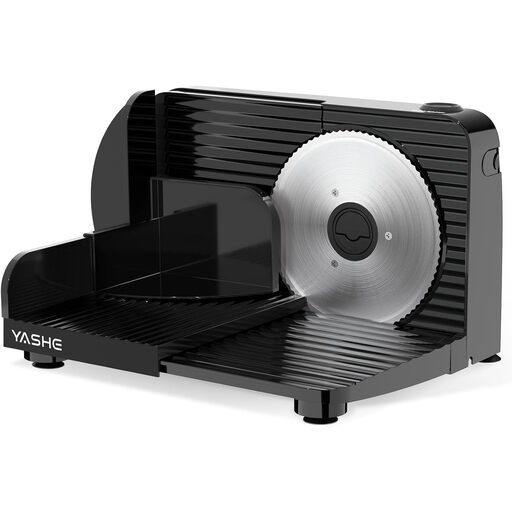
For bread when you want to vary the slice thickness; compare the stated adjustment range with the thickness you usually need.
The product name specifies a slicing thickness of 0–23 mm. Follow the model-specific instructions for cleaning and removing parts.
 No image available
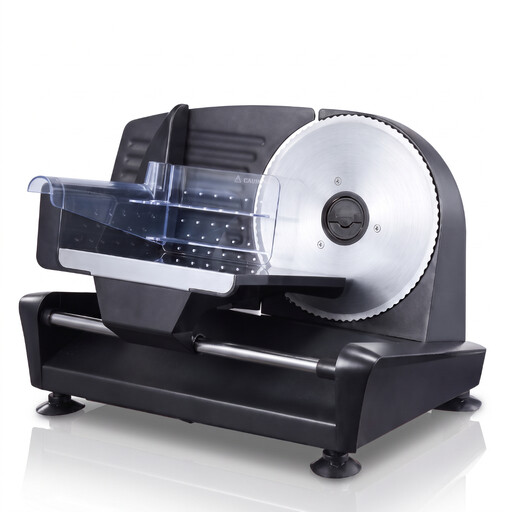
For bread with adjustable slicing thickness; the foldable design may suit a kitchen where you want to store the appliance after slicing.
The product name specifies a slicing thickness of 0–15 mm and a 17 cm stainless steel blade.
 No image available
For bread with adjustable slicing thickness; check which blades and removable parts are included with the specific version.
The product name specifies 200 W and two 19 cm stainless steel blades. The description gives an adjustment range of 0–15 mm and mentions a safety handle.
No. For longer storage, the German Federal Centre for Nutrition recommends freezing bread while it’s as fresh as possible and already sliced. If you’ve cut into a loaf, you can store it with the cut side facing down; if you see any mould, throw the whole loaf away.
Follow the instructions for the specific model and unplug the appliance before taking it apart or cleaning it. ritter explicitly advises this for the E 16; removable parts don’t automatically mean that the appliance is dishwasher-safe.
No. The European Union describes the CE marking as the manufacturer’s declaration that relevant requirements have been met; it isn’t a central EU certificate. Check which regulations apply to the specific version of the product.
If there’s a fault, contact the seller about your statutory consumer rights. The German consumer advice centre distinguishes these from a voluntary guarantee; check the guarantee terms and any spare parts available for the specific model separately.
No. The German Environment Agency explains that old electrical appliances must be collected separately. Contact your local collection point to find out where to take it.