For homemade bread in a shared kitchen, choose a food slicer that suits the size of your loaves, the slice thickness you want and a blade designed for bread. It should also fit your available worktop space and storage arrangements. Folding models are easier to store, but that does not automatically mean they offer the right cutting capacity. If several people will use the slicer, look for clear controls and a food holder, and follow the instructions for cleaning.
Who slices homemade bread?
Home bakers who make different types of bread
If you bake loaves with different crusts, you’ll want to adjust the slice thickness to suit each one. Manufacturer details about the blade and adjustment range can help you compare models, but you’ll still need to check them against the dimensions of your own loaves.
People sharing a kitchen
If you need to clear the worktop when your cooking slot is over, the slicer’s dimensions when set up are just as important as its storage footprint and how easy it is to put away. The manufacturer’s folded dimensions apply when the slicer is stored.
Households with different people using the slicer
If several people use the same appliance, everyone should know how to use the switch, carriage and food holder. Features such as a safety switch or a lockable carriage vary by model; they are no substitute for reading the instructions or handling the blade with care.
What should you look for when buying?
Start by checking the loaf size and slice thickness you need. Then consider worktop space and storage, as well as how easy the slicer is to clean and hand over to someone else.
| Priority |
What to check when buying |
Who it matters most to |
| Bread, crust and slice thickness |
Check that the serrated blade and adjustable cutting range suit the slice thickness you want and the size of your loaf. |
If I bake loaves with different crusts, I want to take both slice thickness and loaf size into account. For around 31% of consumers, getting the right fit for the bread and slice is the main priority. |
| Worktop space and storage |
Check the dimensions when the slicer is set up separately from its folded width. Remember to allow for the cable and any removable parts when storing it. |
If I need to clear the worktop after my cooking slot, I need enough space to use the slicer and a practical place to store it. For around 25% of consumers, keeping the work area clear is the main priority. |
| Safe handover between users |
Check the controls, safety switch, carriage lock and food holder on the specific model. |
If several people use the appliance, everyone should be able to handle the food and carriage in line with the instructions. For around 25% of consumers, safe shared use is the main priority. |
| Cleaning between cooking sessions |
Check whether the blade or carriage can be removed and what cleaning method the instructions recommend. |
If I want to leave the cutting area clean after each use, accessible parts and clear cleaning instructions are important. For around 19% of consumers, cleaning between uses comes first. |
Common misconceptions
-
Looking only at the folded width
The folded width tells you how much space the slicer takes up in storage, not how much room it needs when cutting. For the ritter markant 7, the manufacturer gives a width of 10.5 cm when folded and 26.5 cm when unfolded.
Measure the space you’ll use for cutting and the space available for storage separately before choosing a folding model.
Frequently setting it up and putting it away takes extra effort, and it still occupies worktop space while you’re slicing.
-
Assuming a higher wattage means better bread slicing
Wattage alone doesn’t tell you how well an appliance will slice a particular loaf. Manufacturers specify different blades, adjustment ranges and designs for different models, so these aren’t direct comparisons of how each one slices the same bread.
Check the blade type, suitable cutting range and dimensions first. Only compare power ratings when you know exactly which models and measurement basis you’re comparing.
-
Confusing a manufacturer’s guarantee with your statutory rights
Your statutory rights are against the seller. A voluntary manufacturer’s guarantee can provide additional cover, but it cannot replace them. Your Europe explains the difference for consumer purchases in the EU.
Keep your proof of purchase and read the terms of any additional guarantee separately from your statutory rights.
Contacting the wrong party about a problem can mean extra time spent getting things sorted.
Brands and suitable model ranges
ritterwerk
These examples vary in storage requirements and slice thickness. The dimensions and ranges below are the manufacturer’s specifications for the respective models.
- According to the manufacturer, the markant 7 is 10.5 cm wide when folded and the icaro 7 is 10.0 cm.
- According to the manufacturer, the markant 7 can be adjusted to around 15 mm, the icaro 7 to around 14 mm, and the E 16 to around 20 mm.
- The manufacturer specifies a short-term operating time of 5 minutes for the E 16. Check whether this suits the way you like to slice.
Graef
According to the manufacturer, the SKS110 combines a serrated blade with a lockable carriage.
- The manufacturer specifies a 170 mm serrated blade and an adjustment range of 0–20 mm for the SKS110.
- According to the manufacturer, locking the carriage covers the blade.
- This lock is a model-specific feature, not an independent safety assessment. It does not replace supervision or unplugging the appliance before cleaning.
Severin
The AS 3912 and AS 3917 examples are designed to meet different needs in terms of design and adjustment range.
- The manufacturer specifies an adjustment range of 0–15 mm for the folding AS 3912.
- For the AS 3917, Severin specifies 0–23 mm, as well as a removable blade and support plate.
- These features apply to the models listed and should not be assumed to apply to the entire range.
Unold
According to the manufacturer, the folding Curve and the freestanding Metall Plus food slicer have different adjustment ranges.
- For the Curve, Unold specifies around 0–15 mm, a serrated blade and a food holder with finger guard.
- According to the manufacturer, the Metall Plus can be adjusted to around 0–23 mm and comes with a collection tray.
- Check the actual dimensions of the Curve when set up, and the current availability of the Metall Plus with the relevant retailer.
ETA
The manufacturer describes the Tempo 1094 90000 as an electric food slicer for bread, with an adjustment range of 0–20 mm.
- The manufacturer’s website lists a removable serrated blade and non-slip feet.
- The manufacturer’s information about the materials and whether it folds is contradictory. If storage space is important, don’t rely on this model having a folding function.
Food slicers at Joybuy
This selection includes electric food slicers that are described in their product details as suitable for slicing bread; several models fold for storage.
 No image available
Electric food slicer, folding, 0–15 mm, stainless steel blade
The folding design and 0–15 mm adjustment range make this a good fit for a kitchen where you need to put the slicer away after use and adjust the thickness of your slices.
The product name specifies a stainless steel blade. According to the product description, the appliance is not designed for frozen food or bones.
View at Joybuy
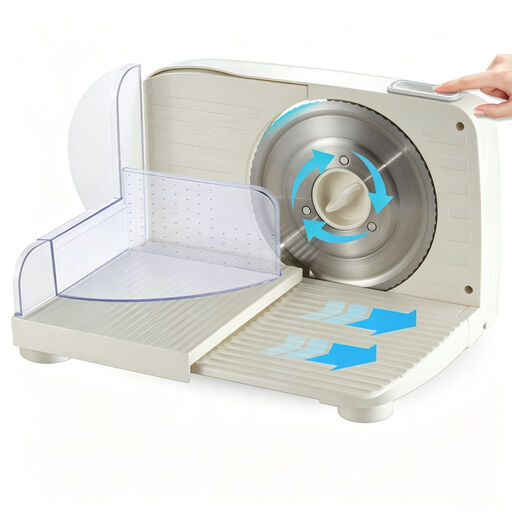 No image available
Electric food slicer, 250 W, 0–15 mm, two blades
According to the product description, this folding food slicer is suitable for bread. Its 0–15 mm adjustment range gives you flexibility over slice thickness.
The product name specifies 250 W and two blades. The description also mentions a finger guard on the pusher, along with a removable blade and cutting surface.
View at Joybuy
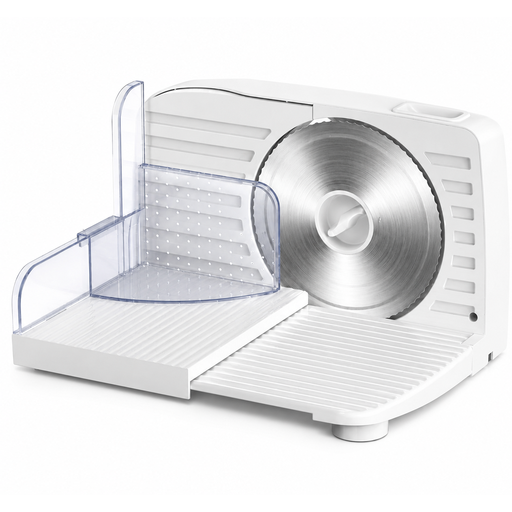 No image available
Electric food slicer, 250 W, 0–15 mm, two blades
This folding model is described as suitable for bread, and the product description says it can be adjusted from 0 to 15 mm.
The product details list 250 W, two blades and a 17 cm serrated stainless steel blade. Removable parts may be useful when cleaning between uses.
View at Joybuy
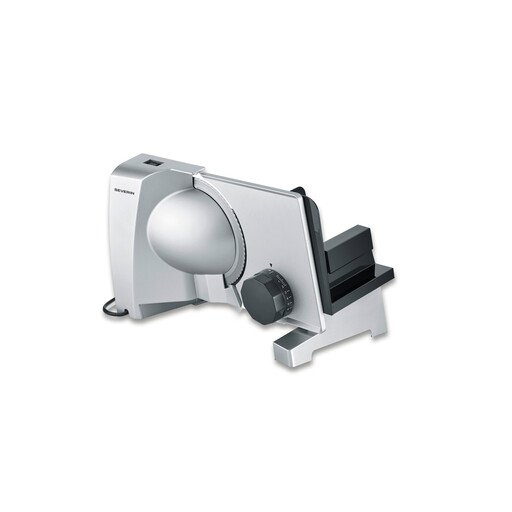 No image available
Severin AS 3917 food slicer, 0–23 mm
Described as suitable for bread, the AS 3917 has an adjustment range of 0–23 mm, making it a good option for households that want to slice bread more thickly too.
The product name specifies 130 W and a grey casing. The blade and support plate are described as removable, which may make cleaning between cooking sessions easier.
View at Joybuy
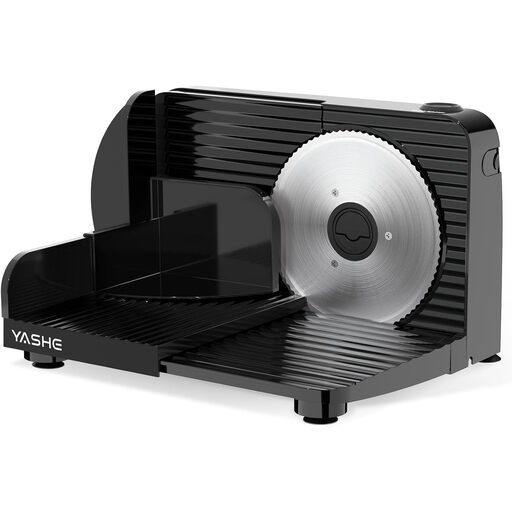 No image available
YASHE SL-5801D23B3 folding food slicer, 0–15 mm
This folding model is described as suitable for bread, and its product name gives an adjustment range of 0 to 15 mm.
The product details specify 180 W and a 17 cm serrated stainless steel blade. A safety switch and food pusher are also mentioned.
View at Joybuy
Frequently asked questions
What slice thickness should I choose for homemade bread?
Compare the slice thickness you want with the adjustment range of the specific appliance. Examples given by manufacturers include up to around 14 mm for the ritter icaro 7, up to around 20 mm for the E 16 and up to 23 mm for the Severin AS 3917. These are adjustment specifications, not independent test results for slicing your bread.
How should I hand over a food slicer in a shared kitchen?
Switch off and unplug the appliance before leaving it unattended in storage or taking it apart to clean. Remove crumbs and residue according to the instructions for the specific model, and refit any protective parts correctly.
Who should I contact if my food slicer is faulty?
For purchases made from an EU consumer retailer, you have a two-year statutory guarantee against the seller, starting from the date you receive the goods. An additional manufacturer’s guarantee does not replace this right, so keep your proof of purchase. Your Europe explains the rules for consumer purchases in the EU.
Does a new electric food slicer in Germany need to carry a CE mark?
According to the Federal Institute for Occupational Safety and Health, the relevant rules apply to new electrical equipment in the 50 to 1,000 V AC range. If the specific product is subject to EU rules requiring CE marking, the manufacturer must mark it accordingly. Your Europe explains that CE marking is the manufacturer’s declaration that the product meets the relevant product rules, not an independent quality mark. Check the information for the specific appliance.
Can I put a food slicer that has reached the end of its life in my household rubbish?
No. The German Environment Agency advises that waste electrical equipment must be collected separately. Find out about suitable return points or take it to a recycling centre.


