
Lieferung heute & morgen

Qualitätsgarantie

Willkommens-Angebote freischalten: KOSTENLOSE Lieferung | Bis zu 80 % RABATT | Kostenlose 30-Tage-JoyPlus-Testphase
App herunterladen
An LED night light with sensor can illuminate the way through a hallway, stairwell or children’s room at night, without anyone having to search for the light switch. However, it is worth taking a close look at the sensor type, light colour, power supply and mounting method before buying. Some models switch on even when there is sufficient ambient light, shine too brightly or need new batteries more often than expected.
A night light with motion sensor responds to movement. It usually only switches on when low ambient light is detected at the same time. A night light with dusk sensor, on the other hand, operates according to the surrounding light level and can remain permanently lit in the dark.
A motion sensor is often suitable for a hallway where light is only needed briefly at night. In a children’s room or beside the bed as a night-time guide light, a constant, dimmed light may be more pleasant. The product description should therefore clearly distinguish between a PIR sensor, light sensor and combined sensor technology.
Power consumption in watts describes energy usage, not brightness directly. For this, luminous flux in lumens (lm) is the deciding factor. An LED plug-in light with 8 lm is more suitable as a guide light, while a cupboard light with a motion sensor and a considerably higher luminous flux can also illuminate worktops or larger cupboard areas.
The light source should not be unnecessarily bright in bedrooms. For stairs, bathrooms or kitchen areas, however, sufficient illumination is important so that edges and obstacles remain visible.
A battery-free night light is plugged directly into a socket and requires neither battery changes nor charging breaks. A USB-rechargeable night light can be mounted more flexibly on cupboards, shelves or beneath wall cupboards, but must be charged regularly depending on the battery and usage.
Pay attention to the stated runtime, charging method and contents of the package. With permanently mounted lights, it may also be important to check whether the USB cable is easily accessible.
With a PIR motion sensor, range and detection angle are crucial. Specifications such as up to 3 or 7 metres and an angle of 100 to 120 degrees provide an initial guide. In practice, mounting height, direction of movement and obstacles affect detection.
A small detection area is often sufficient for a narrow hallway. A wider angle may be useful on stairs or in larger rooms. The sensor should not be obstructed by furniture, curtains or covers.
A warm white night light is usually in the region of 2700 to 3200 Kelvin. This light colour is often chosen for bedrooms, children’s rooms and routes taken at night. Neutral or cool white light of around 4000 to 6500 Kelvin can show contours more clearly, but may feel less subdued in a sleeping area.
A dimming function makes the light more adaptable. Several fixed brightness levels or continuously variable adjustment are practical features. Also check whether the light switches off automatically after a set period or remains permanently on in dusk mode.
For indoor use, the light should be suitable for the available mains voltage of 220–240 V. With plug-in models, specifications such as Protection Class II, CE marking and the intended area of use are relevant. IP20 means that the product is designed for dry indoor spaces and is not protected against water.
A flame-retardant PC or ABS housing can contribute to the product’s built-in safety, but does not replace correct use. Plug-in lights must not be covered, dismantled or used in damp areas unless the manufacturer expressly permits this.
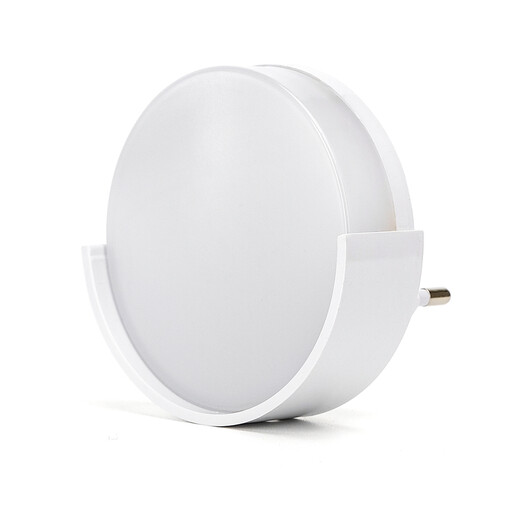
Why this product suits the profile: This plug-in model uses a light sensor and requires neither batteries nor a charging cable. It is suitable for hallways, children’s rooms, bedrooms and stair areas.
The specified switch-on threshold is below 20 LUX. With power consumption of 1 W, regular battery changes are also unnecessary.
40 lm, a 120-degree beam angle, IP20 for dry indoor spaces and a stated LED lifespan of 25,000 hours.
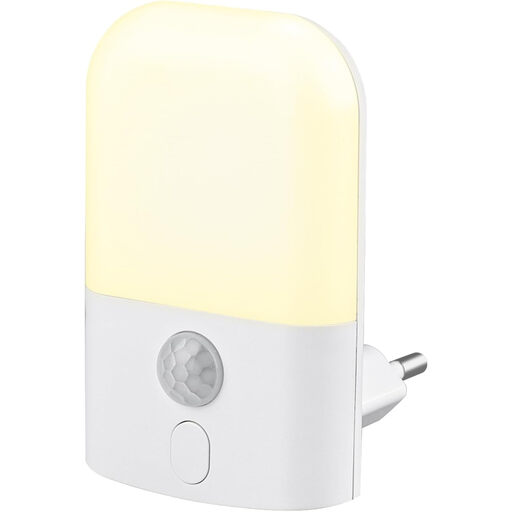
Why this product suits the profile: Five brightness levels and the combination of motion and dusk sensors enable precise use in children’s rooms, hallways, bathrooms or on stairs.
Motion detection is linked to low ambient light. According to the product details, the light switches off after 60 seconds without movement.
2700 K warm white light, five brightness levels, a range of up to 3 m and a 120-degree detection angle at 0.5 W.

Why this product suits the profile: The slim lights can be attached with adhesive tape, without drilling, inside kitchen cupboards, wardrobes, on shelves or in hallways.
It does not depend on having a free socket. Before installation, the surface should be clean and dry so that the adhesive tape can hold securely.
Two lights per pack, 800-mAh battery, USB charging, 3 to 5 m sensor range and three colour temperatures from warm white to cool white.
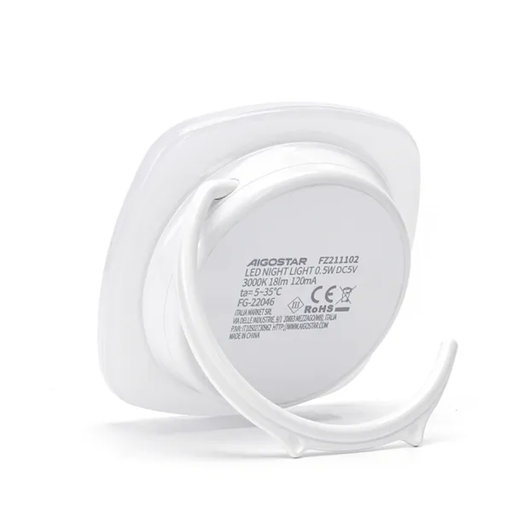
Why this product suits the profile: This compact, USB-rechargeable night light can be used in places without a nearby socket, such as inside a wardrobe or beneath a shelf.
The combination of motion detection and a darkness condition helps prevent unnecessary activation. Battery power means it does not need to stay in one fixed socket position.
3000 K warm white light, 18 lm, a detection range of 3.5 m and USB charging with an integrated 500-mAh battery.
We have put together a complete, regularly updated list of products that fully meet these strict selection criteria and the safety regulations applicable in the EU.
Plug-in models are inserted directly into a suitable wall socket. The sensor should remain unobstructed and should not be covered by the edges of furniture. With a USB model, check before installation that the light can be easily removed for charging. For bathrooms and other damp rooms, the stated IP rating is particularly important; IP20 products are designed only for dry indoor spaces.
You can estimate the electricity costs roughly by multiplying the power consumption in kilowatts by the operating hours and your personal electricity price. A 0.5 W model uses just 0.5 kWh over 1,000 operating hours. With battery-powered lights, charging cycles occur instead, with their frequency depending on the sensor range, how long the light stays on and how often it is used.
A light sensor measures the surrounding brightness. A PIR sensor detects movement by identifying changes in thermal radiation. Combined models usually only switch on when it is dark and movement is detected. The range and switch-off time depend on the individual product.
Warm white light between around 2700 and 3200 Kelvin is often chosen for a children’s room. Low brightness, glare-free light distribution and positioning the light source so that it does not shine directly into the face are also important. A dimming function allows the light to be adjusted to suit different situations.
The lifespan is stated in operating hours and may be 10,000, 15,000 or 25,000 hours, for example, depending on the model. With battery-powered lights, the capacity and stated runtime per charge are also relevant. For a long service life, the device should be operated in dry conditions, kept free from coverings and used in accordance with the manufacturer’s instructions.