
Lieferung heute & morgen

Qualitätsgarantie

Willkommens-Angebote freischalten: KOSTENLOSE Lieferung | Bis zu 80 % RABATT | Kostenlose 30-Tage-JoyPlus-Testphase
App herunterladen
A LED outdoor wall light with motion sensor can illuminate patios, balconies, entrance areas, garages or garden paths without permanently installed power cables. Models with an integrated battery, USB charging and magnetic mounting are particularly practical. However, not every wireless outdoor light is suitable for every location.
Three common purchasing mistakes can easily be avoided:
Light output is measured in lumens. A 300-lumen outdoor light is typically suitable for smaller areas such as:
For a larger driveway or broad courtyard, a model with a considerably higher luminous flux may be the better choice. The beam angle should also be taken into account. A high lumen rating alone does not indicate how evenly an area will be illuminated.
Colour temperature is measured in kelvins. Warm-white outdoor lighting at 3000 K creates a warm, yellowish impression and is often well suited to patios, balconies and entrance areas. Neutral-white 4000 K lighting appears more functional and may be preferable for work or passage areas.
A rechargeable outdoor light does not require a permanent power socket. This makes it easier to use in rented properties or locations without an existing electrical connection. Before buying, you should nevertheless check the following:
With a USB-rechargeable outdoor light, it is also important to check which charger may be used. The product should only be charged with the supplied USB cable or a suitable certified replacement. Actual runtime depends on factors including battery capacity, activation frequency, temperature and the selected operating mode. Binding runtime figures should only be taken from the relevant product specifications.
The IP44 rating indicates protection against splashing water, but not against every type of weather event. The light should be installed so that water cannot collect around it and so that it is not permanently exposed to heavy rain, snow or a direct jet of water. If visible damage, unusual heat build-up or malfunctions occur, the light should be taken out of service.
An LED wall light with a magnet can be positioned quickly on suitable metal surfaces. This is practical for garages, workshops and certain balcony or patio areas. On stone, plaster, wood or plastic, however, a magnet will not hold without an additional metal counter-surface. Before ordering, check the mounting conditions and use corrosion-resistant screws for permanent installation.

Why it is a good fit: For tenants or households looking to illuminate a small outdoor area without a permanent power connection.
The product specifications state 300 lumens, 3000 K, an integrated battery, a USB connection and IP44 protection. This makes it easier to assess the light output and application limits before buying.
Rocker switch, magnetic mounting, USB cable and integrated motion sensor; dimensions: approx. 8 × 10.3 × 10.1 cm.
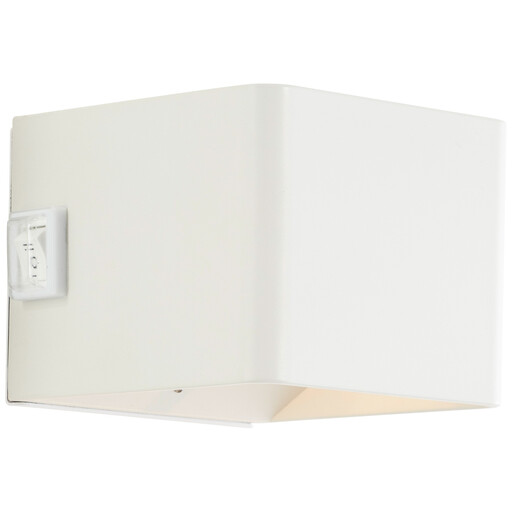
Why it is a good fit: An option for balconies, patios or entrance areas where a light-coloured housing is preferred.
The IP44 rating indicates that splashing water is acceptable, but the light must not be immersed in water or cleaned with a high-pressure jet.
Battery, USB connection, motion sensor, magnet and manual operation; integrated 4 W LED with 300 lumens.
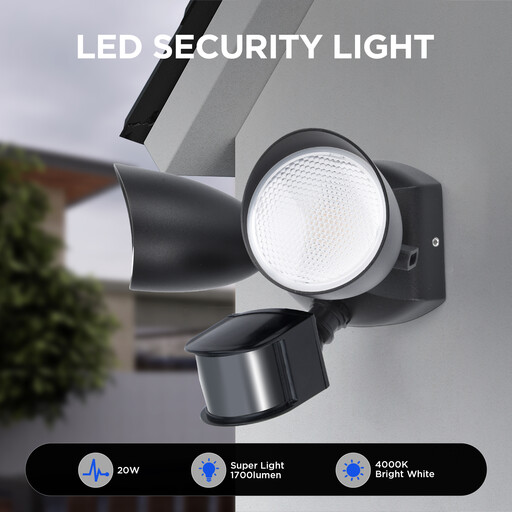
Why it is a good fit: For driveways, courtyards or larger outdoor areas where 300 lumens may not be sufficient.
The specified 1700 lumens and 4000 K provide a clear reference for light output and colour temperature. Before installation, check the required power supply.
20 W output, 1700 lumens, 4000 K and two adjustable light heads according to the product description.
We have put together a current selection of products covering a range of requirements for motion-sensor home lighting and outdoor use.
Install a motion-sensor patio light so that the sensor covers the desired walking area without being triggered constantly by passing vehicles, branches or pets. Positioning the light slightly higher can improve the detection area; the specific sensor range and follow-up time must correspond to the product specifications.
With a mobile light, the battery should be fully charged according to the instructions before first use. Check the charge level regularly, particularly before longer autumn and winter periods. Extreme temperatures can affect battery performance. The integrated battery must not be opened or modified independently and must be disposed of in accordance with local regulations for waste electrical and electronic equipment.
For a small front entrance or balcony, a 300-lumen outdoor light may be sufficient. For driveways, wide courtyards or larger garden paths, the area, mounting height and light distribution are decisive. Models with 1700 lumens are more suitable for larger spaces, but depending on their design, they may require a different power supply and mounting method.
IP44 indicates protection against splashing water, not against immersion or powerful water jets. The light should therefore be installed in a protected position and must not be cleaned with a pressure washer. Always follow the safety and installation instructions provided by the respective manufacturer.
Running costs depend on output, operating time and the price of electricity. A 4 W LED consumes 0.004 kWh during one hour of actual illumination. Rechargeable models also incur minimal electricity costs while charging; the frequency depends on usage and battery capacity. A motion sensor can reduce continuous operation, but it does not replace an accurate consumption calculation.