
Lieferung heute & morgen

Qualitätsgarantie

Willkommens-Angebote freischalten: KOSTENLOSE Lieferung | Bis zu 80 % RABATT | Kostenlose 30-Tage-JoyPlus-Testphase
App herunterladen
A night light for a children’s room should provide orientation without making the room unnecessarily bright. For parents, three situations usually matter most: night-time feeding or nappy changing, short trips to the hallway, and a gentle light to help little ones fall asleep. However, product descriptions often sound more similar than the devices actually are in daily use.
A night light with colour-changing can be decorative, but it isn’t automatically suitable for every night-time situation. RGB colours often appear stronger than a dimmed warm-white night light. For nappy changing or finding your way around a dark room, what really matters is whether the brightness can be finely adjusted and whether a warm-white mode is available.
Claims like “up to 100 hours” usually refer to the lowest brightness setting. For example, the VAVA VA-CL009 states a runtime of up to 100 hours at the lowest brightness, while at maximum brightness it’s around 7 hours. If you’re choosing a rechargeable night light, you should always check:
A night light with a motion sensor requires movement and darkness, whereas a night light with a dusk sensor reacts to ambient light levels. Furniture, curtains or nearby lamps can affect sensor performance. So pay attention to the stated detection angle, range and automatic shut-off time.
For a children’s room, a warm-white night light at around 2,700 to 3,000 Kelvin is a sensible choice if you want a subtle lighting effect. The Kelvin rating describes the colour temperature, not the brightness. For brightness, look at lumens or specific dimming levels.
A dimmable night light with several levels is easy to use. Stepless adjustment, on the other hand, offers more flexibility – for example, a very faint light point during the night. It’s also important whether the last-used setting is saved.
A plug-in model is ideal for hallways, stairs and permanently lit passages. Models with 0.3 or 0.5 watts use relatively little energy during regular operation. With a plug-in night light, you should also consider the design: a slim housing leaves neighbouring sockets free.
A battery-powered night light can be moved flexibly between the cot, changing area and travel luggage. However, you’ll need to keep an eye on the charge level. For devices with a lithium battery, the charging cable, suitable power source and a safe charging spot become part of daily use. Cables should be kept out of reach of unsupervised children.
Smooth surfaces made of ABS, PC or silicone can be cleaned with a dry or slightly damp cloth, provided the manufacturer’s instructions allow it. A night light should not be placed near water, heat sources or damp areas unless a suitable IP rating is specified.
Also check:
CE is a conformity marking and not an independent quality seal. The specific warnings from each manufacturer remain the most important reference.
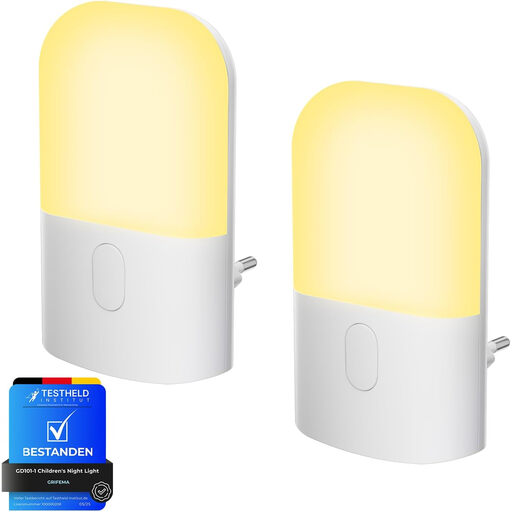
Why this product fits the profile: The 2-pack is ideal for households wanting to equip a children’s room, hallway or bathroom with a simple plug-in solution. The dusk sensor handles switching on and off automatically.
The automatic response to darkness reduces the need for manual switching. Three brightness levels help avoid unnecessarily strong lighting.
2700 Kelvin warm-white light, 0.5 watt power consumption and a slim plug-in design according to product specifications.
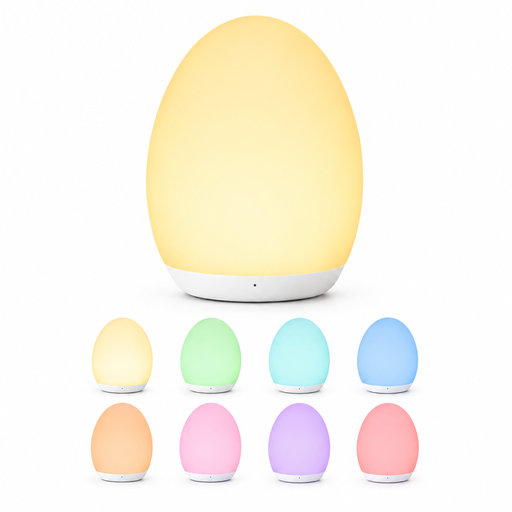
Why this product fits the profile: This portable baby night light combines warm-white light, dimming, touch control and a timer. It’s ideal for night feeds, nappy changes and travel – no app or Wi-Fi connection needed.
The runtime is specified separately for each brightness level. The 1-hour timer prevents the lamp from accidentally staying on permanently.
2000 mAh battery, eight colour modes, memory setting and warm-white, dimmable light according to the product description.
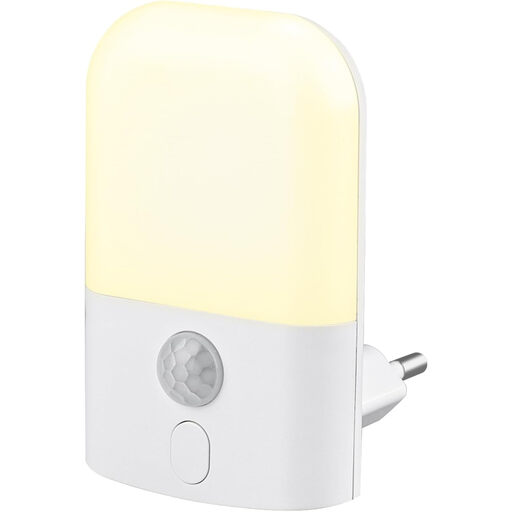
Why this product fits the profile: For hallways, stairs and routes to the bathroom, the combination of motion and dusk sensors is very practical. The model switches off automatically after 60 seconds without movement.
The stated range of up to 3 metres and the 120° detection angle make the sensor data clear. The auto shut-off limits unnecessary operating time.
Five brightness levels, 2700 Kelvin warm-white LED light and 0.5 watt power consumption according to the manufacturer’s specifications.
We’ve put together a full, regularly updated list of products that meet these strict selection criteria and the safety regulations in force across the EU.
A warm-white colour temperature between around 2,700 and 3,000 Kelvin is often chosen for subtle room lighting. What really matters is keeping the brightness low and not pointing the light directly at your child’s face.
That depends on the power consumption and how long it’s on. At 0.3 watts, the consumption is 0.3 watt-hours per hour of operation; at 0.5 watts, it’s 0.5 watt-hours. A sensor can also limit the lighting duration in everyday use.
The runtime varies depending on battery capacity, brightness, colour mode and the age of the battery. Product specifications should always be compared with the relevant brightness setting. At maximum brightness, the operating time is usually much shorter than at the lowest setting.