
Lieferung heute & morgen

Qualitätsgarantie

Willkommens-Angebote freischalten: KOSTENLOSE Lieferung | Bis zu 80 % RABATT | Kostenlose 30-Tage-JoyPlus-Testphase
App herunterladen
A night light with a motion sensor should automatically illuminate the way to a child’s bedroom, the bathroom or across the stairs without staying brightly lit throughout the night. In practice, however, some models disappoint because of unsuitable sensors, excessively bright light or complicated installation.
Three marketing traps in particular often lead to unsuitable purchases:
A night light with a motion sensor responds to physical movement within a defined detection area. The light typically switches off again after a set period. This type is suitable for hallways, stairs, bathrooms or rooms that are only crossed briefly.
A night light with a dusk sensor, by contrast, measures the brightness of its surroundings. According to the product description, the Aigostar model switches on below 20 lux. The light remains active in dark surroundings and switches off again when there is sufficient light. This function is useful when you want to use a socket continuously for subtle guidance lighting.
When choosing automatic indoor lighting with a motion sensor, buyers should also check the following:
For a children’s-room night light or a lamp beside the bed, warm-white LED night light is often preferred. Compared with cool-white light at 6500 Kelvin, warm-white light at 2700 Kelvin feels less clinical and may be perceived as more pleasant for finding your way at night. It does not have any medical or therapeutic effect.
Pay attention to these measurable specifications:
A night light is either powered directly from a socket or placed close to the floor. The material and intended location should therefore suit the surroundings. According to the product specifications, the Aigostar and GRIFEMA products mentioned are made, among other materials, from polycarbonate (PC) or PC and ABS.
The following points are also important for indoor use:
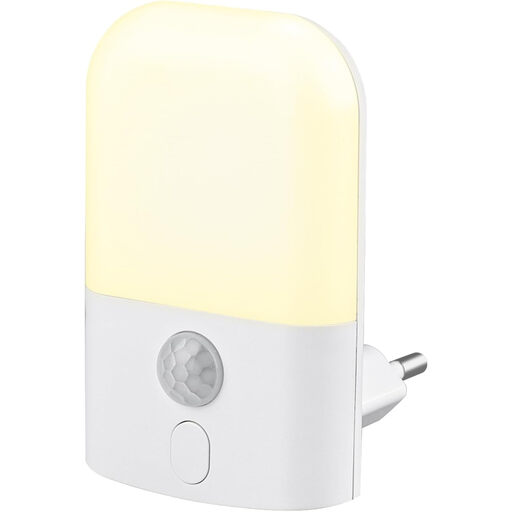
Why this product suits this profile: This plug-in night light combines motion and dusk sensors with five brightness levels, making it suitable for children’s rooms, hallways and stairs.
According to the description, the combination of sensors prevents activation when there is sufficient daylight. The light switches off after 60 seconds without movement.
2700 K warm-white LED light, five brightness levels, a detection range of up to 3 m and a 120° detection angle.
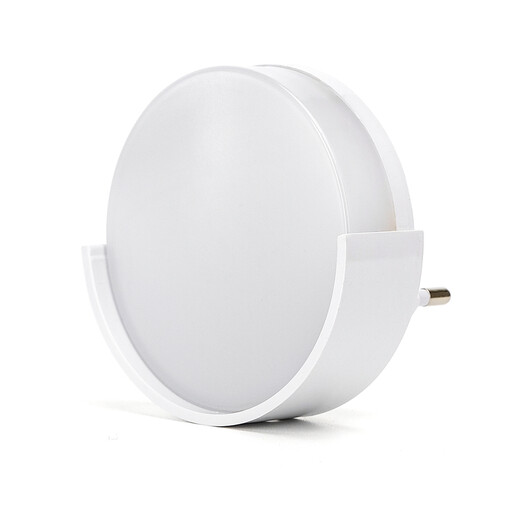
Why this product suits this profile: For households looking for constant, automatic guidance lighting without batteries or recharging.
According to the product specifications, the integrated dusk sensor operates below 20 lux. This makes it clearer when the light is activated.
1 W power, 40 lm, 6500 K, 120° beam angle, a stated lifespan of 25,000 hours, plus CE and RoHS marking according to the product description.
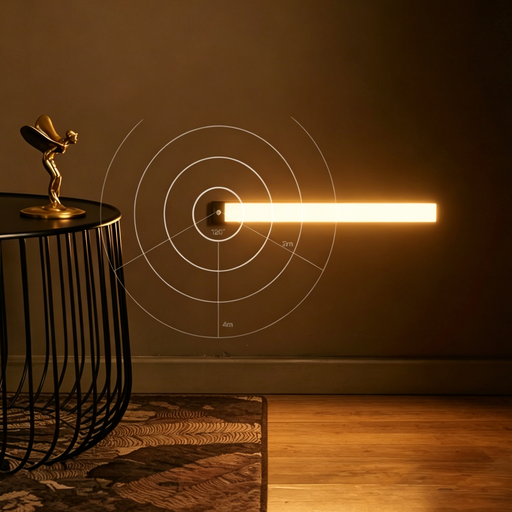
Why this product suits this profile: The 40 cm design is worth considering for cupboards, shelves or work surfaces where a broader strip of light is needed.
The elongated design is better suited to targeted area lighting than a point-source night light. Check the power supply and installation method before buying.
40 cm length and compact design for cupboards or furniture; the product name indicates a sensor function.
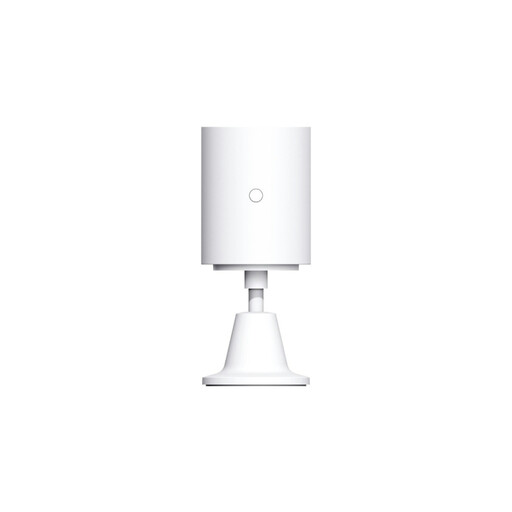
Why this product suits this profile: This sensor is designed for households that want to integrate motion and brightness data into their own smart home automations for lights or notifications.
This product is not a ready-made night light but a separate sensor. This avoids buying an integrated light when bespoke automations are what you need.
170° detection angle, a range of up to 7 m and Matter-over-Thread communication; a compatible border router or hub is required.
We have compiled a complete, regularly updated list of products that fully meet these strict selection criteria and the safety regulations applicable in the EU.
Position the device so that the sensor directly detects the route you take and is not blocked by furniture or curtains. With a plug-in model, the socket should be dry, undamaged and easily accessible. On stairs, it is best positioned where the first movement is detected as soon as someone approaches from the bottom or top.
Lifespan depends on the design, usage and manufacturer’s specifications. The Aigostar model with a dusk sensor is specified as lasting 25,000 hours and 12,500 switching cycles. These are technical manufacturer specifications and do not guarantee the actual service life in every household.
Running costs depend on the power rating, operating time and electricity tariff. A 0.5 W product uses 0.5 kWh over 1,000 operating hours in theory. A motion and dusk sensor can reduce the time the light is on by switching it on only in darkness when movement is detected. With a dusk-sensor model that stays lit continuously, operating time should be included in the cost calculation.