
Lieferung heute & morgen

Qualitätsgarantie

Willkommens-Angebote freischalten: KOSTENLOSE Lieferung | Bis zu 80 % RABATT | Kostenlose 30-Tage-JoyPlus-Testphase
App herunterladen
A no-drill pleated blind is a good choice for rented homes, newly renovated rooms and windows whose frames you don’t want to alter permanently. However, product descriptions aren’t always clear: “blackout”, “light-filtering”, “Klemmfix” and “adhesive” refer to different features. If you choose based on colour and price alone, you risk ending up with the wrong size, an unstable fitting or insufficient light control for your bedroom.
A Klemmfix pleated blind is usually attached to the window sash using adjustable clamp brackets. This only works if the frame thickness falls within the specified range. For the products mentioned, compatible frame thicknesses include 10 to 23 mm or 13 to 23 mm.
A pleated blind with clamp fittings isn’t the same as a model that uses adhesive fittings only. Adhesive fittings need a clean, dry and preferably smooth surface. They may not stick as well to rough, uneven or heavily textured surfaces. For doors or windows that are opened frequently, make sure the fittings are especially secure before use.
A blackout pleated blind with opaque or coated fabric significantly reduces the amount of light coming in. However, light can still get through at the sides, top or bottom if the blind is narrower than the glazed area. A light-filtering pleated blind, on the other hand, lets daylight into the room while providing privacy, but it isn’t the right type of product if you want a completely dark bedroom.
Product dimensions are usually given as width × height. It’s also important to check whether the width refers to the fabric or to the entire blind, including its fittings. Make sure handles, seals and protruding hardware won’t be obstructed.
First, check:
A pleated blind with clamp brackets is best suited to rectangular tilt-and-turn windows. According to their product details, many models aren’t designed for roof windows, wooden windows, sliding windows or sloping windows. For doors, make sure the blind won’t catch on protruding handles.
As a practical guide, several models recommend ordering a width that’s around 3 to 4 cm wider than the glass. The height is usually chosen based on the full height of the window, including the frame. Measure in several places, as older windows may vary slightly in size.
A made-to-measure pleated blind generally offers a more precise fit. If a model is available in different sizes, choose the closest match by following the fitting instructions. Don’t cut the fabric yourself unless the instructions specifically say you can.
Polyester is a commonly used material in the products listed. They can usually be cleaned with a soft, slightly damp cloth. Water-resistant doesn’t automatically mean waterproof, so check the manufacturer’s specific advice for bathrooms and kitchens.
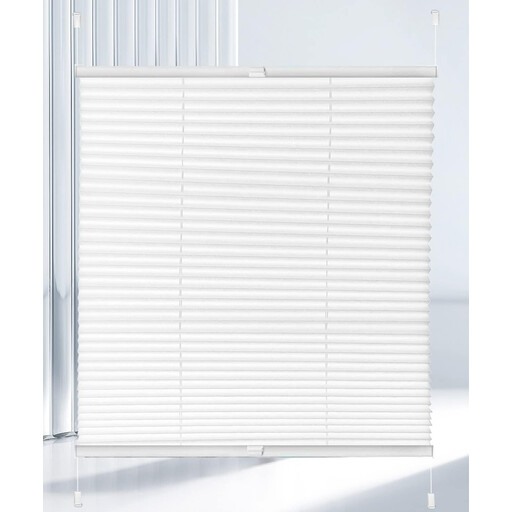
Why this product suits this profile: Measuring 80 × 200 cm, this pleated blind is designed for windows and doors, and filters daylight. Its no-drill Klemmfix fitting makes it a straightforward option for anyone looking for a simple solution for a living room, bedroom or home office.
The product description specifically says it filters light rather than blacking it out. This helps you set realistic expectations about light control before you buy.
Klemmfix fitting, polyester fabric, adjustable height and dimensions of 80 × 200 cm.

Why this product suits this profile: This 50 × 130 cm honeycomb pleated blind has a multi-layer polyester construction and adjustable Klemmfix brackets for frame thicknesses of 10 to 23 mm.
Check that the frame thickness is suitable and note the fitting guidance stating that the blind isn’t suitable for roof windows. This helps prevent buying it on the assumption that it will fit any window.
Honeycomb structure, opaque polyester fabric, top and bottom operating handles, and water-repellent material according to the product details.

Why this product suits this profile: This model combines a Klemmfix fitting option with a handle on the bottom aluminium rail. According to the product description, it’s designed for window frames measuring 16 to 22 mm thick.
Before ordering, check the frame thickness, fabric width and clearance around handles. The product details state that this model isn’t designed for roof windows.
Handle operation without a pull cord, a coated reverse side according to the product details, and two fitting options: clamping or screwing.
We’ve put together a complete, regularly updated list of products that meet these strict selection criteria and fully comply with the safety regulations in force in the EU.
First, measure the visible width of the glass and the full height of the window sash. For many Klemmfix models, a width of around glass width plus 3 to 4 cm is recommended. Also check that the brackets and fabric won’t cover the window handle.
How well it holds depends on the frame thickness, fitting surface, weight and how it’s operated. Clean the frame before fitting the blind, stick to the stated measurements and check the clamp brackets or adhesive fittings regularly. If you have children, keep pull chains and operating cords out of their reach.
Some models are listed as suitable for bathrooms or kitchens and use moisture-resistant polyester fabric. However, moisture-resistant doesn’t mean waterproof. Avoid direct contact with water and prolonged exposure to damp conditions. Good ventilation and the specific care instructions are also important when choosing a blind.