
Lieferung heute & morgen

Qualitätsgarantie

Willkommens-Angebote freischalten: KOSTENLOSE Lieferung | Bis zu 80 % RABATT | Kostenlose 30-Tage-JoyPlus-Testphase
App herunterladen
A no-drill pleated blind promises an elegant and hassle-free solution for sun protection and privacy—ideal for rental apartments or anyone wanting to preserve their window frames. However, the vast selection of products also has its pitfalls. Incorrect measurements, unstable brackets, or unsuitable fabrics can quickly lead to a purchase you'll regret. As your Joybuy Product Recommendation Officer, I'll show you what to look for to make the right choice and avoid common traps.
Before you make a decision, you should be aware of the three most common issues that lead to dissatisfaction. Knowing them is the first step to avoiding them.
To avoid these pitfalls, focus on three essential technical features. These determine the functionality, durability, and perfect fit of your new sun protection.
The type of mounting is the heart of any no-drill pleated blind. The two most common systems have different applications:
Take your time to measure precisely. A simple formula helps determine the correct order width and minimise light gaps at the sides:
Order Width = Width of the Glass Pane + approx. 4 cm (2 cm overlap per side)
Measure the width of the glass pane in at least two places and use the smaller value as your base. Then, add about 2 cm to each side to ensure good coverage. Make sure the width of the blind does not collide with the window handle. The order height should correspond to the height of the entire window sash to guarantee complete coverage.
The choice of fabric determines the atmosphere in the room. Don't be fooled by marketing terms; instead, look for clear definitions:
Here are some recommendations tailored to different needs and living situations.
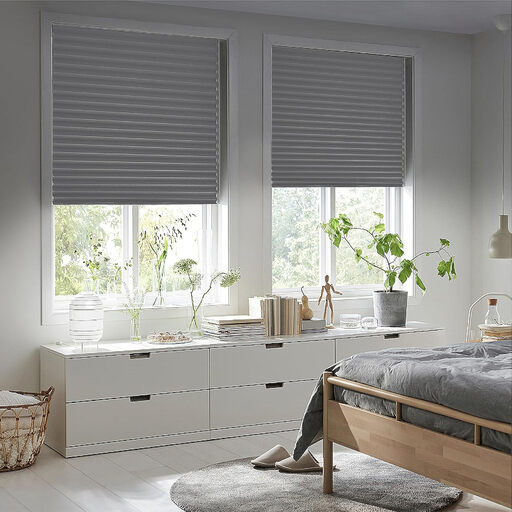
Why it's a great fit: Ideal for renters or for first-time use in a new home. It offers a functional and affordable solution for standard windows without compromising on easy installation.
The product description includes a clear measurement guide (glass width + 4 cm), which helps avoid the common mistake of inaccurate measurements. It comes with both clamp and adhesive brackets, offering flexibility during installation.
The blind is infinitely adjustable, and the moisture-resistant polyester fabric is easy to clean. The combination of clamp and adhesive options makes it highly versatile.
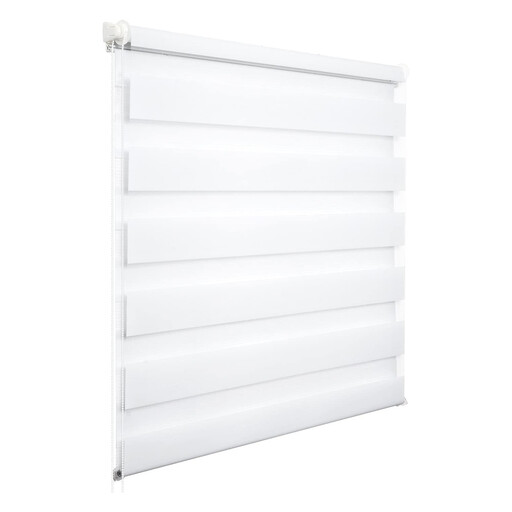
Why it's a great fit: Perfect for living rooms or home offices where lighting conditions need to be adjusted throughout the day. The dual-roller principle offers maximum control over light and privacy.
It solves the problem of misleading fabric descriptions by combining two fabric types. You can seamlessly switch between transparent and opaque, so you don't have to commit to a single level of light filtering.
The alternating transparent and opaque fabric panels allow for precise control of light. Installation is drill-free thanks to clamp brackets suitable for frame thicknesses of 13-23 mm.
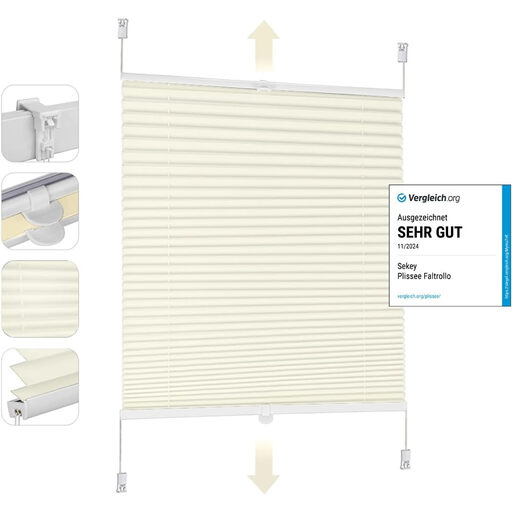
Why it's a great fit: Specifically designed for narrow windows or glass doors where a robust and reliable hold is crucial. The clip-fix system is engineered for durability and ease of use.
This product addresses the concern of unstable brackets. The system, explicitly named "Clip-Fix," indicates a stable clamping mechanism designed for daily use on doors and windows.
The opaque fabric provides reliable privacy and sun protection. The simple installation and robust construction make it a durable solution for frequently used windows and doors.
We have compiled a comprehensive, up-to-date list of products that fully meet these strict selection criteria and quality standards.
1. How securely does a no-drill pleated blind really hold? A high-quality clamp-fit pleated blind system holds very reliably. The clamp brackets are tightened firmly onto the window sash, keeping the blind securely in position even with daily opening and tilting of the window. With adhesive systems, durability depends critically on surface preparation: it must be absolutely clean, dry, and free of grease.
2. Can a clamp-fit pleated blind be attached to a wooden window? This is often not recommended. Most clamp brackets are designed for the standardised profiles of uPVC windows. With wooden windows, the frame shape may differ, and the surface could be damaged by the pressure of the clamps. Some manufacturers explicitly state in their product descriptions that their systems are not suitable for wooden windows. Always check this before purchasing.
3. How do you clean a no-drill pleated blind? Most pleated blind fabrics are made of polyester and are easy to care for. As a rule, it is sufficient to dust them regularly with a soft brush or a feather duster. For light stains, the fabric can be gently dabbed with a slightly damp cloth. Avoid harsh rubbing or the use of aggressive cleaning agents, as this could damage the fabric.