
Lieferung heute & morgen

Qualitätsgarantie

Willkommens-Angebote freischalten: KOSTENLOSE Lieferung | Bis zu 80 % RABATT | Kostenlose 30-Tage-JoyPlus-Testphase
App herunterladen
As summer temperatures rise, the desire for a cool breeze at home grows stronger. A portable air conditioner promises quick relief, but the market is overwhelming, and many units fail to live up to their advertising claims. As your Joybuy Product Recommendation Officer, I'm here to help you avoid the common pitfalls and make an informed decision.
Before you invest, you should be aware of the most common issues that can lead to disappointment and unnecessary costs.
quiet portable air conditioner can still be disruptive in daily use, especially in a bedroom.portable air conditioner with an exhaust hose must vent warm air outside. If the window is only tilted or an inadequate seal is used, warm outside air will continuously flow in. The unit then constantly battles the incoming heat, which drastically reduces its cooling performance and drives up electricity consumption.energy-saving air conditioner is therefore a smart long-term decision.To avoid these traps, focus on three objective metrics that determine a unit's performance and efficiency.
The cooling capacity indicates how effectively a unit can cool a room. It is specified in BTU/h (British Thermal Units per hour) or in Watts (W). As a rule of thumb for sizing a unit for your home, consider the following:
For example, a 9000 BTU air conditioner (equivalent to approx. 2600 W or 2.6 kW) is a common size for rooms of about 30 to 35 m?. Measure your room and choose a unit with a capacity that matches its size. Insufficient capacity leads to continuous operation without a satisfactory result, while excessive capacity consumes unnecessarily high amounts of energy.
The Energy Efficiency Class is shown on the EU energy label and ranges from A (very efficient) to G (inefficient). A Class A unit consumes significantly less electricity for the same cooling output as a Class C unit. Also, pay attention to the EER (Energy Efficiency Ratio). This value describes the ratio of cooling capacity provided to electrical power consumed. A higher EER value means better efficiency.
The noise level is crucial for comfort. The energy label specifies the sound power level in decibels (dB(A)). This value measures the total noise emission directly at the unit. For a real-world impression, the sound pressure level, which measures noise at a certain distance, is more relevant.
Look for models with a special sleep mode that reduces the fan speed and thus the noise level.
Here are some recommendations tailored to different needs and living situations.
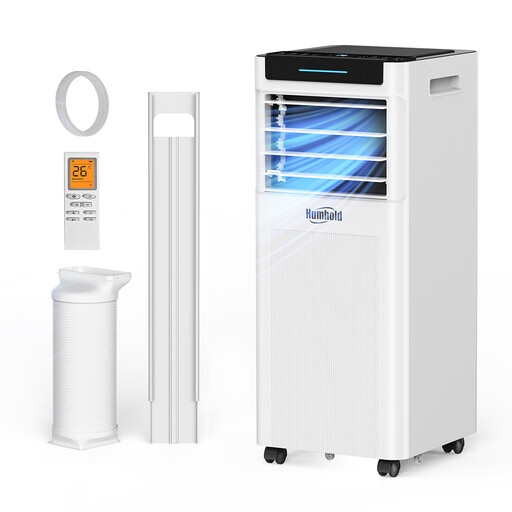
Why This Fits Their Persona: Ideal for users seeking a straightforward, budget-friendly solution for smaller rooms like bedrooms or home offices up to 28 m?. The unit focuses on the essential functions of cooling, dehumidifying, and ventilating.
Addresses the "whisper-quiet" trap with a dedicated sleep mode that operates below 49 dB, according to the manufacturer. The included window kit helps close the efficiency gap.
Its compact design and low weight (19.7 kg) make it highly mobile. The self-evaporating system reduces the need to manually empty the water tank.
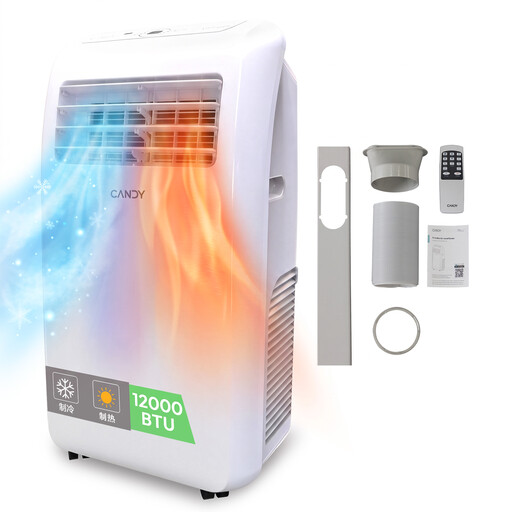
Why This Fits Their Persona: Perfect for users looking for a versatile, year-round solution. With cooling, heating, dehumidifying, and fan functions, this unit is useful not only in summer but also during the transitional seasons and winter.
Directly counters the cost trap: Its A+ energy efficiency class in both cooling and heating modes ensures controlled operating costs. The 4-in-1 functionality maximizes the return on investment.
The integrated air conditioner with heating function (3.3 kW) eliminates the need for a separate heater. The high air circulation of 400 m?/h ensures rapid and even temperature control in the room.
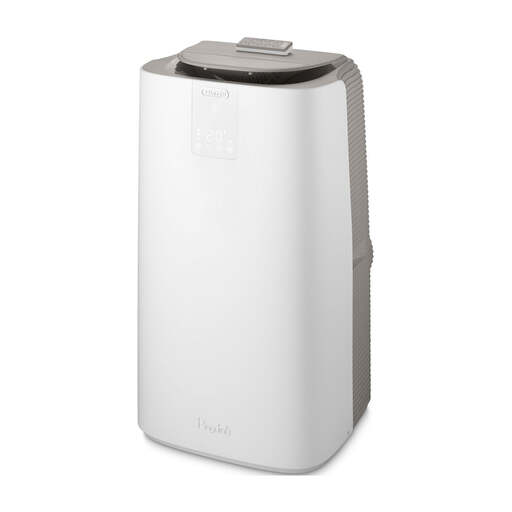
Why This Fits Their Persona: Designed for users who need to effectively cool large living areas up to 110 m? (approx. 40-45 m?) and value high efficiency and advanced technology.
Sidesteps the efficiency trap with Eco Real Feel technology, which automatically adjusts temperature and humidity to optimise energy consumption. Its A+ energy efficiency class and high EER of 3.3 minimise running costs.
The high cooling capacity of 11,000 BTU/h (3.0 kW) ensures rapid cooling. According to the manufacturer, the Silent Technology reduces the sound pressure level to 41–47 dB, which is remarkable for a unit of this power class.
We've compiled a full, up-to-date list of products that fully meet these strict selection criteria and UK safety regulations.
1. How much does it cost to run a portable air conditioner? The cost depends on the power consumption (in kW), the energy efficiency class, and the duration of use. For example: A unit with 1 kW of power consumption (1000 W) and energy class A uses about 1 kilowatt-hour (kWh) per hour. With an electricity price of 35p/kWh, one hour of operation would cost 35 pence. An energy-saving air conditioner with class A+ will consume correspondingly less for the same cooling output.
2. Are portable air conditioners without an exhaust hose a good alternative? Units without an exhaust hose are not true air conditioners but evaporative air coolers. They cool the air by evaporating water (evaporative cooling). Their cooling effect is significantly lower, and they increase the humidity in the room, which can feel unpleasant in muggy weather. For a noticeable reduction in room temperature, a portable air conditioner with an exhaust hose is the technically superior solution.
3. How important is the included window kit? The window kit is crucial for efficiency. It seals the gap in the open window through which the exhaust hose is routed. A good seal prevents warm air from outside from re-entering the room. Without such a seal, the unit operates inefficiently and consumes unnecessarily high amounts of electricity. Make sure the kit is compatible with your window type (sliding or casement).