
Lieferung heute & morgen

Qualitätsgarantie

Willkommens-Angebote freischalten: KOSTENLOSE Lieferung | Bis zu 80 % RABATT | Kostenlose 30-Tage-JoyPlus-Testphase
App herunterladen
As an electric car owner without a permanently installed wallbox, you face a key question: How can you charge your vehicle safely and reliably at home or on the go? A portable Type 2 Schuko charging cable, often called an emergency charging cable or "charging brick," is the standard solution. However, the market is crowded, and not every product lives up to its promises.
Many buyers invest in a device that later proves to be impractical or even unsafe. The most common pitfalls are quickly identified:
An informed approach to selection protects you from these pitfalls and ensures you get a long-lasting, functional, and safe charging solution.
To find a suitable portable EV charger, you should carefully examine three core technical parameters. These determine the safety, compatibility, and user-friendliness of charging your EV from a domestic socket.
A portable charging cable is an active safety device. The most important component is the Residual Current Device (RCD). For charging electric vehicles, an all-current sensitive RCD is required, which detects both alternating (AC) and pulsating direct fault currents (DC). Look for the specification RCD Type A (30mA) + 6mA DC. This combination ensures that even the smallest fault currents, which can originate from the vehicle's battery, are reliably detected. Additionally, temperature monitoring in the Schuko plug and in the charging electronics (the "charging brick") is essential to prevent overheating under continuous load.
A portable charging cable for Schuko sockets typically delivers a maximum charging power of 3.7 kW. This corresponds to a charging current of 16 amps (A) at 230 volts. However, not all household sockets are designed for a continuous load of 16A, especially in older buildings. Models with adjustable amperage (e.g., 8A, 10A, 13A, 16A) offer significant advantages here. They allow you to adapt the charging power to the conditions of the electrical installation, thus preventing an overload of the circuit.
The right cable length depends on your individual parking situation. A 10m Type 2 charging cable is a good compromise of reach and manageability for most use cases in garages or on private parking spaces. Those who regularly rely on public parking or spaces in multi-family housing will benefit from longer versions. A charging cable with a timer is another useful feature. It allows you to schedule charging for nighttime hours to take advantage of cheaper off-peak electricity tariffs and reduce your electricity bill.
Based on the criteria mentioned, we have identified several products suitable for different user groups.
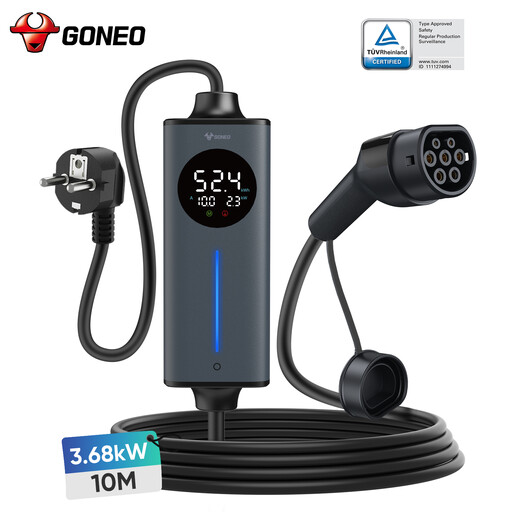
Why it's a great fit: The 10-metre version offers an excellent compromise for daily charging at home in the garage or on a dedicated parking spot. The length is sufficient for most parking situations without being unwieldy.
This charger features integrated RCD protection (30mA AC + 6mA DC) and temperature monitoring. This systematically eliminates the typical safety risks found in cheaper models.
The combination of adjustable amperage, a timer function, and a universally suitable 10-metre cable length makes it a flexible and safe all-round solution.
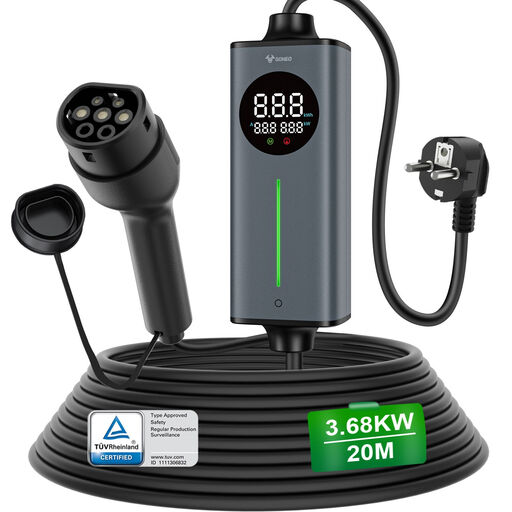
Why it's a great fit: Ideal for renters in apartment buildings or travellers who often face distant power outlets. The 20-metre reach reliably bridges even long distances.
It solves the problem of insufficient reach without compromising on safety. All safety features are identical to those of the shorter models, which is not a given for very long cables.
The maximum reach of 20 metres offers a level of charging flexibility that is unattainable with standard cables. The robust cable is designed for frequent mobile use.

Why it's a great fit: This 8-metre version is a sensible choice for users whose parking space is in close proximity to a socket and who do not require excessive cable length.
It offers the full safety package, including RCD and temperature monitoring, at an attractive price by forgoing the cost of an extra-long cable. This means savings are made on features, not on safety.
A fully-featured and safe Schuko to Type 2 charging cable that meets all standards. The adjustable amperage ensures compatibility even with weaker power grids.
For added security in your charging infrastructure, we have curated a selection of products that meet strict selection criteria and rigorous safety standards.
1. How safe is it to charge an EV from a standard domestic socket? Charging from a Schuko socket is safe, provided a high-quality portable charger is used. Integrated safety features are crucial, such as an all-current sensitive Residual Current Device (RCD Type A + 6mA DC) and temperature monitoring in the plug. Furthermore, the socket should be in perfect condition and inspected by a professional if there are any doubts about the home installation's load capacity.
2. How long does it take to charge my EV with a portable charging cable? The charging time depends on your vehicle's battery capacity and the charging power. At a maximum power of 3.7 kW (16A), you can add about 3.7 kilowatt-hours (kWh) of energy per hour. To charge a 40 kWh battery from 20% to 80% (i.e., to add 24 kWh), the process would take approximately 6.5 hours (24 kWh / 3.7 kW). At a reduced charging current (e.g., 10A, approx. 2.3 kW), the charging time will be extended accordingly.
3. Can I use a portable charging cable outdoors in the rain? Yes, most portable chargers are designed for outdoor use and have an appropriate IP rating (e.g., IP66 for the control box, IP54 for the plugs). This means they are protected against dust and powerful water jets. Nevertheless, the Schuko plug and the socket should be shielded from direct rain. The connection between the charging cable and the vehicle (Type 2 plug) is waterproof when plugged in.