
Lieferung heute & morgen

Qualitätsgarantie

Willkommens-Angebote freischalten: KOSTENLOSE Lieferung | Bis zu 80 % RABATT | Kostenlose 30-Tage-JoyPlus-Testphase
App herunterladen
A pressure washer can clean vehicles, patios, garden furniture, fences and driveways considerably faster than a garden hose. However, the bar figure shown on the packaging is not the only factor that matters when choosing one. What is crucial is whether the pressure, water flow rate, power supply, hose length and accessories suit the intended use.
An advertised figure such as 180 Bar generally describes the maximum possible pressure. For practical cleaning, the actual working pressure, flow rate in litres per hour and the right nozzle are also important. A highly concentrated water jet can damage delicate paintwork, grouting or wooden surfaces.
For a vehicle or garden furniture, a finely adjustable nozzle is often more important than the highest possible peak figure. Higher pressure can be useful for heavily soiled driveways or robust stone surfaces, provided the surface is suitable for it.
A pressure washer with accessories can be more versatile, but not every attachment is suitable for every surface. A surface cleaner makes it easier to treat a patio evenly. A rotating nozzle concentrates the water jet and should be used from a safe distance. A foam sprayer distributes cleaning solution, but does not replace the subsequent rinsing process.
Make sure that the accessories are actually included in the package and check whether connectors and replacement parts are available.
A cordless pressure washer does not depend on a power socket and is suitable for camping, balconies, bicycles or washing your car while out and about. Compared with an electric pressure washer connected to the mains, however, its runtime is limited by battery capacity and charging time. For larger areas, a mains-powered appliance with a continuous power supply may be more practical.
Pressure is measured in Bar, while the water flow rate is given in litres per hour. Both figures should be considered together:
A 180 Bar pressure washer may be suitable for many outdoor surfaces, provided the pressure can be controlled at the gun or nozzle. For car paintwork, tyres, wood and grouting, first test the jet from a greater distance on an inconspicuous area.
An electric pressure washer requires a suitable socket and should only be operated with a connection suitable for outdoor use. Cables, plugs and extension leads must be protected from splashing water.
Portable cordless pressure washers can sometimes draw water from a bucket, container or another clean source. Before buying, check:
A long high-pressure hose expands your working area and often reduces the need to reposition the appliance. An 8-metre hose length can be particularly practical for driveways, patios or vehicles. An integrated hose reel helps with storage and reduces the risk of kinks.
Also consider the wheels, carrying handle, appliance dimensions and weight. A portable pressure washer should be easy to move around your own property without the hose constantly catching on things.
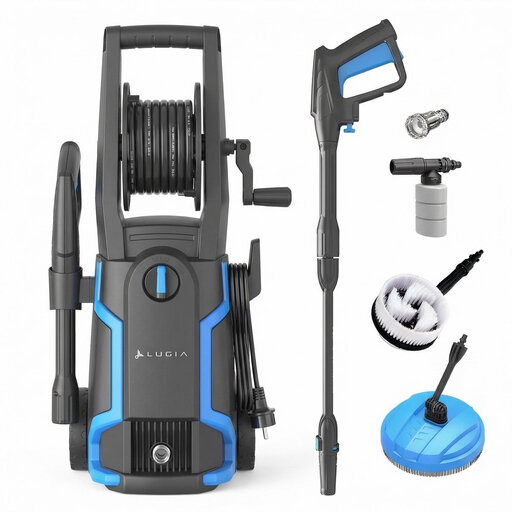
Why this product suits this profile: This mains-powered model is designed for households that want to clean cars, patios, garden furniture and fences with one appliance.
The working pressure can be adjusted using the adjustable nozzle. This means that not every surface has to be cleaned with the same jet intensity.
135 Bar, 430 l/h, 5-metre hose, plus patio cleaner, rotating brush, turbo nozzle and external foam gun.
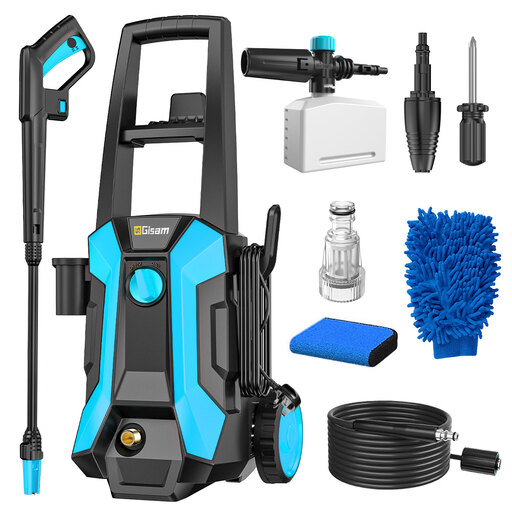
Why this product suits this profile: For regular work on driveways, patios, fences and vehicles, this appliance provides clear performance and feature specifications.
The specified flow rate is stated alongside the pressure. This makes it easier to assess the performance than by looking at the bar figure alone.
2200-watt motor, 180 Bar, 480 l/h, 8-metre high-pressure hose, hose reel and foam sprayer.
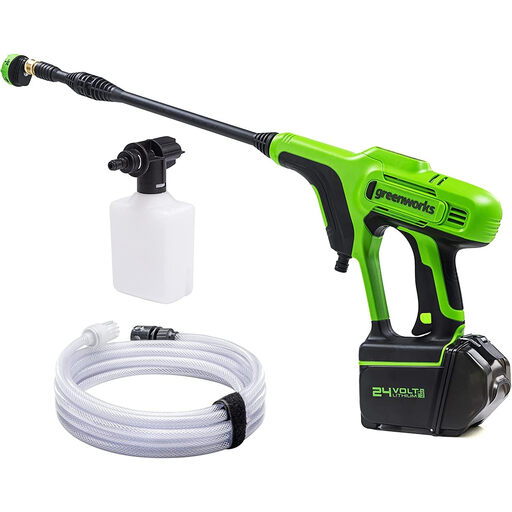
Why this product suits this profile: The compact cordless design is suitable for bicycles, balconies, garden furniture and locations without a fixed water or power connection.
With a pressure of 24 Bar, it is better suited to more delicate tasks than an appliance designed for heavy-duty stone surfaces.
24 Bar, 180 l/h, 5-in-1 nozzle, 6-metre suction hose and water drawn from a clean source.
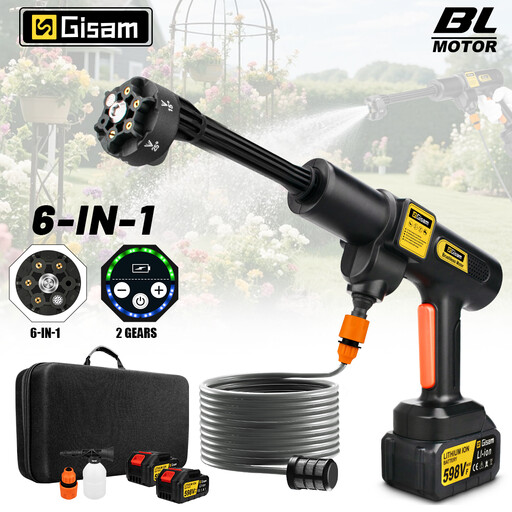
Why this product suits this profile: For vehicle care, camping and gardening, the cordless design offers flexible water collection from a bucket, cistern or another suitable source.
The pressure can be adjusted from 25 to 65 Bar. This lets you switch between gentler and more powerful applications.
Two batteries, 6-in-1 nozzle, foam sprayer, 5-metre hose, water filter and storage bag.
We have put together a complete, regularly updated list of products that fully meet these strict selection criteria and the safety regulations applicable in the EU.
The water jet from a pressure washer can cause injuries and damage surfaces. Never aim it at people, animals, sockets or electrical appliances. When washing a car, the jet should not be directed straight at seals, bearings, tyre sidewalls or damaged areas of paintwork.
After each use, rinse the hose, nozzle and filter with clean water. Drain any remaining water before periods of frost, as freezing water can damage the pump and pipes. Cleaning products must be suitable for both the appliance and the surface. The information on electrical safety, mains connections and personal protective equipment in the relevant instruction manual takes precedence.
For washing a car, an appliance with adjustable pressure, a wide nozzle and an optional foam sprayer is a sensible choice. Start from a distance and with low intensity. A pressure washer with 180 Bar should not automatically be used on paintwork at maximum pressure.
Running costs depend on electricity consumption, usage time, the price of water and the cleaning product used. A 2200-watt appliance theoretically consumes 2.2 kilowatt-hours when running at full load for one hour; in normal operation, however, the pump does not necessarily run continuously at full power. Cordless appliances also incur charging losses and require replacement batteries depending on the model.
That depends on its design. Models with a suction hose or filter are designed for this, provided the water source is clean and free from sand or coarse particles. An appliance without a corresponding suction function should only be operated using the designated water supply. Before buying, check the manufacturer's information on the water source, filter and maximum suction height.