
Lieferung heute & morgen

Qualitätsgarantie

Willkommens-Angebote freischalten: KOSTENLOSE Lieferung | Bis zu 80 % RABATT | Kostenlose 30-Tage-JoyPlus-Testphase
App herunterladen
A high-quality ratcheting wrench set is a fundamental investment for professional mechanics and ambitious DIY enthusiasts. It boosts efficiency, especially when working in tight spaces like engine bays or on industrial machinery. However, the market is flooded with options, and the differences in quality often only become apparent during real-world use. This guide highlights the critical features that separate a durable set from a useless one, helping you make an informed decision.
Before choosing a set, it's crucial to understand the typical weaknesses often hidden behind marketing promises. These three points frequently lead to frustration and unnecessary expense.
To avoid the pitfalls mentioned above, you should base your selection on objective technical features. The following three parameters are crucial for the performance and longevity of a ratcheting wrench set.
The material is the foundation of any durable tool. Look explicitly for the Cr-V steel specification. This alloy provides the necessary toughness and hardness to withstand high torques without deforming. Additionally, the manufacturing process is relevant: drop-forged and heat-treated wrenches offer superior structural integrity compared to cast alternatives. A chrome-plated and polished surface not only protects against corrosion but also makes it easier to clean off oil and grime.
The core of any ratcheting wrench is its mechanism. A standard for high-quality tools is a ratchet with 72 teeth. This allows for a minimal swing arc of just 5 degrees.
A fine-toothedratcheting combination wrench set is therefore not a luxury, but a necessity for efficient work.
A practical set covers the most common metric sizes without any gaps. For most applications in automotive and workshop settings, a range from 8 mm to 19 mm has become standard. A sturdy professional tool case or a tool roll is also a mark of quality. It not only protects the tools during transport but also ensures order and quick access through clear size markings.
Based on the quality criteria mentioned, we have identified several products suitable for different user profiles.
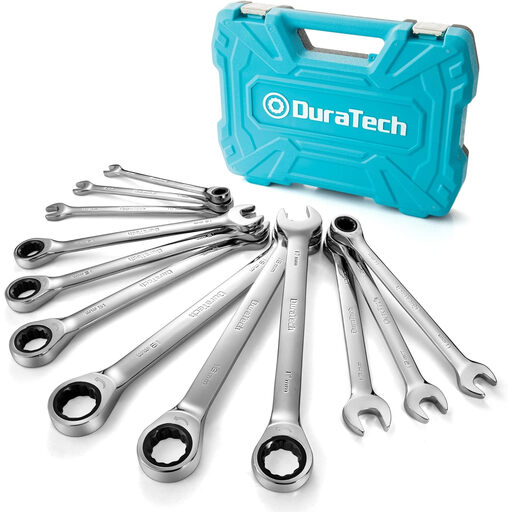
Why this set is a match: This set provides a solid foundation for any workshop. It covers the most common fastener sizes in automotive and home use, combining proven materials with a field-tested mechanism. Ideal for users seeking a reliable and complete set for regular maintenance and repair work.
According to the manufacturer, the set is made of Cr-V steel and features a 72-tooth ratchet. This avoids the typical weaknesses of inferior materials and coarse mechanisms. The sizes from 8 to 19 mm are included without any gaps.
Comprehensive size range (8-19 mm) in an organized storage case. The 5° swing arc is sufficient for most applications.
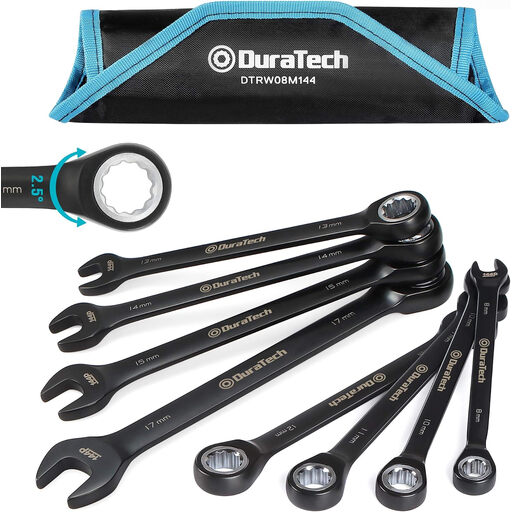
Why this set is a match: This set is aimed at professional users who regularly work in extremely confined environments. The ultra-small working angle makes it a specialized tool for complex repairs on modern vehicles or industrial plants where standard ratchets reach their limits.
With a 144-tooth ratchet, this set surpasses the common standard and specifically addresses the problem of an overly large swing arc. The material is also Chrome Vanadium steel, according to the manufacturer.
Extremely small 2.5-degree swing arc for maximum efficiency. The included tool roll allows for compact and organized storage.
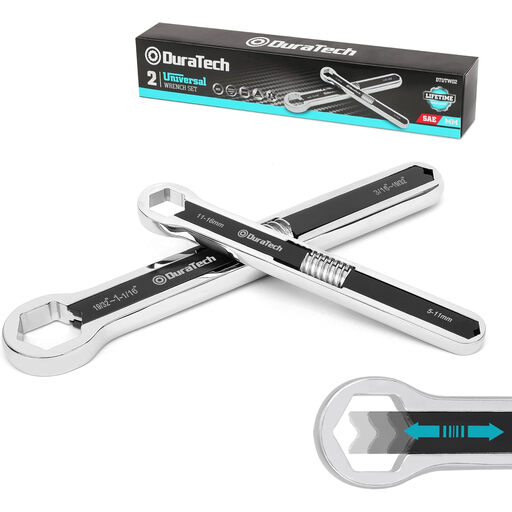
Why this set is a match: This set is an alternative for users who need maximum flexibility with minimal luggage. Instead of a case with many individual wrenches, it offers two adjustable tools that cover a wide range of metric and imperial sizes. Ideal for mobile jobs or as a supplement to your toolbox.
This set bypasses the problem of missing wrench sizes by being infinitely adjustable. It adapts to various fastener types, including 6-point, 12-point, and even E-Torx, which increases its compatibility.
Two wrenches cover a wide range from 5 mm to 27 mm. The design allows for use on various fastener head shapes.
We've compiled a complete, up-to-date list of products that fully meet these strict selection criteria.
The main difference lies in the swing arc. A 72-tooth ratchet requires 5° of movement to engage the next tooth, while a 144-tooth ratchet needs only 2.5°. In practice, this means that with a 144-tooth ratchet, you can still tighten or loosen a bolt even when you can barely move the wrench handle. For extremely tight spots, like next to a radiator or deep in an engine bay, this difference can be decisive.
Although Chrome Vanadium steel is corrosion-resistant, basic care is recommended for a long service life. Wipe the tools with a clean, dry cloth after use to remove moisture, oil, and dirt. Store the set in a dry place, ideally in the case provided. The ratchet mechanism should not be overloaded or used as a hammer. Occasional cleaning of the mechanism with compressed air can remove dust and particles.
An offset, meaning a slight angle of the box end relative to the shaft, is often advantageous when working on vehicles. It creates extra clearance for your fingers and makes it easier to work on flat surfaces or with recessed bolts without scraping your knuckles. Many high-quality combination and ratcheting wrenches come standard with a slight offset of about 15 degrees, which provides a good compromise between accessibility and power transmission.