Keeping an eye on sugar
You’d like to have rusks with your coffee and compare the stated sugar content per 100 g. A claim such as ‘no added sugar’ alone isn’t enough to help you decide.


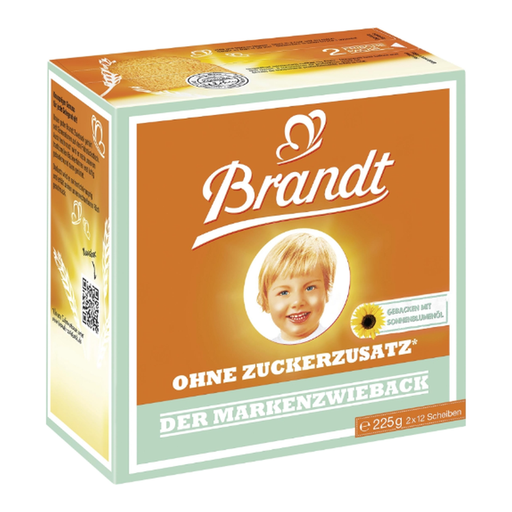
If you’re looking for rusks with the lowest stated sugar content for your coffee break, compare the ‘of which sugars’ figure per 100 g rather than relying on front-of-pack claims alone. REWE lists 4.5 g of sugar per 100 g for Brandt Original Rusks with no added sugar, while Praum lists 2.4 g per 100 g for its wholegrain rusks with no added sugar. If avoiding lactose is your priority, Brandt lactose-free Original Rusks are another option; Combi lists 9.3 g of sugar per 100 g and says they contain 30% less sugar than classic Brandt Original Rusks.
You’d like to have rusks with your coffee and compare the stated sugar content per 100 g. A claim such as ‘no added sugar’ alone isn’t enough to help you decide.
You’re specifically looking for lactose-free rusks and also checking the sugar content. A ‘less sugar’ claim doesn’t automatically mean the lowest figure across different products.
You’d like wholegrain rusks with no added sugar for your coffee break. As well as sugar and fibre per 100 g, you check the ingredients and allergen information.
First decide whether the stated sugar content, lactose-free status or wholegrain ingredients matter most to you. Then compare suitable packs using their nutrition information and ingredients.
| Criteria | What to check | Who it matters to |
|---|---|---|
| Sugar content | Compare ‘of which sugars’ per 100 g for similar rusks. Also check the ingredients list and, for ‘less sugar’ claims, which product is used for comparison. | For my morning coffee, I want to choose rusks whose stated sugar content I can compare with other varieties. Around 50% of consumers put sugar content first when making this choice. |
| Lactose-free | Look for an explicit lactose-free label and check sugar content, ingredients and allergen information separately. | If I want to avoid lactose, this matters more to me than finding the lowest sugar content in the range. Around 30% of consumers prioritise lactose-free products. |
| Wholegrain | Check the grain ingredients, sugar and fibre per 100 g, and the allergen information. | For my coffee break, I’m mainly looking for a wholegrain option with no added sugar, and I want to be able to make sense of its nutrition information. Around 20% of consumers make this their first priority. |
A percentage comparison refers to a particular comparison product, not every type of rusk. Lebensmittelklarheit also explains that the claim relates to sugar, not total carbohydrates.
Compare the ‘of which sugars’ figure per 100 g and check what the product is being compared with.
Rusks with no added sugar can still contain sugar: REWE lists 4.5 g of sugar per 100 g for Brandt Original Rusks with no added sugar.
Check the ingredients list to find out what’s in the recipe, and the nutrition information for the stated sugar content.
The Brandt lactose-free Original Rusks described by Combi still contain wheat, barley malt extract and soya.
For every variety, check the full ingredients and allergen information, including any possible traces.
ALDI SÜD notes that GOLDÄHREN rusks may come from different suppliers, so the nutrition information can vary.
If sugar content or ingredients will determine your choice, check the information on the specific pack.
The Brandt rusks mentioned here mainly differ in whether they’re made with no added sugar or are lactose-free.
Praum makes wholegrain rusks with no added sugar for people who prefer a wholegrain recipe with their coffee.
The 450-g pack of GOLDÄHREN rusks listed by ALDI SÜD is a useful comparison with classic rusks, but it isn’t evidence of a reduced-sugar variety.
This product selection features wholegrain rusks with no added sugar to enjoy with coffee. To compare the actual sugar content and grain ingredients, check the information on the pack.
 No image available
An option to enjoy with coffee if you’re looking for wholegrain rusks with no added sugar. Before buying, compare the sugar content per 100 g and, if needed, check the wholegrain content and the ingredients and allergen information on the pack.
No. ‘No added sugar’ doesn’t mean the product contains no sugar. REWE lists 4.5 g of sugar per 100 g for Brandt Original Rusks with no added sugar. You’ll find the figure for another variety in its nutrition information under ‘of which sugars’.
Combi bases this claim on classic Brandt Original Rusks and lists 9.3 g of sugar per 100 g for the lactose-free variety. As Lebensmittelklarheit explains, the percentage comparison relates to sugar, not total carbohydrates. When choosing between different varieties, also compare their actual figures per 100 g.
Of the manufacturer and retailer figures listed here, Praum gives the lowest figure for its wholegrain rusks with no added sugar: 2.4 g of sugar per 100 g. REWE lists 4.5 g for Brandt with no added sugar, Combi lists 9.3 g for Brandt lactose-free Original Rusks, and ALDI SÜD lists 14 g per 100 g for the GOLDÄHREN rusks shown. These figures apply to the specific varieties named, not to other products from the same brands.
Yes. Having no added sugar says nothing about allergens. For Brandt Original Rusks with no added sugar, REWE lists wheat and soya, as well as possible traces of egg, milk and sesame. For its wholegrain rusks, Praum lists wheat and possible traces of sesame. Check the information on the pack you intend to buy.