
Lieferung heute & morgen

Qualitätsgarantie

Willkommens-Angebote freischalten: KOSTENLOSE Lieferung | Bis zu 80 % RABATT | Kostenlose 30-Tage-JoyPlus-Testphase
App herunterladen
As a Joybuy Product Recommendation Officer, my role is to provide you with clear, objective information so you can make an informed purchasing decision. A functional Tire Pressure Monitoring System (TPMS) is critically important for the driving safety of motorhomes, trailers, and trucks. A sudden tire failure on the highway can have severe consequences. Yet, the market is flooded with products whose marketing promises often don't hold up in practice.
This guide focuses on the most common pitfalls and the key technical parameters you should check before buying.
Many buyers focus on price or cosmetic features like a color display, overlooking crucial technical flaws. These three mistakes often lead to disappointment and unnecessary expenses:
To avoid these mistakes, you should focus on the following technical specifications. They form the basis for a reliable tire safety system.
The most important parameter is the maximum pressure the system can monitor. Check the recommended tire pressure for your vehicle (found in the owner's manual or on the driver's side B-pillar) and choose a system whose measurement range significantly exceeds this value.
Also, pay attention to the number of included tire pressure sensors for your RV. Standard packages often contain only four sensors. For vehicles with dual-wheel setups on the rear axle or for tire pressure monitoring on the trailer, you will need six or more sensors.
Data is typically transmitted from the sensor to the monitor via a 433.92 MHz radio frequency. For vehicle lengths over 7 meters (23 feet), especially with trailers, the signal can be severely weakened by metal structures and distance.
A signal booster (repeater) is therefore not an option, but a necessity for a TPMS for caravans and large motorhomes. It is usually placed in the middle of the vehicle or at the rear of the towing vehicle and reliably forwards the signal from the rear sensors to the monitor. Systems that already include a repeater in the package have a clear advantage.
When retrofitting a TPMS, you have the choice between two types of sensors:
For most users, external sensors offer the best balance of functionality and convenience. For the monitor's power supply, there are models with a USB connection and those with an integrated solar panel. Solar-powered displays reduce cable clutter in the cockpit and are particularly practical on long trips.
Here are some product recommendations tailored to specific user profiles that meet the criteria mentioned above.
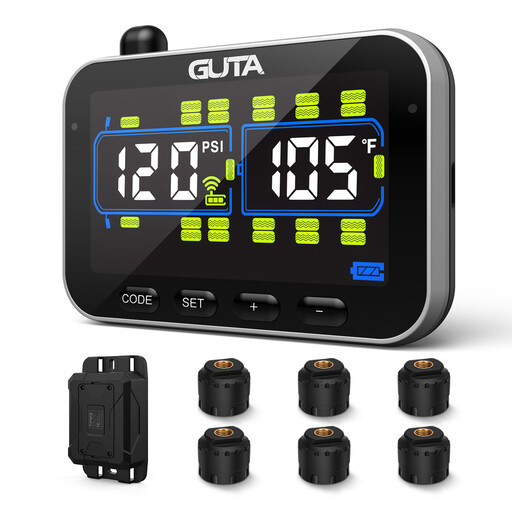
Why This Fits Their Persona: Ideal for large motorhomes and rigs with trailers. The high pressure range and included repeater ensure reliable monitoring, even for vehicle lengths over 10 meters (33 ft).
The monitoring range up to 13 Bar (188 PSI) is designed for heavy vehicles. The included repeater actively prevents signal loss, the most common failure on long rigs.
Large color display for excellent readability; system is expandable up to 24 tires; long sensor battery life (approx. 4 years according to the manufacturer).
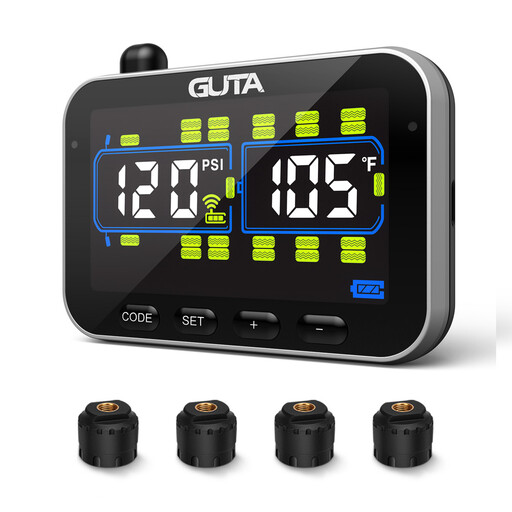
Why This Fits Their Persona: This system is designed for professional use in trucks and commercial vehicles. Its extremely high pressure range and expandability make it a future-proof investment for fleets.
Directly addresses the pitfall of an incompatible pressure range by monitoring up to 14 Bar (203 PSI). The ability to expand the system to 24 tires offers scalability that basic systems lack.
Professional-grade pressure range; suitable for long vehicles with a repeater (sold separately or in a kit); robust design for daily use.
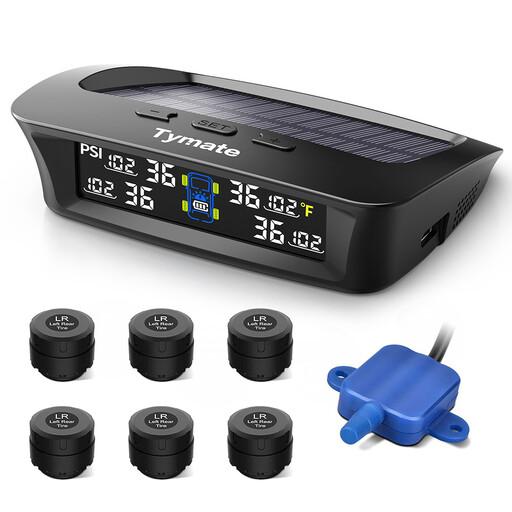
Why This Fits Their Persona: A practical solution for standard motorhomes, camper vans, and smaller rigs. The solar-powered display ensures a clutter-free cockpit and greater independence from the vehicle's electrical system.
Avoids hidden costs with easy-to-install external sensors that have replaceable batteries. The solar function reduces maintenance and reliance on charging cables.
Solar-powered display; 6 sensors for flexible use (e.g., for a trailer or spare tire); pressure range up to 6 Bar (87 PSI) is sufficient for most campers.
We have compiled a complete, up-to-date list of products that fully meet these strict selection criteria and safety regulations.
Yes, especially systems with external sensors are designed for easy DIY installation. The sensors are screwed onto the tire valves like valve caps. Pairing with the monitor is often done at the factory or completed in just a few steps. A trip to the workshop for retrofitting a TPMS is not necessary in this case.
The lifespan of batteries in external sensors varies by model and usage. Typically, they last between 2 and 4 years. When purchasing, make sure the batteries (usually coin cells like CR1632 or CR2032) are replaceable. This avoids the expensive repurchase of a complete sensor set.
External sensors typically weigh less than 10 grams. On the large, heavy wheels of an RV or truck, this added weight is so minimal that it usually does not cause a noticeable imbalance. Re-balancing the wheels after installing the sensors is not necessary in the vast majority of cases.