
Lieferung heute & morgen

Qualitätsgarantie

Willkommens-Angebote freischalten: KOSTENLOSE Lieferung | Bis zu 80 % RABATT | Kostenlose 30-Tage-JoyPlus-Testphase
App herunterladen
Self-adhesive mirror stickers are a practical option for rented homes, small rooms and quick DIY projects. They can be applied without a drill and help to break up the look of plain walls. However, they do not automatically replace a traditional glass mirror. Before buying, check the material, dimensions, adhesive surface and intended location.
Many products are made from PVC mirror film or a thin acrylic layer. These materials reflect light, but the image may be slightly distorted depending on the surface. For decorative purposes, light accents or visually dividing a room, this is usually sufficient. If you expect an accurate full-length or facial reflection, check the product description and customer images particularly carefully.
With multi-piece products, each individual measurement counts. For example, four square elements measuring 20 × 20 cm will not create a continuous surface if there is a gap between the pieces. With splicing mirror stickers, decide in advance whether the elements will be fitted flush together, with gaps, or in a pattern.
Adhesion depends on the surface, adhesive, temperature and contact time. On smooth, dust-free surfaces, removable mirror stickers generally adhere better than on textured wallpaper, porous plaster or freshly painted walls. Before installing a larger arrangement, it is advisable to test the product in an inconspicuous area. When removing it, work slowly and keep the sticker as parallel to the wall as possible.
PVC mirror stickers are often lightweight and flexible. They are suitable for decorative wall patterns and can be positioned easily on suitable surfaces. Acrylic mirror decoration may offer a more pronounced mirror effect, but it is still not a substitute for a heavy glass mirror. Look for a sufficiently flat backing and avoid products whose surface is already creased or scratched on delivery.
Before buying, compare these three details:
Individual decorative wall mirrors may be enough for small accent areas. Multi-piece sets are useful if you want to create a symmetrical wall design, a border or a geometric pattern.
Self-adhesive wall mirrors require a clean, dry, smooth and sound surface. Dust, grease and moisture can affect adhesion. For bathrooms, bathroom mirror stickers are only suitable if the installation area is not permanently exposed to splashing water, condensation or direct steam. Adhesion may work better on tiles than on textured walls; nevertheless, the specific surface should be tested.
For living rooms and bedrooms, living-room mirror stickers or bedroom mirror stickers are primarily suitable as decorative elements. In children’s rooms and busy areas, also make sure that the pieces are securely attached and have no sharp edges.
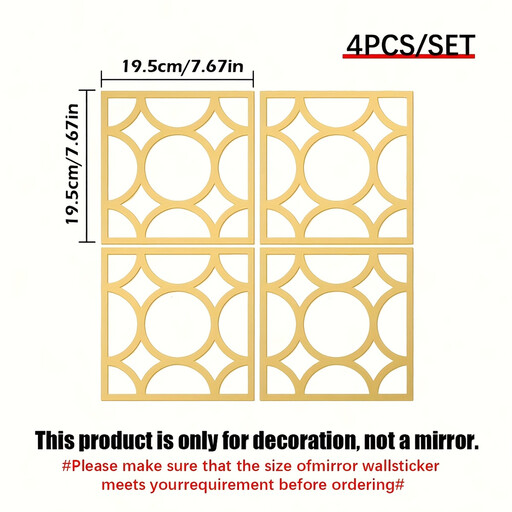
Why this product suits this profile: The set contains four square PVC elements, each measuring 19.5 × 19.5 cm, making it suitable for a clearly defined decorative area.
The individual size and number of pieces are clearly stated. This makes it easier to estimate the wall area required before buying.
Four pieces in a square shape with a floral pattern; according to the product description, they are made from PVC and designed for decorative arrangements.
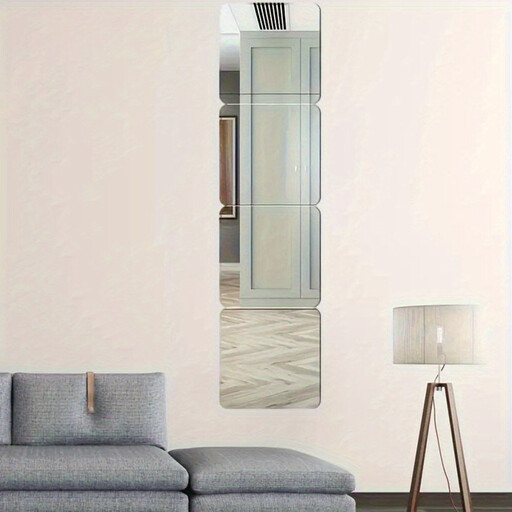
Why this product suits this profile: The four identical 20 × 20 cm squares allow you to create a planned, symmetrical wall design without drilling holes.
The product description specifies that the pieces can be arranged together and installed without drilling. Nevertheless, check the surface for flatness and adhesion beforehand.
Four identical square elements with defined dimensions; self-adhesive installation according to the product description.
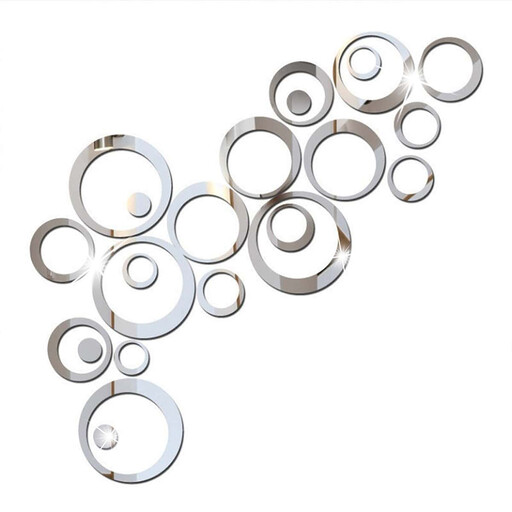
Why this product suits this profile: The pack of 24 pieces, in sizes from 3.5 to 13.8 cm, is designed for patterns, accent areas and flexible room decoration.
The different piece sizes reduce reliance on a single fixed format. For delicate walls, an adhesion test is still recommended.
24 PVC elements in several sizes and, according to the product description, a removable design for living rooms and bedrooms.
We have put together a complete, regularly updated list of products that fully meet these strict selection criteria and the safety regulations applicable in the EU.
This depends on the installation location and the individual product. Areas exposed to direct contact with water, high condensation or heavy steam can be problematic. Adhesion may be better on dry, smooth tiles. Check the product information carefully and carry out a test on a small area.
It is not possible to give a fixed lifespan that applies in every case. The key factors are the surface, room conditions, adhesive, cleaning and mechanical stress. Dusty walls, frequent moisture and significant temperature fluctuations can shorten the adhesive’s lifespan. If individual pieces begin to come loose, remove them rather than simply sticking new pieces over them.
Removal is often easier from smooth, properly prepared surfaces than from textured wallpaper or porous plaster. However, ‘removable’ is not a guarantee for every wall. Test the product first in an inconspicuous area and peel it off slowly rather than pulling it away abruptly.