
Lieferung heute & morgen

Qualitätsgarantie

Willkommens-Angebote freischalten: KOSTENLOSE Lieferung | Bis zu 80 % RABATT | Kostenlose 30-Tage-JoyPlus-Testphase
App herunterladen
An LED ceiling light should illuminate the room evenly, complement your interior style and work reliably day in, day out. But when choosing one, it’s not just about wattage and design. Vague brightness ratings, an unsuitable light colour or a fiddly installation can mean your new ceiling light ends up rarely used.
This buying guide explains which technical specs really matter before you purchase, and which models suit different living situations.
Wattage describes power consumption, not brightness directly. What counts is the luminous flux in lumens. A 24W ceiling light can appear differently bright depending on its design and light distribution. A model with 36W and 4,000 lumens is better suited to rooms where high visibility is needed.
Images in an online shop can be misleading due to screen and camera settings. Always check the specification in Kelvin:
A warm white ceiling light at 3,000K can provide a gentle, subdued glow in living rooms and bedrooms. A cool white ceiling light at 6,500K, on the other hand, is better suited to workspaces, reading nooks or rooms that need high brightness.
‘Dimmable’ doesn’t mean the same thing on every product. Some models have several fixed brightness levels, while others need a compatible wall switch or remote control. With a dimmable LED ceiling light, it should be clearly stated how the adjustment works.
For an LED ceiling light with a presence sensor, you also need to know the detection range, follow-up time and control options. If these details are missing, it’s worth checking the product information carefully before buying.
As a rough guide, the following values can help:
These figures are no substitute for a proper lighting plan. Dark walls, high ceilings and heavily shielded covers can all affect how bright the light actually feels.
The term energy-saving ceiling lamp shouldn’t be judged on LED technology alone. Compare wattage, lumens and energy efficiency class together. The Brilliant model with 24W, for example, is rated at 2,400 lumens and energy efficiency class F. That tells you far more than the wattage alone.
For living spaces, warm white light is usually preferred, while a cool white ceiling light can work well for focused tasks or high visibility. Also relevant is the colour rendering index (Ra or CRI), if the manufacturer provides it. A higher value makes colours appear more natural. For living rooms, kitchens and studies, clear manufacturer information on light colour and colour rendering is a good idea.
Measure the existing connection area before you buy and check the diameter of the light. A flat ceiling light is often a good choice for rooms with low ceilings. For dry indoor spaces, IP20 is the usual rating. Such a light is not suitable for damp rooms or outdoor use.
In the UK, electrical connection should be carried out by a qualified electrician. Before installation, also check the fitting instructions, wall plugs, screws and whether your ceiling is suitable.
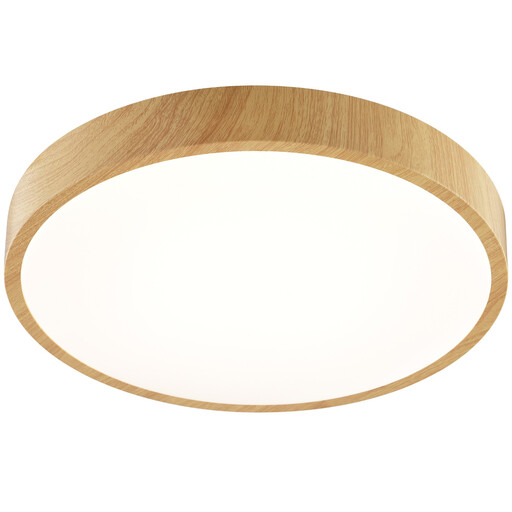
Why this product fits the profile: The 38.5 cm light combines 24W, 2,300 lumens and 3,000K warm white light. It’s designed for living rooms, bedrooms, hallways or dining areas and doesn’t require separate bulbs.
The product data clearly states luminous flux, colour temperature, power consumption and explicitly notes that the light is not dimmable. This lets you assess the features realistically before buying.
Integrated LED technology, warm white 3,000K light colour and a wood-effect finish in plastic.

Why this product fits the profile: This model offers 2,400 lumens, 3,000K warm white light and an integrated three-step dimmer with memory function. The stated FSC certification and wooden elements add to the design.
The dimming function is specifically described as three-step and operated internally. Buyers therefore won’t expect stepless control or automatic sensor operation.
Three-step dimming with memory function, 2,400 lumens and a natural wood look at 35 cm diameter.
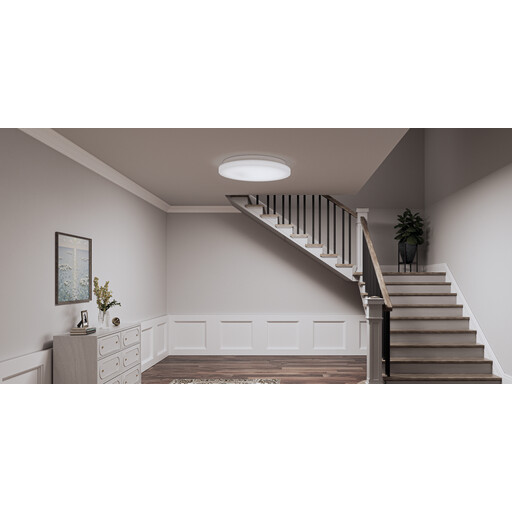
Why this product fits the profile: The product name indicates presence detection. This could be ideal for hallways, entrance areas or rooms where automatic activation is wanted.
Before buying, you should check the detection range, follow-up time, mounting height and possible settings. These details are crucial for the practical usefulness of a sensor.
Presence detection as per the product name and a ceiling light concept designed for indoor use.
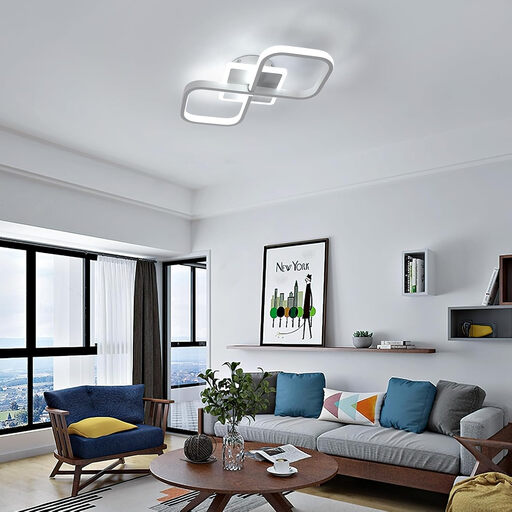
Why this product fits the profile: With 36W, 4,000 lumens and 6,500K, this ceiling light delivers cool white light for studies, reading areas or spaces that need high visibility.
The product description states both 4,000 lumens and 6,500K. This makes it clear upfront that the light effect will be noticeably cooler and brighter than a warm white room light.
36W power consumption, 4,000 lumens, acrylic cover and a stated LED lifespan of 50,000 hours.
We’ve put together a full, regularly updated list of products that meet these strict selection criteria and comply with all applicable EU safety regulations.
For a living room, depending on its size and any additional lighting, around 1,500 to 2,500 lumens is usually a good starting point. In large or darkly furnished rooms, a higher luminous flux may be needed. Also check whether the light distributes its output widely and evenly.
The stated lifespan depends on the specific product and operating conditions. One model, for example, quotes 50,000 hours. This is a manufacturer’s figure, not a guarantee of identical performance in every home. Heat build-up, switching frequency and the quality of the electronics can all affect the actual lifespan.
Running costs depend on power consumption, daily usage time and your electricity tariff. A simple calculation is: Wattage ÷ 1,000 × hours of use × price per kilowatt-hour. For a 24W light used for three hours a day, that works out at roughly 0.072 kWh per day. For a meaningful comparison, always look at wattage and actual usage time together.