
Lieferung heute & morgen

Qualitätsgarantie

Willkommens-Angebote freischalten: KOSTENLOSE Lieferung | Bis zu 80 % RABATT | Kostenlose 30-Tage-JoyPlus-Testphase
App herunterladen
Smart LED spotlights RGB+CCT combine coloured light with adjustable white light. Depending on how you use them, they can provide practical room lighting, decorative RGB ceiling spotlights or atmospheric accent lighting outdoors. Before you buy, it’s worth taking a closer look at the technology, installation and compatibility.
Not every RGB bulb produces usable white light. RGB refers to coloured light created by red, green and blue LEDs. For warm or cooler task lighting, a product also needs CCT LEDs. RGB+CCT lighting should therefore specify a clear white-light range, such as 2700 to 6500 Kelvin.
Without this information, it’s difficult to judge how the light will look in practice. Luminous flux, measured in lumens, is also important for living rooms, hallways and retail spaces. Colour alone tells you little about brightness.
A dimmable recessed LED spotlight with an IP20 rating is designed for dry indoor spaces. It isn’t suitable for open patios, damp cellars or areas where it may be exposed to splashing water. For paths, flowerbeds and driveways, you’ll need a solar LED ground-recessed spotlight with an appropriate outdoor protection rating.
The IP code indicates the level of protection. IP20 generally offers no protection against water. A product rated IP67 is protected against temporary immersion, provided you follow the installation instructions and the manufacturer’s specific guidance.
“App control” doesn’t automatically mean a bulb will work with every smart home system. Before you buy, check:
A Bluetooth Mesh LED spotlight can connect several lights together. However, some models require a compatible gateway for remote control beyond the direct Bluetooth range. If you’re choosing an Alexa-compatible LED bulb, also check how it connects to the relevant app.
A range of 2700 to 6500 Kelvin covers everything from warm white to daylight-style white. The RGB function provides coloured scenes. Luminous flux, measured in lumens, helps you compare brightness, while the CRI or Ra value describes colour rendering. The indoor lights featured here have a rating of Ra≥80.
Also consider the beam angle. At 120 degrees, the light spreads fairly widely, making it suitable for hallways, rooms and larger ceiling areas. A narrower beam creates more focused accents.
With a smart LED downlight, the ceiling cut-out needs to match the product. For example, one 9-watt downlight in this selection requires a cut-out of 120 to 130 millimetres. The stated cut-out for the 15-watt model is 150 to 160 millimetres. Don’t estimate these dimensions based only on the visible outer rim.
For existing light fittings, a GU10 smart LED spotlight is often easier to retrofit. Check the GU10 fitting, installation depth and ventilation. Some bulbs must not be used in fully enclosed fittings. Several smart products aren’t designed for use with a traditional wall dimmer, so you’ll need to adjust them using an app or voice assistant instead.
Consider the energy efficiency rating alongside actual power consumption. A low wattage doesn’t automatically mean the light will be bright enough. You can compare luminous flux, power and operating time when choosing a product.
A qualified electrician should install mains-powered recessed spotlights connected to 220–240 volts. Before working on the ceiling, switch off the power at the circuit breaker. Products rated IP20 should also be kept away from moisture and heat build-up.
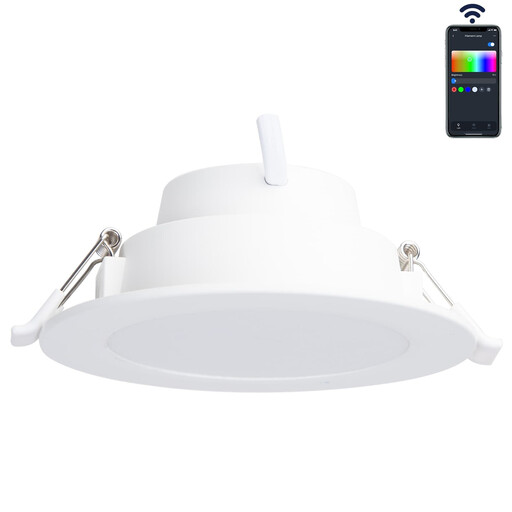
Why this product suits this profile: This 9-watt downlight is designed for smaller ceiling cut-outs of 120 to 130 millimetres and offers RGB as well as 2700 to 6500 Kelvin. It’s a good choice for individual rooms, hallways or gradually upgrading your lighting.
The specified cut-out size, IP20 rating and app control make the installation requirements clearer. According to the product information, it isn’t designed for use with an external wall dimmer.
780 lm, 120-degree beam angle, Bluetooth Mesh, dimming function and a stated standby power consumption of no more than 0.5 W.
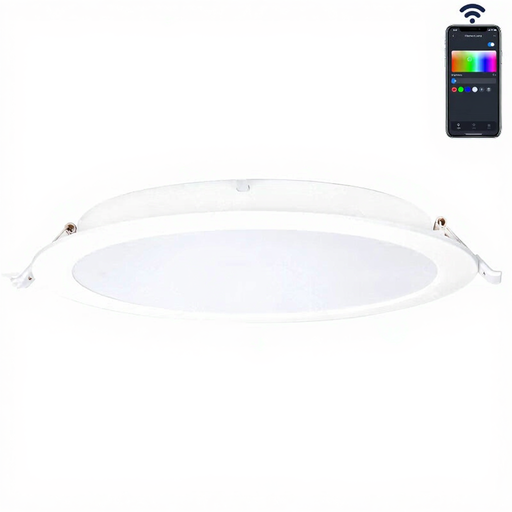
Why this product suits this profile: With 1760 lm, 18 W of power and a cut-out size of 200 to 220 millimetres, this model is designed for larger ceiling areas and brighter general lighting.
The technical specifications include luminous flux, colour temperature range, beam angle and installation dimensions. The IP20 rating clearly limits its use to dry indoor spaces.
1760 lm, Ra≥80, 120-degree beam angle, Bluetooth Mesh, plus dimming and CCT adjustment via the app or voice control.
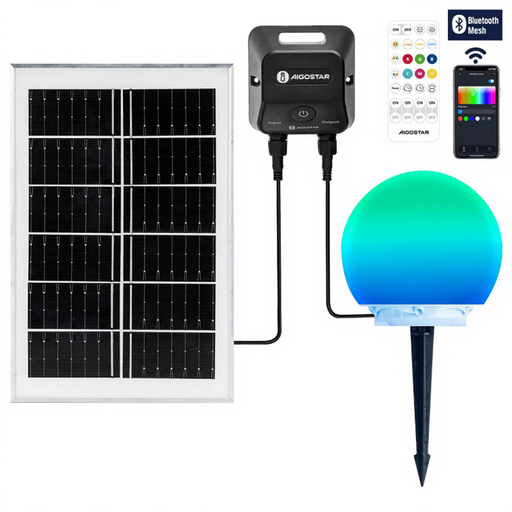
Why this product suits this profile: This solar-powered ground-recessed spotlight is designed for gardens, paths and patios. The separate solar panel makes it easier to position the light where it can get the most sun.
Its IP67 rating is more suitable for outdoor use than an indoor light with an IP20 rating. Actual lighting time depends on the charge level and exposure to sunlight.
20 W, RGB+CCT, Bluetooth Mesh, 4000-mAh battery, 5-W solar panel and stated connectivity for over 200 lights.
We’ve put together a complete, regularly updated list of products that meet these strict selection criteria and fully comply with the safety regulations in force in the EU.
For existing spotlights, a GU10 smart LED spotlight can make upgrading easier. According to the product information, the Aigostar GU10 model with Bluetooth Mesh offers brightness adjustment from 1 to 100 per cent, as well as RGB and 2700 to 6500 Kelvin. It’s designed for indoor use with an IP20 rating and isn’t suitable for traditional wall dimmers.
Another option is an LED Matter light strip. The 5-metre model listed supports RGBCCT, Wi-Fi and Matter. It can be cut at the marked points and controlled by app or voice. With an IP20 rating, it’s suitable only for dry indoor areas. For installation, use clean, smooth surfaces and the included power supply.
First, have the recessed spotlight installed correctly and then switch the power back on. Next, pair it using the specified app. Bluetooth Mesh models may also need a compatible gateway. The app, gateway and voice assistant must all meet the same compatibility requirements.
The product information for the indoor models featured here gives a lifespan of up to 30,000 hours, while the GU10 spotlight is rated for up to 25,000 hours. Actual lifespan depends on factors including operating time, ambient temperature, ventilation and correct installation.
Yes. Connected lights often need a small amount of standby power so they can receive commands from an app, gateway or voice assistant. The 9- and 18-watt models are listed as having a standby power consumption of no more than 0.5 W. Running costs also depend on wattage, daily operating time and your electricity tariff.