
Lieferung heute & morgen

Qualitätsgarantie

Willkommens-Angebote freischalten: KOSTENLOSE Lieferung | Bis zu 80 % RABATT | Kostenlose 30-Tage-JoyPlus-Testphase
App herunterladen
A storage jar with a wooden lid combines transparent storage with a natural look. Rice, pasta, flour, sugar, coffee, tea and spices can be stored visibly in your kitchen or pantry. However, not every model lives up to what product images and marketing promises suggest. That's why households should carefully check the seal, maintenance requirements and dimensions before buying.
A wooden lid alone does not automatically make a jar airtight. What matters is a silicone seal that sits evenly on the rim of the jar. If it's missing or doesn't fit correctly, air and moisture can get in more easily. This is particularly important for flour, sugar, muesli or spices.
Even a lid with a seal will only stay reliable if the jar rim and lid are clean and dry. Crumbs or damp residue can compromise the closure.
With many models, the glass body is dishwasher-safe, but the wooden lid is not. Wood should generally only be wiped with a slightly damp cloth and then dried. If you regularly clean several glass storage jars, you'll need to factor in this extra step.
Product specifications can also vary: one glass container with a wooden lid may be dishwasher-safe, while a similar-looking model may only be suitable for hand washing.
A tall, narrow jar uses shelf space differently from a square glass storage container. The litre measurement describes the usable volume, but not automatically the quantity of a particular food item. A litre of flour, rice or pasta can be more or less practical to remove depending on the fill height and shape.
Before buying, you should therefore compare height, width, depth and opening diameter with your intended storage space.
For an airtight storage jar, the combination of a well-fitting lid and an integrated silicone seal is crucial. Look out for the following points:
With wooden and acacia lids, the seal should be left to dry completely after cleaning. Do not use a storage jar for liquids if the manufacturer does not specify this.
A food storage container should be explicitly suitable for contact with food. For the models featured here, glass or borosilicate glass is specified. Borosilicate glass is mentioned for some products, but this does not replace the individual usage instructions.
Avoid extreme temperature changes, such as placing a hot jar directly into cold water. This can damage the glass. The microwave, oven or freezer should only be used if the product description clearly allows it.
The right size depends on the contents and how quickly you use them:
A square glass storage jar can often be placed side by side to save space. Round containers, on the other hand, can be more practical for narrow shelves or deep drawers. For a well-organised kitchen, it's a good idea to group similar containers by height or width and label the contents with the name and date of purchase.
The following selection categorises the models by capacity, material specifications, care requirements and typical use.
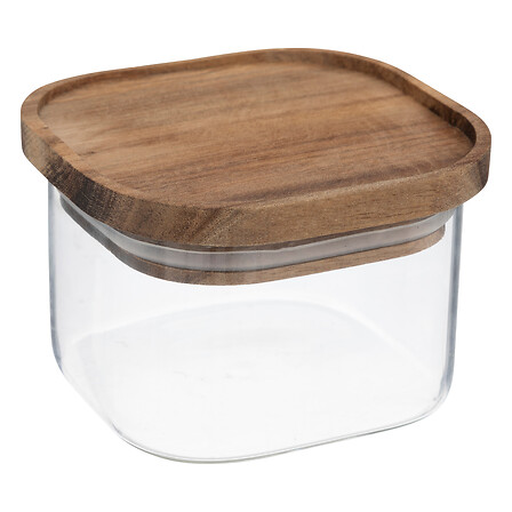
Why this product suits the profile: The compact square jar takes up little space at 11 × 11 × 7.4 cm and is ideal for small quantities of supplies, tea or spices.
The product details mention an acacia lid with a silicone seal and explicitly state hand washing only, as well as use for dry foods.
0.4 litre usable capacity, square shape, borosilicate glass and a permanently reusable concept according to the product description.
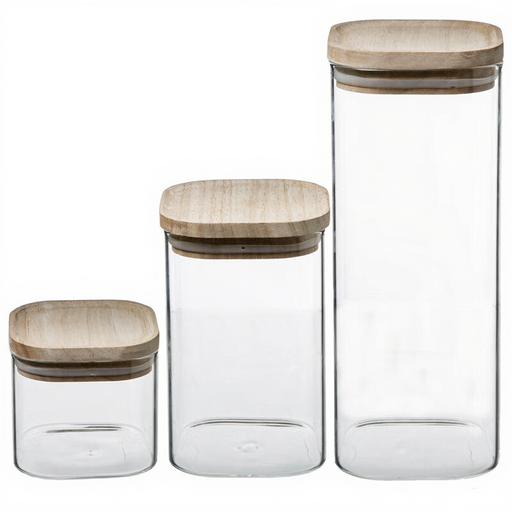
Why this product suits the profile: The set contains three containers, each with a 1 litre capacity, and is ideal for a coordinated kitchen organisation on the worktop or in the pantry.
The description mentions borosilicate glass, an integrated silicone seal and specific care instructions: glass is dishwasher-safe, wooden lid should be wiped by hand.
Three identical jars, 1 litre each, 10 cm diameter and 17.3 cm height according to the product data.
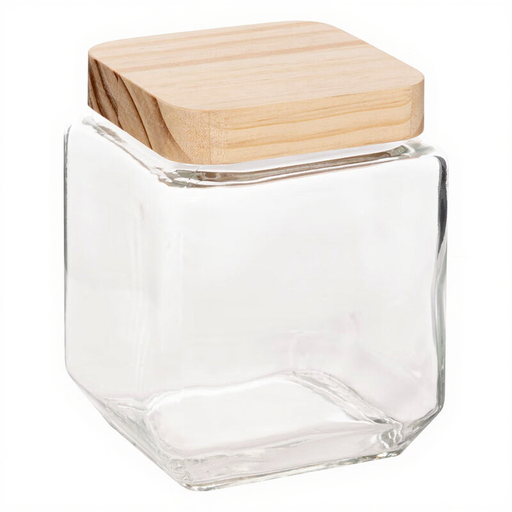
Why this product suits the profile: The 1.25-litre jar is aimed at households that want to store larger quantities of dry foods in a tidy, space-saving way.
The specifications mention an integrated silicone seal and provide separate care instructions: glass is dishwasher-safe, pine lid should be cleaned with a damp cloth.
Square dimensions of 20 × 10 × 10 cm, visible glass contents and 1.25 litre capacity.
We've put together a complete, regularly updated list of products that fully meet these strict selection criteria and the safety regulations in force in the EU.
To keep a glass container with a wooden lid usable for a long time, a few simple routines are worthwhile:
That depends on the design. A glass container with a silicone seal and a well-fitting lid can be designed to provide an airtight closure. Check the manufacturer's specifications and make sure the rim and seal are clean, dry and undamaged.
Not as a general rule. With many products, only the glass body is dishwasher-safe. Wooden or acacia lids should be wiped by hand according to the care instructions and kept dry. For models that require hand washing, this applies to the entire container.
For smaller quantities, 0.4 to 0.6 litres is often enough. For regular supplies, 0.75 to 1.25 litres is more practical. Alongside the volume, the opening is also crucial: it should be large enough to fill and remove the contents without spilling.