
Lieferung heute & morgen

Qualitätsgarantie

Willkommens-Angebote freischalten: KOSTENLOSE Lieferung | Bis zu 80 % RABATT | Kostenlose 30-Tage-JoyPlus-Testphase
App herunterladen
A 3/8-inch ratchet is a practical size for many jobs on cars, motorbikes and around the home. It accepts common sockets, is more manageable than a 1/2-inch version and can often reach areas where space is limited. However, models vary considerably in terms of mechanism, protection and build quality.
If you focus only on the tooth count or a low price, you may overlook important details. Three common purchasing pitfalls are:
Before buying, you should therefore be clear about which sockets you will use, how much space is available where you will be working and whether the 3/8-inch ratchet will regularly be exposed to dirt and oil.
The tooth count affects how far the handle must be moved before the next ratchet position is reached. According to the DURATECH model’s product information, a 90-tooth ratchet requires just a 4-degree movement angle. This is particularly useful in confined working areas, such as when working on an engine, mounting brackets or underneath a vehicle.
However, a 90-tooth ratchet does not replace a suitable extension bar or universal joint. For seized bolts, you should also check whether the tool is designed to withstand the force required. The tooth count primarily describes accessibility; it does not automatically indicate the tool’s overall load capacity.
A flat or teardrop-shaped head can make it easier to access hard-to-reach fasteners. A clearly accessible direction switch is also important. With a reversible ratchet, the lever should not be easy to operate accidentally while you are working.
A fully enclosed ratchet head has fewer exposed areas where dirt can enter. This is a practical consideration for a dust-resistant ratchet or a dirt-resistant version. However, “dust-resistant” should always be understood as a specification provided by the respective manufacturer and should not be taken to mean unlimited sealing under all conditions.
A chrome vanadium ratchet is a popular choice because chrome vanadium steel is widely used for hand tools. The specific construction remains crucial, including heat treatment, manufacturing quality, the connection between the drive and the head, and the fit of the sockets.
According to the product description, the DURATECH model uses heat-treated chrome alloy steel. Its fully polished chrome surface is designed to make it easier to wipe away grease and dirt while helping to inhibit surface rust. Even so, the tool should be cleaned and dried after use and not stored in damp conditions for long periods. A rust-resistant ratchet also requires proper care.
The following selection distinguishes between the ratchet tool itself and supplementary equipment for vehicle work. A trolley jack does not replace a socket ratchet, but it can form part of a safe working environment when carrying out car repairs. Before working underneath a vehicle, always follow the manufacturer’s instructions and use suitable safety measures.
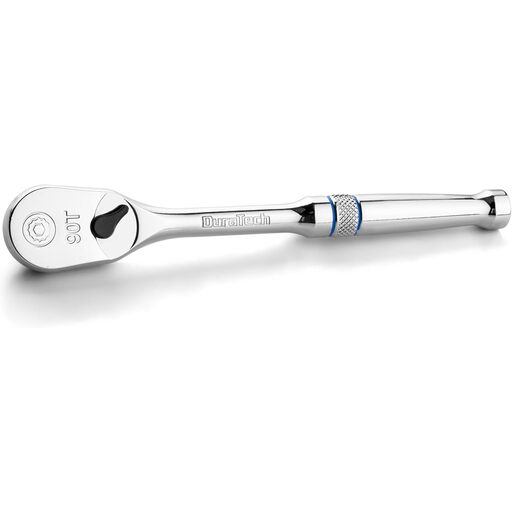
Why this product suits this profile: For occasional work on cars, bicycles or around the home, the 3/8-inch drive accepts common sockets without making the handle unnecessarily bulky.
The specified 90-tooth mechanism with a 4-degree return angle reduces the need for frequent repositioning in confined areas. The enclosed head leaves fewer openings for dirt to enter.
3/8-inch drive, heat-treated chrome alloy steel and polished chrome surface according to the product description.
Why this product suits this profile: For regular maintenance work, an accessible head, finer gearing and a surface that is easy to clean after oily jobs all make a difference.
The teardrop-shaped head is designed to provide access to confined spaces. The direction switch can be operated with your thumb, while the fully enclosed head shields the mechanism from dirt.
90-tooth ratchet mechanism, fully polished surface and reversible direction according to the supplier’s specifications.
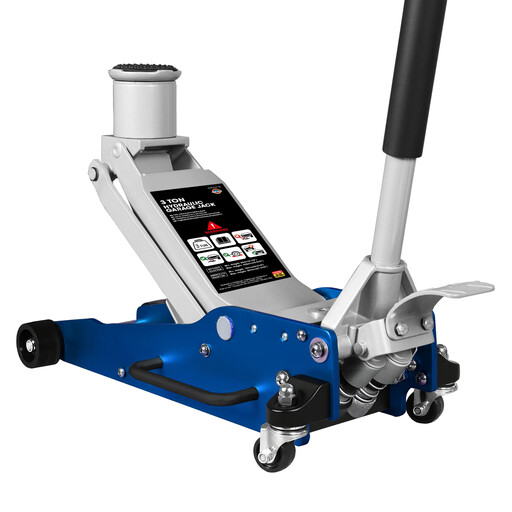
Why this product suits this profile: For frequent users in the garage, this trolley jack is a supplementary solution to a ratchet wrench when preparing to work underneath a vehicle. It is not a replacement for a 3/8-inch ratchet.
The specified 85 mm minimum height and EN-1494 and CE markings help you check whether the lifting tool is suitable for your vehicle and intended application.
3-tonne stated load capacity, dual-pump system and height range from 85 to 465 mm according to the product description.
We have put together a complete, regularly updated list of products that fully meet these strict selection criteria and the safety regulations applicable in the EU.
For safe, material-friendly use of a socket ratchet, it is important to follow a few basic rules:
A ratchet is not a torque wrench. If specified tightening torques are required, you should use a calibrated torque tool.
It is suitable for many jobs on cars, motorbikes, bicycles and household appliances, provided that the sockets used are compatible. A 1/4-inch ratchet may be more manageable for very small bolts, while a larger drive is often chosen for high torque applications.
A 90-tooth ratchet can be practical in confined areas because it has a smaller specified return angle. This makes it easier to work where there is limited room to move. However, the tooth count alone says nothing about other properties of the tool, such as its permitted load or service life.
After use, remove oil, dirt and moisture with a cloth. A dry toolbox and occasional care of the mechanism help maintain usability. Even a polished chrome surface does not protect against prolonged damp, aggressive cleaning products or incorrect storage.