
Lieferung heute & morgen

Qualitätsgarantie

Willkommens-Angebote freischalten: KOSTENLOSE Lieferung | Bis zu 80 % RABATT | Kostenlose 30-Tage-JoyPlus-Testphase
App herunterladen
The right wall lighting needs to do more than look good. It should suit the size of the room, the available power supply and the lighting effect you want to achieve. However, when shopping for wall lights, marketing terms such as “modern”, “bright” or “energy-efficient” don’t automatically point you towards the right choice.
Three common buying pitfalls are worth watching out for:
For living rooms, bedrooms, studies and hallways, indoor lights with an IP20 rating are often suitable. This rating means the light has no special protection against water. A bathroom wall light, on the other hand, should have an IP rating suitable for the planned installation position.
The IP rating alone doesn’t replace proper installation. In a bathroom, you also need to take the applicable installation zones and distances from water sources into account. If you’re unsure, have the light connected by a qualified electrician. A mirror light above the mirror isn’t automatically suitable for every position in a wet area.
Colour temperature is measured in Kelvin (K):
For LED wall lights, you should also check the light output in lumens (lm). Wattage mainly describes power consumption, so it isn’t a reliable way to compare the brightness of different LED products. A dimmable wall light also needs a compatible dimmable light source and, for hard-wired models, a suitable dimmer.
A wall light with an E27 fitting gives you a choice of compatible bulbs up to the stated maximum wattage. For example, the Atmosphera Flave has an E27 fitting, a maximum wattage of 40 W and an exposed bulb design. The bulb is not included.
Also check the depth of the light and how far it will project from the wall. In narrow hallways or beside the bed, compact wall lights measuring 10 to 12 cm wide may be a better choice than larger models. If the light has a cable, check that there’s a socket within reach and that the cable can be routed neatly.
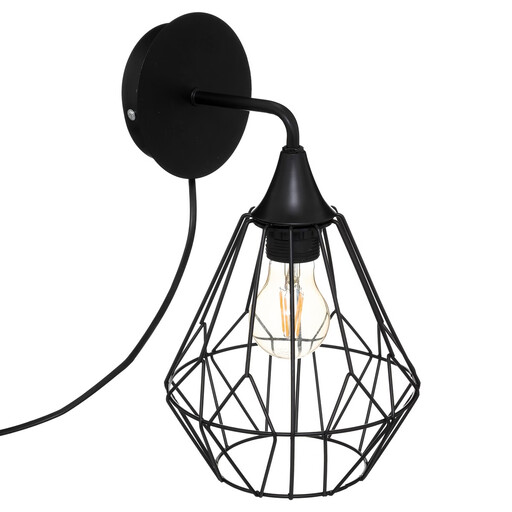
Why this product suits this profile: This compact wall light is suitable for dry indoor spaces such as living rooms, bedrooms and studies. Its exposed E27 bulb can be paired with a range of light bulbs.
The specifications clearly state the fitting, maximum wattage, IP20 rating and indoor use. This makes it easier to distinguish the light from unsuitable bathroom options.
E27 fitting, 40 W maximum wattage, 90 cm external cable and a 19 cm shade.
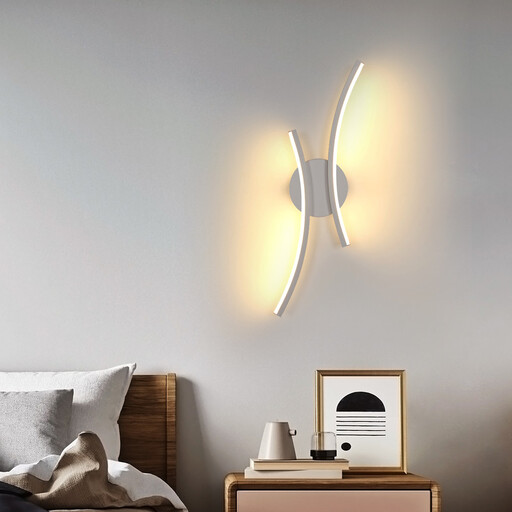
Why this product suits this profile: Its curved design and up-and-down lighting make it a good choice for design-conscious shoppers looking for modern wall lighting with a shallow profile.
The product details specify the colour temperature, power consumption and a depth of 5 cm. This lets you check the light’s projection from the wall and the effect it will have in the room before you buy.
Integrated LED technology, warm white 3,000 K light and vertical or horizontal installation, according to the product description.
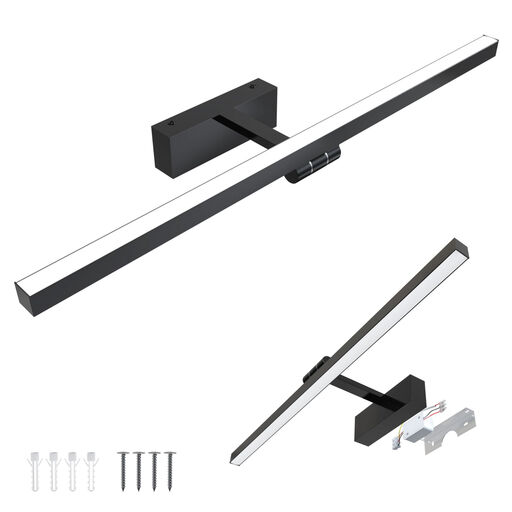
Why this product suits this profile: This bathroom wall light is designed to be installed above mirrors or mirrored cabinets. According to the product description, the light head can be adjusted through 180°.
The choice of 40 or 60 cm lengths and warm or cool white versions makes it easy to check the size and colour temperature before you buy.
15 W, 1,050 lm according to the product details, 60 cm long and an adjustable light body.
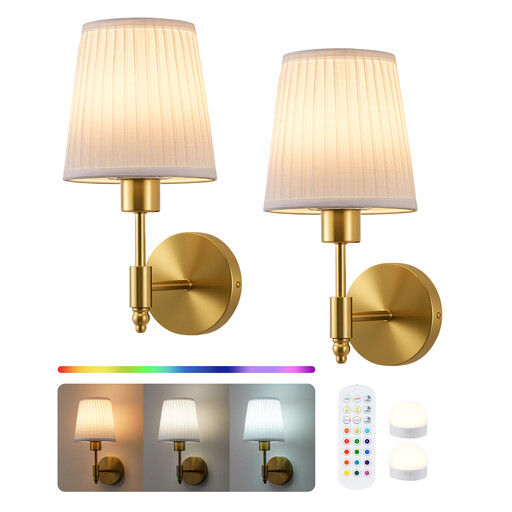
Why this product suits this profile: Cordless installation may be a good option for rented homes, hallways, stairways or walls without an existing power connection.
There’s no need for a fixed electrical connection. According to the product description, you can use the remote control to adjust brightness and colour temperature, and set the timer.
Two lights, 10–100% dimming range, 3,000–6,500 K, RGB function and timer options.
We’ve put together a complete, regularly updated list of products that meet these strict selection criteria and fully comply with the safety regulations in force in the EU.
It depends on the model. Lights with a plug or external cable can be fixed to a suitable wall and connected to a socket. Hard-wired wall lights are connected to the mains circuit. Before drilling, check for cables in the wall. If you’re unsure, consult a qualified electrician.
Lifespan depends on the LED module, heat dissipation, operating time and ambient temperature. Only rely on a specific lifespan if it’s stated in the technical product details. For lights with integrated LEDs, also check whether the module can be replaced.
LED technology often uses less power than traditional light bulbs to produce a similar amount of light. For a realistic comparison, look at wattage, lumens and daily operating time. For battery-operated models, you’ll also need to consider how often they need recharging and the battery capacity.