
Lieferung heute & morgen

Qualitätsgarantie

Willkommens-Angebote freischalten: KOSTENLOSE Lieferung | Bis zu 80 % RABATT | Kostenlose 30-Tage-JoyPlus-Testphase
App herunterladen
A wardrobe has to do more than just hold your clothes. Dimensions, weight capacity, dust protection and the type of assembly all determine whether the piece of furniture remains practical in a bedroom, a rented flat or during a house move. If you only focus on the look or a high number of compartments, you often overlook important details.
A large wardrobe can offer less usable storage space than expected due to thick side panels, wide doors or an awkward layout. So don't just check the external dimensions – also look at:
A wardrobe that is 200 cm wide, for example, requires sufficient wall space and a clear area in front of the doors. In a narrow room, a wardrobe with sliding doors can be more practical, as no door wings protrude into the room.
Claims like "stable" or "robust" mean very little without technical values. Pay attention to the maximum static load per shelf and for the hanging rail. With a fabric wardrobe, heavy winter coats should not automatically be stored on every shelf.
The construction also plays a role: metal tubes, connectors and the fixing of the shelves affect stability. A portable wardrobe should be completely emptied before being moved. Taller models may require wall fixing.
A fabric-covered wardrobe protects the contents from loose dust, but does not replace a dry, well-ventilated environment. Non-woven fabric is lightweight and suitable for mobile solutions, but cannot be equated with a solid furniture panel. Textile covers should be cleaned carefully on a regular basis and must not be exposed to direct, prolonged sunlight if the manufacturer advises against it.
Measure the available floor space at three points: width, height and depth. Take into account skirting boards, sloping ceilings, radiators and doors. For a mobile wardrobe, dimensions such as 150 × 45 × 175 cm are compact enough for many bedrooms or transitional situations. A large wardrobe measuring 200 cm wide and 210 cm high, on the other hand, offers a permanent storage solution but needs more space and usually two people to assemble and move.
A wardrobe with a hanging rail is ideal for shirts, jackets, dresses and coats. Shelves are useful for folded clothes, bedding or bags. A wardrobe with shelves can be used flexibly, while a wardrobe with drawers neatly stores smaller accessories, underwear or belts.
Don't compare the number of compartments in isolation. What matters is whether the compartment heights suit your clothes and whether the shelves can bear the intended weight.
With mobile models, tool-free click-together assembly makes setup easier. Check that the tube diameters, connectors and shelves are clearly described. For a fixed model made of laminated wood-based panels, edge sealing, the door mechanism and drawer runners are relevant technical details.
Tall furniture must be secured to the wall according to the assembly instructions. This measure reduces the risk of tipping over. Sliding doors also require a correctly aligned track, while with push-to-open mechanisms there must be sufficient clearance in front of the doors and drawers.
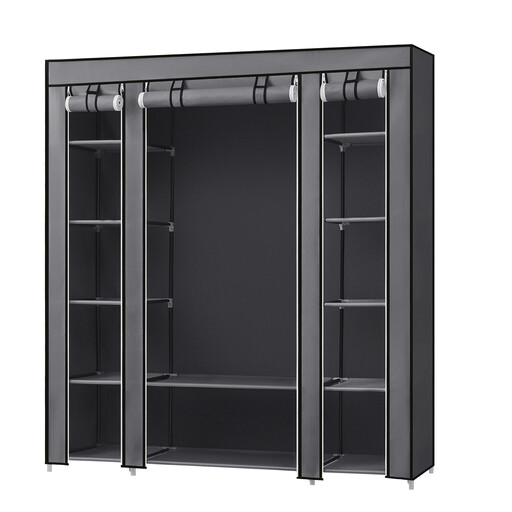
Why this product suits the profile: The mobile construction measuring 45 x 150 x 175 cm is ideal for students, tenants and households that need extra storage without a fixed piece of furniture.
The product data specifies concrete dimensions, material thicknesses and load limits rather than just general stability promises. The fabric cover provides dust protection.
12 storage compartments, one hanging rail, 16 mm metal tubes and a stated load capacity of 5 kg per shelf and 15 kg on the rail.
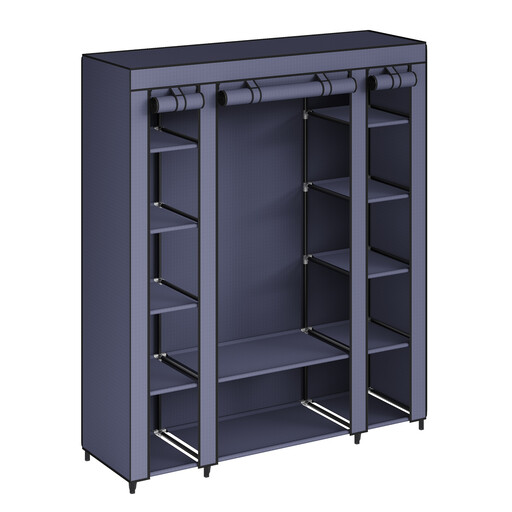
Why this product suits the profile: The combination of mobile use, twelve compartments and a closable fabric cover is suitable for people who want to combine organisation with flexible access.
The hanging rail is designed to be movable, while the cover can be used either closed or rolled up. An anti-tip device for wall fixing is included.
Tool-free assembly, 120 g/m² non-woven fabric, 16 mm metal tubes and specified limits of 5 kg per compartment and 15 kg for the hanging rail.
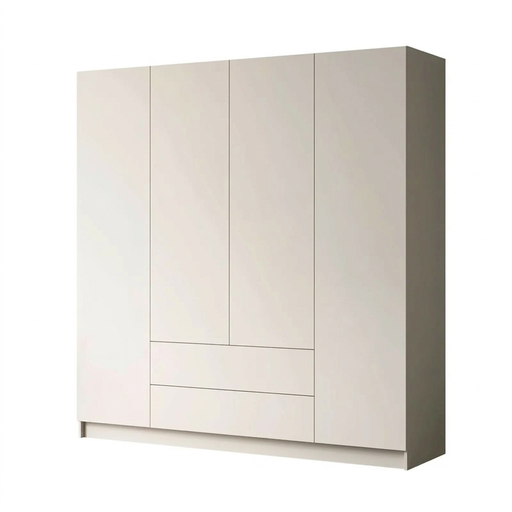
Why this product suits the profile: This fixed wardrobe is aimed at families and households with a permanent storage need who require shelves, a hanging rail and drawers in one piece of furniture.
The internal layout is concretely described with twelve shelves, one hanging rail and two drawers. Assembly by two people and mandatory wall anchoring are explicitly stated.
200 cm width, 210 cm height, 57 cm depth, 16 mm laminated chipboard, ABS edges, four doors and ball-bearing drawer runners.
We have put together a complete, regularly updated list of products that fully meet these strict selection criteria and the safety regulations in force in the EU.
For clothes on standard hangers, an external depth of around 55 to 60 cm is often practical. A mobile wardrobe with a depth of 45 cm can save space, but you should check the usable internal width and the position of the hanging rail before buying.
Follow the assembly instructions and secure tall models to a suitable wall using the provided anti-tip device. The piece of furniture should stand on a level surface. Heavy items should be placed in the lower compartments if possible. A fabric wardrobe must not be loaded before being moved.
The service life depends on the load, assembly, humidity, sunlight and how often the cover is opened. Keep within the stated weight limits, avoid damp locations and check the connectors regularly. For a permanent setup with heavy use, a fixed wardrobe made of laminated panels may be the more suitable design.