
Lieferung heute & morgen

Qualitätsgarantie

Willkommens-Angebote freischalten: KOSTENLOSE Lieferung | Bis zu 80 % RABATT | Kostenlose 30-Tage-JoyPlus-Testphase
App herunterladen
Watercolour markers combine the immediacy of a marker with the creative versatility of traditional watercolours. They are particularly practical for watercolour drawing, urban sketching, calligraphy and illustration, as there is no need to prepare a watercolour palette. However, products vary considerably in terms of nib design, ink, paper compatibility and storage.
If you are looking for a 20-colour watercolour marker set, you should not be guided solely by an extensive colour selection or especially vivid product images. What matters is whether the markers suit your personal working style and whether the stated features are relevant and credible for your intended use.
Water-soluble markers can be blended with water and a brush. However, this initially says nothing about the colours’ resistance to light. For sketches, cards or journaling, lower lightfastness may be perfectly adequate. For illustrations intended for longer-term display or archiving, an explicitly stated level of lightfastness is more relevant.
Terms such as “watercolour artist pens” or “professional quality” should not be assessed in isolation either. Instead, check the specific information provided about the ink, paper compatibility and lightfastness.
Watercolour pens with brush tips are ideal for variable line widths, filled areas and calligraphic movements. For outlines and small details, however, a second, firmer tip is often useful. A watercolour marker with a watercolour brush pen function and an additional fibre tip therefore offers more versatility than a model with only one soft tip.
A set with 60 or 120 colours offers greater variety, but it can be overwhelming for beginners. Some shades may also be used only rarely. A compact watercolour marker set in a case with 20 well-coordinated colours can be more practical for travel, plein-air work and initial illustration projects.
Look for the description water-soluble markers or water-based, water-soluble ink. On suitable watercolour paper, these markers can be blended or lifted with a damp brush. The result depends heavily on the paper weight, surface texture and amount of water used.
For clean transitions, watercolour paper or sturdy mixed-media paper is recommended. On thin copy paper, water can cause the sheet to buckle or distribute the colour unevenly. The claim “no bleed-through” should therefore always be considered in relation to the paper being used.
A soft brush tip is suitable for dynamic lines, shading and broad areas of colour. A stable fibre or chisel tip, by contrast, supports precise outlines and smaller drawings. With dual-tip markers, you should also check whether both tips are included and whether replacement tips are available.
Pressure control is particularly important for calligraphers and illustrators: less pressure generally produces narrower lines, while more pressure creates broader strokes. For highly precise technical drawings, an additional fineliner may be required.
If your work is intended to last, the product should include a specific indication of lightfastness. This should not be confused with water resistance. Water-soluble ink can become soluble again after drying if water is applied once more.
For storage, a horizontal position is recommended so that the ink remains evenly distributed. Caps should be closed completely after every use. A robust case protects the pens during transport and makes colour selection easier in the studio, on the train or while working outdoors.
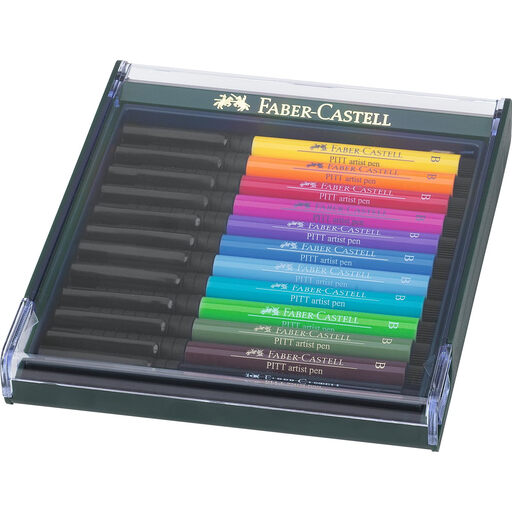
Why it fits: This set is ideal for users looking for variable brush-pen lines for calligraphy, sketching and hand lettering without committing to an extensive watercolour range straight away.
The product specifications explicitly state that the ink is water-based and not waterproof. This makes it clear that the set should not be equated with lightfast or permanent watercolour markers.
12 brush pens with soft brush tips, an ergonomic grip zone and click-secure caps for illustration and hand lettering.
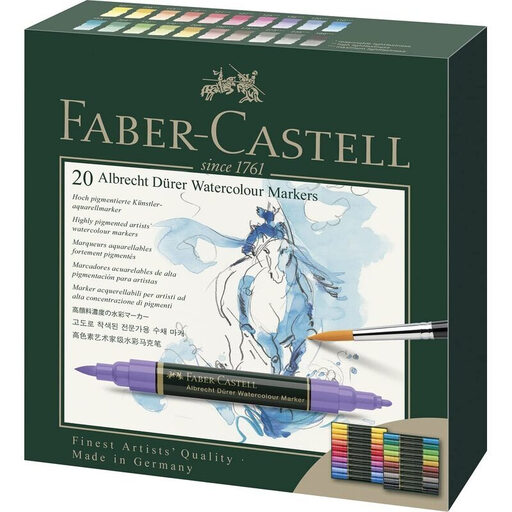
Why it fits: For artists, illustrators and ambitious hobbyists looking for a compact set with two tips, water-soluble ink and explicitly stated high lightfastness.
The specifications clearly identify both tips: a soft brush tip for areas and a stable fibre tip for lines. Water solubility and high lightfastness are also listed separately.
20 colours, a rounded ergonomic barrel, water-soluble ink and a compact case for the studio, travel and plein-air work.
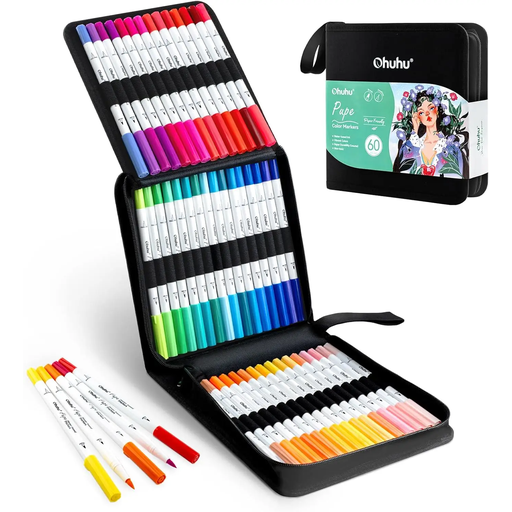
Why it fits: For illustrators, calligraphers and journaling enthusiasts who need a wide range of colours together with a fineliner tip and a flexible brush tip in one case.
The product description specifies a 0.4 mm fine tip and a flexible brush tip measuring approximately 1 to 5 mm. A colourless blender is also included.
59 shades plus blender, water-based ink, a storage case and dual tips for details, filled areas and gradients.
Start by applying a light shade dry, then activate it with a damp brush. For controlled gradients, work from light to dark. Test new colours on a strip of paper, as the same shade can look different depending on the paper used.
When using markers for sketches and illustrations, a separate outline is recommended if you want the lines to remain visible after blending. Waterproof fineliners may be suitable for this purpose, while water-soluble outlines can be deliberately integrated into the colour gradient. Allow individual layers of colour to dry before applying additional layers to reduce unwanted blending.
Our overview features a regularly updated selection of drawing, brush-pen and marker sets for a range of applications and budgets.
Yes, provided the set offers an intuitive combination of tips and a manageable selection of colours. A 20-colour set makes it easier to get started because the colours can be sorted and tested more quickly. Using watercolour or mixed-media paper is essential.
Their service life depends on usage frequency, pressure, paper and storage. Keeping caps closed, storing the markers horizontally and using a case can help protect the tips and maintain consistent ink flow. With intensive use, frequently used colours will naturally dry out sooner.
This depends on the model. For the sets mentioned here, no refill system is listed in the product specifications. Before buying, you should therefore check whether replacement tips, refill ink or individual replacement markers are available.