
Lieferung heute & morgen

Qualitätsgarantie

Willkommens-Angebote freischalten: KOSTENLOSE Lieferung | Bis zu 80 % RABATT | Kostenlose 30-Tage-JoyPlus-Testphase
App herunterladen
An acacia wood chopping board can be used in many ways in the kitchen, at breakfast or on the dining table. However, models differ significantly in size, construction and intended use. If you only pay attention to the type of wood or a decorative grain, you risk overlooking important details.
Not every acacia wood board is designed for heavy-duty chopping. A round wooden cheese board is often intended primarily for arranging cheese, fruit and snacks. For regular chopping or cutting hard foods, you need a sufficiently thick work surface and a stable base.
"30 cm" can refer to the diameter of a round board, whereas rectangular models are given by length and width. A 30 cm chopping board therefore does not automatically offer the same usable surface area as an oblong kitchen board. Before buying, you should clarify whether the board will be used on the worktop, the dining table or a serving trolley.
Wood should not be left in water for long periods and should generally not go in the dishwasher. Heat, moisture and incorrect storage can lead to warping or cracking. Clear care instructions are therefore more important than purely marketing claims about appearance or durability.
Acacia wood is often used for kitchen and serving items because of its distinctive grain and warm colour. What really matters, however, is whether the product is explicitly described as a chopping board, a wooden serving board or solely as a decorative and presentation surface.
Look out for the following details:
With an acacia wood cheese board, a tapas board or a snack board, the focus is usually on arranging food. For daily preparation of vegetables, bread and other ingredients, the product description should explicitly support that kind of use.
The right size depends on how you plan to use it:
As well as length and width, check the height or material thickness. Accurate measurements make it easier to assess weight, stability and storage.
After use, a wooden board should be cleaned with a damp cloth and then dried thoroughly. Avoid prolonged soaking and cleaning in the dishwasher unless the manufacturer explicitly allows it. For different foods, it can make sense to use one board for chopping and a separate wooden board for serving. This helps to limit wear marks and the transfer of odours.
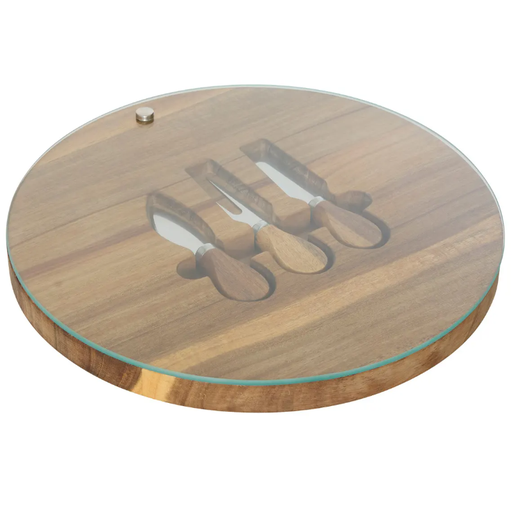
Why this product fits the profile: The round board with a 30 cm diameter is sized for smaller households and occasional arranging of cheese, cold cuts, fruit and snacks.
The stated diameter makes the usable surface area easier to assess. The description clearly indicates its use as a cheese and serving board.
Natural acacia wood, round shape and 30 cm diameter; according to product details, intended for cheese, cold meats, fruit and snacks.
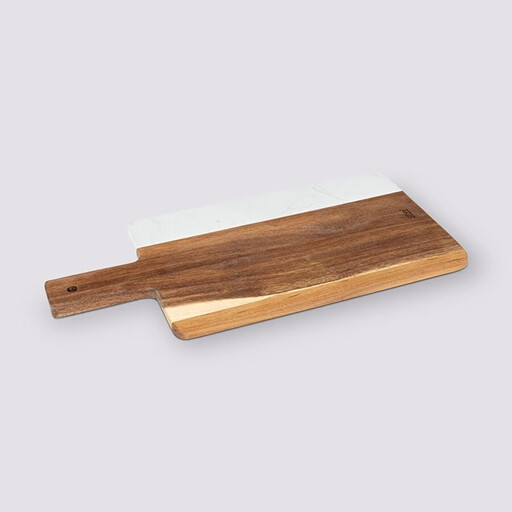
Why this product fits the profile: The rectangular format offers a clearly defined work surface for kitchen tasks and can also be used as an oblong wooden serving board.
The dimensions 42 x 20 x 1.2 cm are clearly stated, preventing a round serving surface from being confused with an oblong cutting surface.
Acacia wood as the stated material, rectangular shape and a length of 42 cm for bread, smaller ingredients or elongated presentations.
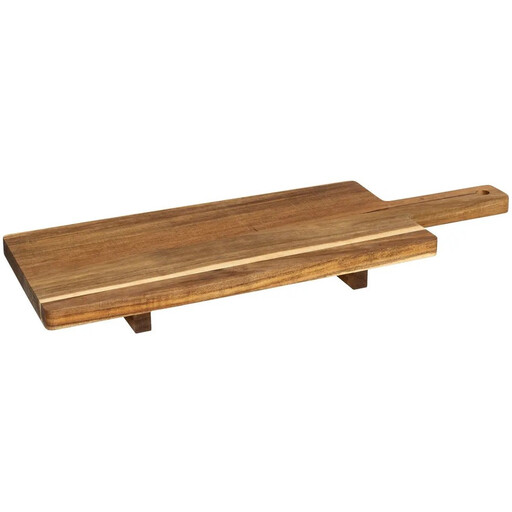
Why this product fits the profile: The oblong surface is designed for extensive presentations with cheese, tapas, starters and snacks – ideal for hosts, cafés or restaurants.
The dimensions 70 x 25 cm and the stated weight of 2.260 kg make the space required and handling clear before purchase.
Generous format, acacia wood as the material and a focus on cheese, tapas and snack presentations.
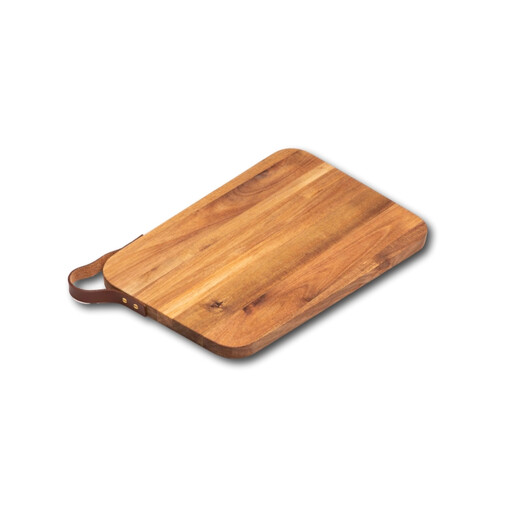
Why this product fits the profile: The rectangular kitchen board with 38 cm length and 26.5 cm width can be used for everyday preparation and smaller serving tasks.
All three dimensions are given in millimetres. This allows you to compare the 15 mm thickness with your available storage space before buying.
Rectangular format, acacia wood and a stated thickness of 15 mm with a 380 x 265 mm surface area.
With heavy use, check the surface regularly for deep grooves, cracks or splinters. A board with significant damage should be considered unsuitable for contact with food.
We have put together a complete, regularly updated list of products that fully meet these strict selection criteria and the safety regulations in force in the EU.
For smaller kitchens and arranging individual portions, a round board with a 30 cm diameter can be sufficient. If you regularly prepare bread, vegetables or several ingredients, you will usually benefit from a longer rectangular surface. The worktop space, weight and storage are also important factors.
Only if the manufacturer explicitly allows it. For the models described here, cleaning with a damp cloth and without soaking is recommended. Water, heat and prolonged moisture can damage wooden surfaces.
It is not possible to give a general lifespan. It depends on the material thickness, workmanship, cutting intensity and care. Gentle cleaning, thorough drying and dry storage can all help to maintain the board's usability.