
Lieferung heute & morgen

Qualitätsgarantie

Willkommens-Angebote freischalten: KOSTENLOSE Lieferung | Bis zu 80 % RABATT | Kostenlose 30-Tage-JoyPlus-Testphase
App herunterladen
A flat battery always seems to happen at the worst possible moment: before the drive to work, after your motorhome has been sitting for a while, or during the middle of motorcycle season. A suitable car battery charger can recharge the battery in a controlled way and support it with a maintenance mode during longer periods of storage. For emergencies, on the other hand, a jump starter power bank or car booster is the right tool.
However, buying mistakes are common. High amperage ratings, terms like "Repair" or a long list of protection features alone are not enough to base your choice on. What really matters is whether the voltage, battery type, capacity and intended use actually match.
A 20A or 30A charger won't charge every battery sensibly. Small motorcycle or lawnmower batteries usually need a lower current than large vehicle batteries. A device that is too powerful can be unsuitable if the manufacturer hasn't included appropriate regulation or a suitable mode.
So pay attention to the stated capacity range in Ah. According to the product details, the EAFC 12V/24V device is designed for 12V and 24V batteries and offers different charging outputs. Another 12V charger, by contrast, may be explicitly suitable only for 4 to 100 Ah or 2 to 150 Ah.
A battery repair charger or pulse charger may, depending on the model, offer a special pulse or desulphation mode. This can help with an attempted charge on certain aged or sulphated lead-acid batteries. However, a visibly damaged, leaking, frozen or internally defective battery will not reliably be made functional again by this.
The term "Repair" should therefore be understood as an additional feature, not a guarantee of longer battery life.
A mobile car battery charger normally needs a mains socket and charges over a longer period. A booster delivers a high current briefly to start the engine. A jump starter power bank therefore does not replace a battery charger for maintaining the battery over winter.
Products with an integrated tyre compressor, LED light and USB power bank are especially designed for emergencies on the road. Even so, before buying you must check whether they are suitable for your vehicle with a 12V system and for the stated engine size.
The vehicle battery must match the output voltage of the charger. A 12V battery charger is suitable for typical cars, motorcycles, many motorhomes and boats with a corresponding on-board electrical system. A 24V battery charger is mainly needed for larger vehicles or certain commercial vehicle systems. A 12V booster must not be used on a 24V vehicle.
In addition, the battery chemistry is important:
The charging current is given in amps. When choosing, it's not just 6A, 10A, 15A or 20A that matter, but also the supported battery size. An intelligent battery charger normally adjusts the charging process in several phases and stops or reduces charging when the battery is full.
According to the product description, the EAFC 12A 12V/24V model states 12V 10A and 24V 5A, a power output of 180W and a range of 2 to 150 Ah. The EAFC 12V/24V model with 20A lists seven modes, including STD, LiFePO4, AGM/GEL, Motorcycle, Repair and Supply. You should compare these details with your own battery label before buying.
Look for verifiable features such as:
A CE mark indicates the manufacturer's declaration of conformity with relevant EU requirements, but it is not an independent quality judgement. Also read the instruction manual and only use chargers in the environment for which they are intended. Many models are designed for indoor use and must be protected from rain.
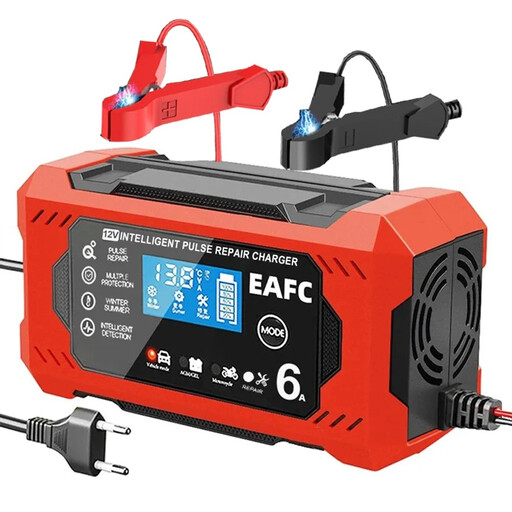
Why this product fits the profile: This 12V charger is designed for cars and motorcycles with lead-acid, AGM, GEL, WET or EFB batteries within the stated range of 4 to 100 Ah.
The stated capacity range more clearly defines its suitability. Protection features such as reverse polarity, over-temperature and short-circuit protection are integrated according to the product details.
6A charging current, LCD display, automatic charging mode and pulse repair function according to the product description.
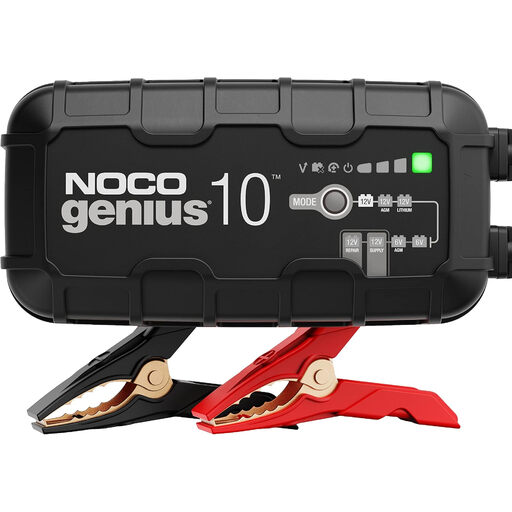
Why this product fits the profile: Suitable for users who regularly charge and want to maintain vehicles, motorcycles, motorhomes or tractors over the long term.
The product details list separate modes for 6V and 12V as well as lead-acid, AGM, GEL, EFB and LiFePO4 batteries. Checking the battery label before connection is still necessary.
10A charging current, temperature monitoring, maintenance mode and a stated 3-year limited warranty.
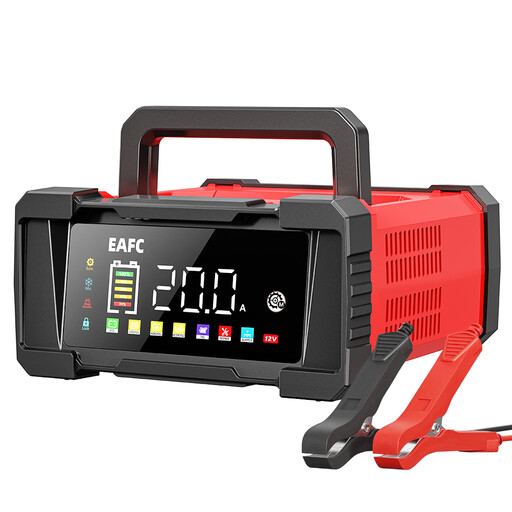
Why this product fits the profile: For garages, workshops, boats, motorhomes and larger vehicle batteries when you need to cover several chemistry types and voltages.
The seven operating modes make the battery type selection visible. The stated 12V/24V operation reduces the risk of choosing a device with the wrong voltage.
20A for 12V, 10A for 24V, LiFePO4 mode, 2m cable and display of voltage, current and temperature according to the supplier's details.

Why this product fits the profile: For drivers, campers and outdoor users who want to combine jump starting, a tyre compressor, power bank and LED light in one portable device.
The details explicitly state 12V vehicles, engine limits and reverse polarity, overload and temperature protection. The compressor has an automatic shut-off at a pre-set pressure.
4500A peak current, 150 PSI compressor, five inflation modes, USB power bank and 500-lumen LED according to the product description.
We have put together a complete, regularly updated list of products that fully meet these strict selection criteria and the safety regulations in force in the EU.
The time depends on the capacity, state of charge, charging current and battery condition. A rough guide is capacity divided by charging current, but you also need to account for charging losses and the multi-stage charging phase. So a 60 Ah battery will not be fully charged in exactly ten hours with a 6A charger.
According to product details, a pulse or repair mode can support an attempt on certain lead-acid batteries. For a damaged, leaking, frozen or internally defective battery, replacement or a professional inspection is necessary. A repair function is not a substitute for a condition diagnosis.
Compact 12V chargers with a low charging current and an explicitly stated motorcycle mode are suitable for motorcycles. The Ah rating and battery type are decisive. A powerful car battery charger should only be used if the manufacturer specifies the appropriate capacity range and charging mode.