
Lieferung heute & morgen

Qualitätsgarantie

Willkommens-Angebote freischalten: KOSTENLOSE Lieferung | Bis zu 80 % RABATT | Kostenlose 30-Tage-JoyPlus-Testphase
App herunterladen
A ceramic fan heater can warm rooms quickly without the need to install a permanent heating system. This makes an electric fan heater a practical choice for bedrooms, studies, offices or smaller living areas. However, models can differ considerably in terms of noise levels, controls, safety features and day-to-day convenience.
If you focus solely on a high wattage or eye-catching advertising claims, you may easily end up with a model that does not suit the size of your room or the way you use it. This buying guide explains which specifications really matter and which product features should be checked carefully.
A 2000 W fan heater produces heat quickly, but at full power it uses 2 kWh per hour of operation. The actual cost depends on your electricity tariff and how long the heater runs. An energy-saving fan heater does not automatically use less electricity simply because it uses ceramic or PTC technology.
The key features are:
The term quiet fan heater is only meaningful when a specific noise rating is provided. The fan, airflow and operating setting all affect the sound level. For bedrooms or offices, models with documented ratings of around 25 to 50 dB are generally easier to assess than models with no stated figure.
Bear in mind that manufacturers’ ratings can vary depending on the measurement method and distance. A low figure is therefore a point of comparison, not a guarantee of complete silence.
A fan heater with tip-over protection and overheat protection should switch off if it is knocked over or reaches an excessive internal temperature. However, these features do not replace safe positioning. The heater must not be covered, used on soft fabrics or left running unattended. Even a fan heater that appears to be suitable for use near water should not automatically be placed close to a shower, washbasin or splashing water.
A PTC fan heater uses a ceramic heating element with a positive temperature coefficient. For buyers, the specific operating settings matter more than technical marketing terms. A compact room heater with an output of 750 W or 1000 W may be sufficient for a seating area or small study. Outputs of 1500 to 2000 W provide more capacity, but can increase potential electricity consumption during longer use.
The stated room size always depends on:
A manufacturer’s claim such as “for 10 to 20 m²” should therefore be treated as a guide rather than a guaranteed heating capacity.
A fan heater with a thermostat reduces the heating output or switches it off once the target temperature has been reached, depending on the model. Fine temperature adjustment is useful, for example in one-degree increments. A fan heater with a timer is suitable for time-limited use, such as warming a study in the morning.
An ECO mode can automatically switch the output between several settings. Compared with leaving the heater permanently on its highest setting, this may reduce consumption. The amount actually saved depends on the room, temperature, insulation and operating time. Brands’ percentage claims should therefore be regarded as manufacturer information.
Look out for the following:
The CE mark is a legally required conformity marking, but it is not an independent quality seal. Additional markings such as GS, RoHS or VDE may help with assessment, but should be attributable to the specific model and its official documentation.
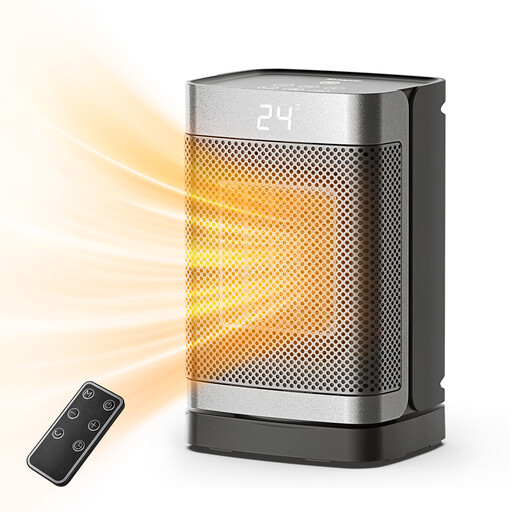
Why this product suits the profile: This compact model offers two heat settings, digital temperature control, a remote control and a 12-hour timer for bedrooms, offices or studies.
The timer lets you limit the operating time; the product specifications state that tip-over protection and overheat protection are built in.
PTC heating element, LED display, remote control and oscillation, with a net weight of around 1.8 kg.
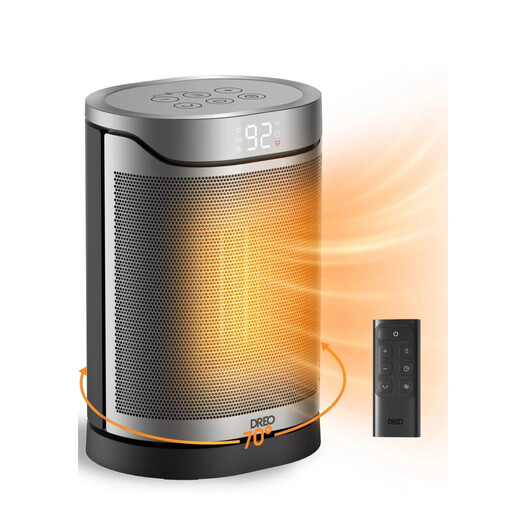
Why this product suits the profile: If quiet operation and precise control are important to you, the product description states that this model offers a temperature range of 5 to 35 °C and a noise level of 25 to 42 dB.
The specific decibel rating makes it easier to assess this model than vague claims such as “whisper-quiet”. A 12-hour timer limits the operating time.
1500 W, 70° oscillation, remote control and, according to the manufacturer, eight safety layers including overheat and tip-over protection.

Why this product suits the profile: For frequent use in medium-sized rooms, the manufacturer specifies a heating coverage of 15 to 25 m², 70° oscillation, a remote control and a temperature range of 5 to 35 °C.
Several safety features, including tip-over protection, overheat protection and child lock according to the manufacturer, complement safe positioning.
2000 W output, stated noise level of 25 to 42 dB and a 24-hour timer.
We have put together a complete, regularly updated list of products that fully meet these strict selection criteria and the safety regulations applicable in the EU.
Place the portable fan heater on a firm, level and non-flammable surface. Keep the air outlet clear and maintain a safe distance from curtains, paper, bed linen and furniture. A multiway adaptor or unsuitable extension cable can be problematic at high output. Check the permitted load and use a suitable wall socket wherever possible.
Before cleaning or moving the electric fan heater, switch it off, disconnect it from the mains and allow it to cool down completely. Dust at the air inlet can restrict airflow. If you notice a burning smell, sparks, smoke, a damaged cable or unusual noises, stop using the appliance immediately.
At full power, a 2000 W appliance uses 2 kWh per hour of operation. The cost can be calculated as follows: 2 kWh × personal electricity price × operating hours. The thermostat, lower heat settings and timer can reduce the actual operating time.
In principle, a model with a documented noise level, thermostat and timer may be suitable for use in the bedroom. It should be placed on a stable surface and never left running unattended. Figures such as 25 to 42 dB come from the relevant product information and may differ in real-world use.
It is not possible to give a reliable fixed lifespan without information about usage, maintenance and components. Regularly removing dust, keeping airways clear and using the heater in accordance with the instructions can help support safe operation. If there is visible damage or a fault, stop using the appliance.