
Lieferung heute & morgen

Qualitätsgarantie

Willkommens-Angebote freischalten: KOSTENLOSE Lieferung | Bis zu 80 % RABATT | Kostenlose 30-Tage-JoyPlus-Testphase
App herunterladen
A ceramic fan heater can quickly warm individual rooms without needing permanent installation. This makes a compact electric fan heater a practical choice for rented homes, student rooms, home offices or bedrooms. However, your choice should not be based solely on wattage or marketing claims. Room size, thermostat, noise level, safety features and actual usage are all key considerations.
A 2000-watt fan heater can warm a room more quickly than a lower-powered model. However, when running continuously, it can theoretically use up to 2 kWh per hour. An energy-saving fan heater does not produce less heat from the same amount of energy. Instead, it reduces consumption through thermostat control, lower power settings or an ECO mode.
You should therefore look for:
Noise levels depend primarily on the fan, airflow and operating mode. The term quiet fan heater alone is not enough. A specific dB rating is more helpful: depending on the model, the devices in this selection are rated at around 25 to 50 dB. Bear in mind that measuring conditions are not always identical and that the highest fan setting is usually louder.
Models with a low stated noise level, mute function or regulated DC motor are particularly suitable for bedrooms and offices.
A fan heater with overheat protection and tip-over protection provides important technical safeguards. Nevertheless, the device must not be covered, placed on soft surfaces or operated directly next to curtains. The casing and the air coming out of the heater can become hot. Keep to the distance from textiles and flammable objects specified by the manufacturer, and do not leave the fan heater running unattended.
For rooms of around 10 to 20 m², a 1500-watt device may be sufficient, depending on insulation and ceiling height. For areas of 15 to 25 m², 1800 to 2000 watts are more suitable, particularly when heating a room quickly. Actual suitability also depends on windows, external walls, insulation standards and the desired temperature.
A PTC fan heater uses a ceramic heating element with a positive temperature coefficient. The power consumption is influenced by the element’s temperature characteristics. This makes PTC technology a popular design for compact electric heaters, but it is not in itself proof of low overall consumption.
A fan heater with a thermostat adjusts the heating output according to the measured room temperature. The finer the adjustment range, the more accurately you can set your preferred temperature. Models with a range of 5 to 35 °C and 1 °C increments offer more adjustment options than simple heat-setting switches.
Important: The temperature shown on the device may differ from the room temperature measured elsewhere. Do not place the fan heater immediately next to a window, door or heat source.
A fan heater with oscillation distributes warm air across a wider angle. This can be useful in elongated rooms or when the seating and working areas share the same space. Depending on the model, an oscillation angle of 70° or 90° may be specified.
A remote control makes it easier to operate the heater from your desk or bed. A 12- or 24-hour timer limits the operating time and helps prevent unnecessary use. A child lock is particularly useful if children or pets live in the household.

Why this product suits the profile: This compact device offers four heating modes, an ECO function, remote control, oscillation and a 24-hour timer for flexible use in bedrooms, home offices or living rooms.
The combination of a 5–35 °C thermostat and ECO mode goes beyond a simple on/off switch. Overheat and tip-over protection are also specified.
1800 watts, a 24-hour timer and three stated noise levels of up to 38 dB.

Why this product suits the profile: For medium-sized rooms of around 15 to 25 m², it offers precise temperature selection, remote control, 70° oscillation and a stated noise range of 25–42 dB.
Specific information about output, room size, thermostat range and noise level makes comparison easier. The 8-fold protection system includes tip-over and overheat protection, among other features.
2000 watts, 5–35 °C in 1 °C increments and a 250 × 44 mm PTC heating element, according to the product information.
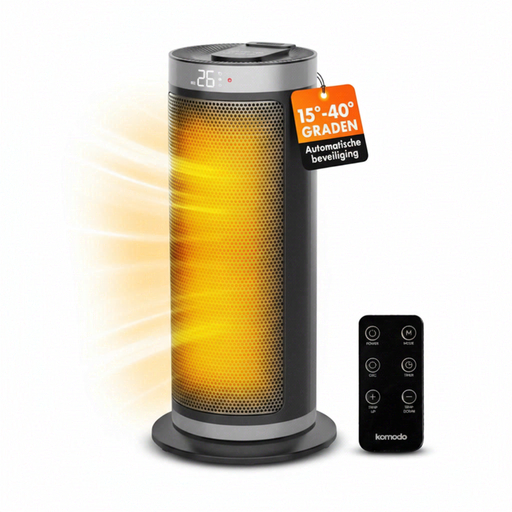
Why this product suits the profile: Three power settings from 750 to 2000 watts, 90° oscillation, remote control and a stated IP66-rated casing make this model interesting for changing locations and uses.
The lower 750-watt setting can be selected for limited heat or smaller rooms. Despite the IP66 rating, the manufacturer’s safety instructions still apply; water and plug connections must be kept separate.
750/1500/2000 watts, 90° oscillation and compact dimensions of 19.4 × 19.4 × 40.3 cm, according to the product data.

Why this product suits the profile: This lightweight device is specified for areas of around 10 to 20 m² and offers remote control, a 12-hour timer, thermostat and a noise range of 25–42 dB.
The 900, 1300 and 1500-watt settings allow you to select the appropriate output instead of running the heater continuously at full power.
A stated low operating level of 34 dB and an adjustable thermostat range of 5–35 °C.
We have put together a complete, regularly updated list of products that fully meet these strict selection criteria and the safety regulations applicable in the EU.
You can estimate the running costs as follows:
Power in kW × operating hours × electricity price per kWh = electricity costs
A 2000-watt device is equivalent to 2 kW. After one hour of operation at full power, it will theoretically use 2 kWh. The thermostat, ECO mode and a lower heat setting can reduce the actual operating time and power consumption. However, usage depends on the room temperature, insulation and target temperature selected.
If you are using the heater in Germany, you should also bear the following points in mind:
Depending on the model, the manufacturers’ stated coverage in this selection ranges from approximately 10 to 25 m². Poor insulation, high ceilings or many external surfaces may mean that more power is required. A fan heater is primarily suitable as a mobile supplementary heater, not as a replacement for a permanently designed building heating system.
A model with a low dB rating, thermostat, timer and tip-over protection may be suitable for limited use in a bedroom. Nevertheless, do not leave the device running unattended for extended periods. Check the noise information before buying and use an automatic switch-off time.
Its service life depends on operating time, dust exposure, storage and build quality. Clean the air inlet regularly, avoid moisture and only transport the device once it has cooled down. If there is visible damage or a malfunction, stop using it.