
Lieferung heute & morgen

Qualitätsgarantie

Willkommens-Angebote freischalten: KOSTENLOSE Lieferung | Bis zu 80 % RABATT | Kostenlose 30-Tage-JoyPlus-Testphase
App herunterladen
A ceramic fan heater can warm rooms quickly and can be used flexibly in the bedroom, living room, office or study. However, a low price or high wattage does not automatically mean it is the right choice. Room size, controls, noise level, safety features and your intended use are all important factors.
A 2000 W fan heater delivers high heat output, but at full power it uses up to 2 kWh per hour of operation in theory. The actual cost depends on your electricity tariff and how long the heater runs. An energy-saving fan heater does not automatically reduce consumption simply because it uses a ceramic element. It mainly helps through:
The required output does not depend solely on the number of square metres. Ceiling height, insulation, window area and outside temperature all affect heating performance. Claims such as “up to 25 m²” should therefore be treated as a guide. In poorly insulated rooms, a 2000 W appliance may still only be suitable as a short-term supplementary heater.
A quiet fan heater can be useful in a bedroom or study. However, the decibel rating should be examined carefully: some manufacturers only state the figure for a particular operating mode or give a minimum value. Fan noise, oscillation and the power setting can all affect the perceived volume. At night, display brightness, button sounds and a shut-off function are also relevant.
A PTC ceramic heater uses a ceramic heating element and a fan to distribute the warmed air around the room. PTC stands for “Positive Temperature Coefficient”. The material’s electrical characteristics change with temperature. However, this is not a substitute for a thermostat and does not automatically indicate a particular level of electricity consumption.
For small personal areas, 750 to 1500 W may be sufficient. In medium-sized rooms or when rapid heating is required, appliances with 1800 to 2000 W may be suitable. Models with several power settings allow you to adapt the heater more effectively to the room and your intended use.
A fan heater with a thermostat adjusts its heat output according to the set target temperature. Look for a useful temperature range and controls that allow you to make small adjustments. For example, some models can be set between 5 and 35 °C, while others only start at 10 °C.
A fan heater with a timer stops operating after a set period. Depending on the model, the range may be from 1 to 12 hours or up to 24 hours. A timer is particularly useful if you only want the fan heater to run before going to bed or during a limited period of work.
A fan heater with overheat protection should switch off the heating function if the internal temperature becomes unusually high. A fan heater with tip-over protection responds if the appliance is knocked over. Both features help reduce risks, but they do not replace safe positioning.
Always remember to:
A CE marking indicates that the manufacturer declares compliance with the relevant EU requirements. You should also check the details of the responsible person in the EU and read the complete operating instructions.
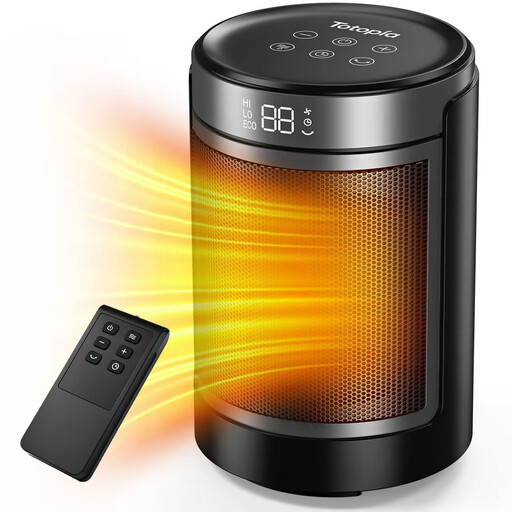
Why this product suits the profile: Four operating modes – including fan, 750 W, 1500 W and ECO – make it easy to adjust the heater for smaller rooms, desk areas or bedrooms.
The graduated power modes mean you do not need to use the highest setting continuously. A timer and tip-over protection are also listed.
PTC heating element, 1–12-hour timer, LED display, remote control and oscillation according to the product details.

Why this product suits the profile: For medium-sized rooms, the manufacturer specifies 2000 W, heating coverage of 15–25 m², a temperature range of 5–35 °C and a noise range of 25–42 dB.
Specific details about noise, thermostat range and coverage make it easier to compare the heater with your actual room. Its power control is not limited to a single setting.
According to the product details: 70° oscillation, 12-hour timer, remote control, overheat and tip-over protection, plus eight layers of protection.

Why this product suits the profile: Five modes, a 24-hour timer and an adjustable thermostat are ideal for households that want to adapt supplementary heating regularly to changing situations.
The ECO mode and multiple heat settings allow you to use the heater according to your needs. The timer limits the operating time and can help reduce unnecessary continuous use.
PTC technology, Eco mode, precise temperature display, overheat protection, tip-over protection and carry handle according to the product description.

Why this product suits the profile: According to the manufacturer, this compact appliance has a noise range of 25–42 dB, an output of 1500 W and a thermostat range of 5–35 °C.
The specific decibel range helps you compare it with other appliances. Multiple power settings prevent small rooms from being heated continuously at full power.
Remote control, 12-hour timer, oscillation, overheat and tip-over protection, plus a compact design according to the product details.
We have put together a complete, regularly updated list of products that fully meet these strict selection criteria and the safety regulations applicable in the EU.
At full power, one hour of operation equals 2 kWh in theory. Calculate the cost as follows: 2 kWh × your electricity price. The thermostat, Eco mode and lower power settings can reduce the amount of time the heater actually runs at full power.
That depends on its noise level, safety features and operating instructions. A quiet fan heater with a timer, thermostat, overheat protection and tip-over protection may be suitable for limited periods of use. The appliance should not be covered or operated unattended.
It is not possible to give a reliable, general lifespan. This depends on operating time, exposure to dust, storage conditions and build quality. Clean the air intake regularly in accordance with the manufacturer’s instructions, do not use the appliance if the cable is damaged, and store it in a dry place once it has cooled completely.