
Lieferung heute & morgen

Qualitätsgarantie

Willkommens-Angebote freischalten: KOSTENLOSE Lieferung | Bis zu 80 % RABATT | Kostenlose 30-Tage-JoyPlus-Testphase
App herunterladen
When temperatures drop, a ceramic heater is a practical solution for quick, targeted warmth in your home office, living room, or workshop. However, the market is flooded with devices whose marketing promises often suggest more than the technology can deliver. Before you make a decision, it's crucial to understand the common pitfalls that can lead to an unsatisfying purchase and unnecessarily high electricity costs.
As your Joybuy Product Recommendation Officer, I will help you define objective criteria for your selection. This guide focuses on the facts, enabling you to find a device that is safe, efficient, and perfectly tailored to your needs.
Many buyers focus on superficial features and overlook crucial details. Pay close attention to these three points to avoid a poor investment:
To avoid the pitfalls mentioned above, you should base your selection on three fundamental parameters. These determine the heater's efficiency, safety, and comfort.
Modern ceramic heaters use PTC (Positive Temperature Coefficient) heating elements. These ceramic stones heat up quickly and self-regulate their temperature: the hotter they get, the lower their electrical resistance and thus their power consumption. This not only makes a PTC heater safer by inherently reducing the risk of overheating, but also more efficient.
In combination with an electric heater with a thermostat, energy consumption is further optimised. The device only heats until the set target temperature is reached, then switches off or enters a power-saving mode. A good energy-saving heater, therefore, always includes an adjustable thermostat and, ideally, an ECO mode that automatically adjusts the heating levels to the ambient room temperature.
A safe device is non-negotiable. Look for the following features:
User comfort depends on smart features and the physical design. A heater with a remote control allows you to manage all functions without getting up. A programmable timer (e.g., 1–12 hours) ensures the device switches off automatically.
For even heat distribution in a room, an oscillation feature (swivelling function) is crucial. In this regard, the tower heater has proven particularly effective, as its height allows it to distribute warm air over a larger vertical area.
Based on the criteria above, we have identified several models that represent a considered choice for specific user profiles.

Why This Fits Their Persona: Ideal for work environments where concentration is essential. The compact design fits discreetly under a desk, delivering targeted warmth without overheating the entire room.
With a manufacturer-specified noise level of just 34 dB in its lowest mode, this model avoids the trap of vague "quiet" promises by providing a concrete, verifiable figure.
Precise thermostat (5–35 °C), multi-level safety system (Shield360?), and a brushless DC motor for quiet and energy-efficient operation.
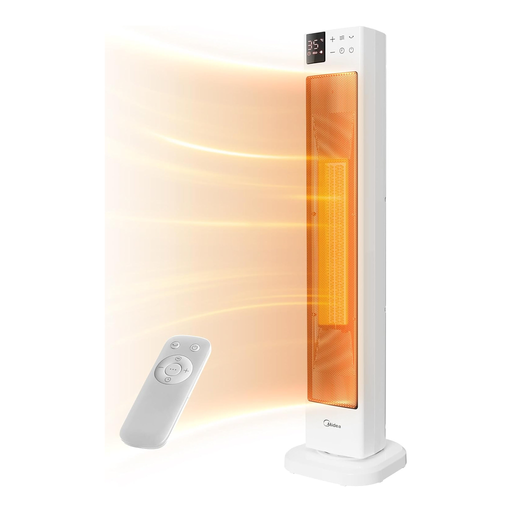
Why This Fits Their Persona: This tower heater is designed for users who want to heat larger living areas or offices quickly and evenly. Its height and wide oscillation ensure effective heat distribution.
Instead of relying solely on its 2000W power, this model combines high wattage with an ECO mode and a precise thermostat. This allows it to intelligently manage power to maximise efficiency and prevent unnecessarily high electricity bills.
Wide 75° oscillation for excellent room coverage, a 24-hour timer, and a remote control for superior convenience. Comprehensive safety features include tip-over and overheat protection.

Why This Fits Their Persona: This model offers a solid set of essential features for users looking for a reliable supplementary heater without complex extra functions. It covers the fundamental requirements for safety and performance.
Despite its attractive price point, this model doesn't compromise on safety. It is explicitly equipped with tip-over and overheat protection, thereby avoiding the most dangerous pitfall of cheap alternatives.
Four operating modes, including an ECO function, a 12-hour timer, and a remote control, offer a comprehensive feature set in this price category.
We have compiled a complete, up-to-date list of products that fully meet these strict selection criteria and comply with German safety regulations.
Electricity consumption depends on the power (wattage) and duration of use. A heater with 1,500 watts (1.5 kW) consumes 1.5 kilowatt-hours (kWh) for one hour of operation at its highest setting. With an electricity price of, for example, 30 cents/kWh, that would be 45 cents per hour. Models with an ECO mode and a precise thermostat are significantly more economical, as they adjust their power output based on need and do not run continuously at full power.
Yes, PTC heating element technology is considered safer. Unlike traditional heating coils, which glow at a constant high temperature, PTC ceramics have a self-regulating property. They automatically reduce their heat output when a certain temperature is reached. This significantly reduces the risk of overheating and makes the devices more durable.
The lifespan of a heater depends on the intensity of use and its maintenance. To ensure optimal performance, the device should be regularly cleaned of dust. To do this, unplug the unit and wipe the housing with a dry cloth. The air intake and outlet grilles can be gently cleaned with a soft brush or a vacuum cleaner to prevent blocking the airflow. Store the device in a dry, dust-free place during the off-season.