
Lieferung heute & morgen

Qualitätsgarantie

Willkommens-Angebote freischalten: KOSTENLOSE Lieferung | Bis zu 80 % RABATT | Kostenlose 30-Tage-JoyPlus-Testphase
App herunterladen
A ceramic fan heater can quickly warm up a bedroom, office or living room, but it does not automatically replace your regular heating system. Before buying, wattage is not the only factor that matters. Room size, noise level, temperature control and safety features all determine whether a heater is genuinely suitable for everyday use.
A 2,000 W heater can provide plenty of heat, but at full power it also uses 2 kWh of electricity per hour of operation. Here is a simple example:
An electric fan heater is therefore not automatically an energy-efficient heating solution. A fan heater with a thermostat, ECO mode or several power settings can adjust its running time and power consumption more effectively to suit your needs. Manufacturer claims such as ‘up to 40% energy savings’ should be viewed as product claims. They depend on room size, insulation, target temperature and how long the heater is used.
Heating power alone says little about the room size a heater is suitable for. A poorly insulated room with high ceilings requires more energy than a small, well-insulated space. You should therefore check:
A portable electric heater with oscation distributes warm air over a wider area. However, this does not mean that every corner of the room will warm up at the same speed.
A fan heater with a remote control, timer and LED display can be convenient. However, what matters is whether the timer can be set for long enough, whether the temperature can be adjusted in small increments, and whether the display or beep could be disruptive in the bedroom.
The decibel rating should also be considered realistically. A 34 dB appliance may seem quieter than a 51 dB model, but perceived volume depends on the fan setting, distance and room acoustics.
A PTC ceramic heater warms a ceramic heating element and distributes the heat around the room using a fan. Look for at least two power settings, such as low and high heat output. For smaller rooms or longer periods of use, a lower setting may be more suitable.
Models with 1,500 to 2,000 W are often suitable for small to medium-sized rooms. The specific suitability depends on the manufacturer’s information and the building conditions. A 2,000 W appliance should be plugged directly into a suitable socket. Extension leads or multiway adaptors should only be used if they are rated for the required power.
A fan heater with a thermostat allows you to set a target temperature. Useful features include temperature ranges such as 5–35 °C and adjustment in 1-degree increments. A fan heater with a timer can limit the operating time and prevent the appliance from running for longer than necessary.
The following features are also relevant for bedrooms and home offices:
A ceramic fan heater should have at least overheat protection and tip-over protection. Tip-over protection cuts off the power supply if the appliance falls over, but it does not replace a stable, level surface.
You should also observe the following:
A CE marking is an important indication of the manufacturer’s declared conformity. However, it does not prove that an appliance is suitable for every application.
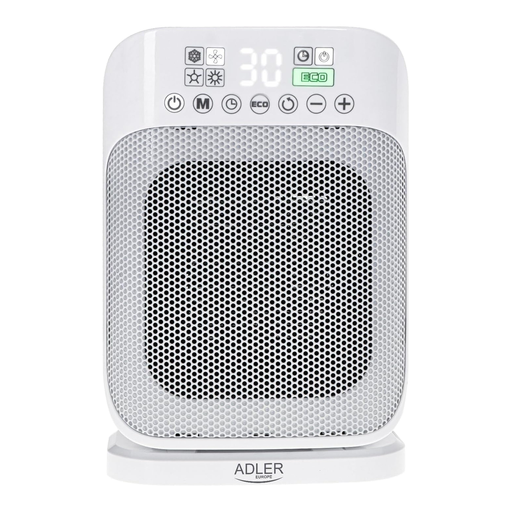
Why this product suits this profile: This model offers 1500 W, a temperature setting of 10–35 °C, a remote control and 45° oscillation for everyday use in smaller rooms.
The stated room size, power output and noise rating of under 51 dB make it easier to assess against broad advertising claims.
1500 W, anti-frost function at 7 °C, remote control and automatic 45° oscillation.

Why this product suits this profile: The product specifications list temperature control from 5–35 °C, 70° oscillation and a noise range of 25–42 dB.
The stated coverage of 15–25 m² and the eight listed protection levels make the selection criteria transparent.
2000 W, 12-hour timer, remote control, thermostat with 1-degree increments and a stated noise range of 25–42 dB.

Why this product suits this profile: Four heating modes, an ECO function, a 24-hour timer and a thermostat range of 5–35 °C support flexible use around the home.
The power settings and ECO mode allow you to choose the output according to your needs, rather than relying solely on maximum power.
1800 W, four operating modes, remote control, oscillation, child lock, plus overheat and tip-over protection according to the product description.
We have put together a complete, regularly updated list of products that fully meet these strict selection criteria and the safety regulations applicable in the EU.
A 2,000 W appliance uses 2 kWh per hour at full power. Actual consumption may be lower when the thermostat, ECO mode or a reduced heat setting is active. To calculate the cost, multiply the consumption by your electricity price.
Only if the operating instructions do not rule out this type of use. Place the appliance in a clear, stable position, activate a timer and keep it away from textiles. Because of the high surface temperature and fire risk, a fan heater should not be operated unattended.
Its lifespan depends on operating time, exposure to dust, the fan motor and proper use. Regularly cleaning the air inlets, keeping the airflow unobstructed and following the manufacturer’s instructions can help maintain performance. Do not continue using the appliance if the cables are damaged or you notice unusual noises.