
Lieferung heute & morgen

Qualitätsgarantie

Willkommens-Angebote freischalten: KOSTENLOSE Lieferung | Bis zu 80 % RABATT | Kostenlose 30-Tage-JoyPlus-Testphase
App herunterladen
A digital torque wrench does more than display a set value: it can alert you acoustically, visually or through vibration while tightening. This is useful when screw connections on bicycles, motorcycles, vehicles or machinery need to be tightened to a specified torque. However, your choice should not be based solely on the large numbers printed on the packaging.
A torque wrench with a range of 6.8 to 135 Nm is designed for different jobs than a model covering 1 to 20 Nm. For delicate bicycle components, an oversized wrench may be unwieldy or fail to cover the low range you need. For wheel nuts or larger machinery connections, a 1/4-inch model with a maximum of 20 or 30 Nm is generally unsuitable.
The key point is that the desired target value must be within the stated measuring range. The wrench should not be used continuously at either the lower limit or close to its maximum load.
Specifications such as ±2% accuracy are only meaningful in the context of the measurement direction, measuring range and the manufacturer’s conditions. Check whether the specification, for example, applies only to tightening clockwise. Information about calibration, permitted overload and storage is equally important.
An LED display makes readings easier, but it does not replace correct adjustment. With an electronic torque wrench, you should also consider battery condition, display readability and how intuitive the controls are.
A comprehensive torque wrench set with bits, sockets and adapters may seem versatile. However, it is only cost-effective if you genuinely need the sizes included. Check the drive size, socket coverage and the quality of the extensions. A small 1/4-inch torque wrench is more suitable for smaller screws, while a 3/8-inch torque wrench can cover a wider range of vehicle and workshop applications.
First, note the torque values specified in the relevant assembly instructions. Bicycle components often have requirements in the lower Nm range. Work on motorcycles, cars or machinery may require considerably higher values.
Advertised accuracy of ±2% should be understood as a manufacturer’s specification. Also check:
A torque wrench with an audible signal and vibration can be useful when the display is not constantly visible while you work. A model with an LED display complements the acoustic warning with a visual signal. In a noisy workshop, vibration may be more practical than a quiet beep.
Preset memory locations, a button lock and an easy-to-read display are all useful features. However, the warning does not mean you should continue tightening after the signal: once the target value has been reached, stop applying force.
The ratchet function makes it easier to work in confined areas. According to the product description, a fine mechanism with 72 or 90 teeth requires only a small return angle. This is particularly relevant around bicycle frames, motorcycle engines or cramped areas in the engine bay.
For a torque wrench for bicycles and motorcycles, 1/4-inch drive together with suitable bits and sockets is often a sensible choice. A torque wrench for cars and workshops may benefit from a 3/8-inch or larger drive. Also check whether interchangeable heads, adapters, extensions and a storage case are included.
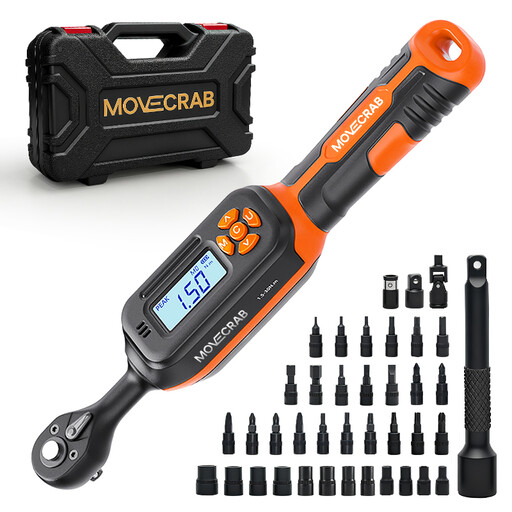
Why this product suits this profile: The low measuring range is designed for smaller screw connections. The set includes bits, sockets and adapters for bicycle, motorcycle and selected repair work.
The defined range of 1.5 to 30 Nm makes its application limits clear. The included parts reduce the need for additional purchases, but you should still check which sizes you require.
1/4-inch drive, 40 pieces, LED display and audible signal. According to the product information, up to 500 readings can be stored.
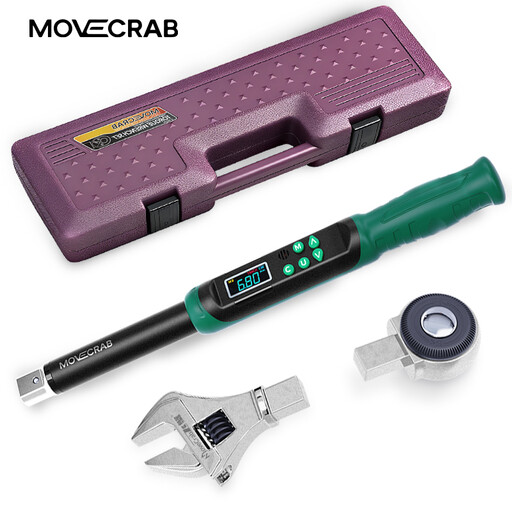
Why this product suits this profile: The 3/8-inch torque wrench combines a ratchet head with an adjustable open head, making it suitable for different nuts, bolts and selected pipe connections.
The measuring range and two heads are clearly specified. This makes it possible to check before buying whether the intended application can be handled without unsuitable adapters.
According to the product information: ±2% accuracy, four units, peak, track and preset modes, plus memory for up to 500 values.
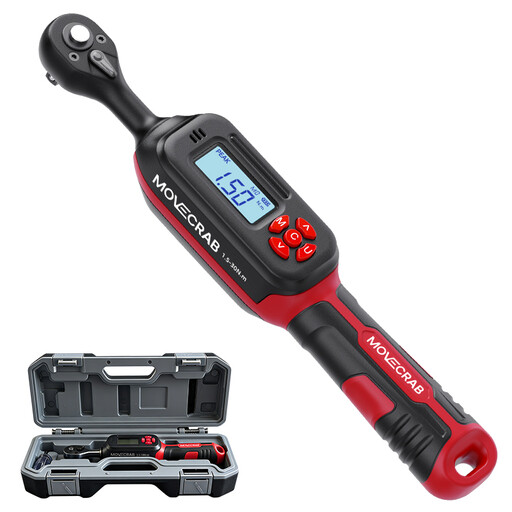
Why this product suits this profile: This model is aimed at users who regularly switch between bicycles, motorcycles, cars and general workshop tasks.
According to the supplier, the warning is provided through vibration, an audible signal and an LED. The maximum load must still not be exceeded.
According to the product information: ±2% accuracy, 10 preset values, peak and track modes, plus a bidirectional ratchet.
We have put together a complete, regularly updated list of products that fully meet these strict selection criteria and the safety regulations applicable in the EU.
Low measuring ranges are essential for bicycles. A model covering approximately 1 to 30 Nm may be suitable, provided the values specified by the bicycle manufacturer fall within this range. A 1/4-inch torque wrench with bits and small sockets covers many jobs involving stems, handlebars, seatposts and attachments.
Its service life depends on storage, battery condition, load and regular care. Overloading, moisture and using it as a ratchet for particularly high loosening torques can affect measuring accuracy. If you use it frequently, calibration should be carried out in line with the supplier’s instructions or by a suitable testing facility.
Electronic models generally run on batteries. Consumption increases with prolonged display illumination and frequent warning signals. Remove the batteries before storing the tool for an extended period, provided this is recommended in the operating instructions, and keep the tool dry.