
Lieferung heute & morgen

Qualitätsgarantie

Willkommens-Angebote freischalten: KOSTENLOSE Lieferung | Bis zu 80 % RABATT | Kostenlose 30-Tage-JoyPlus-Testphase
App herunterladen
A ratchet should loosen and tighten fasteners securely, even when space is limited. DIY enthusiasts, car mechanics and workshops often wonder whether a single 3-in-1 reversible ratchet can replace several conventional ratchets. The key factors aren’t just the number of drive sizes, but also the gear mechanism, material, swing angle and maximum load.
According to the product details, the DURATECH 3-in-1 Ratchet is designed for 1/4, 3/8 and 1/2 inch drives. This means you can use it with sockets in different sizes. However, it’s worth checking a few common potential pitfalls before you buy or use one.
A ratchet with three drive sizes may seem practical, but each size has its own load limit. According to the product details, the DURATECH 3-in-1 Ratchet has the following maximum torque ratings:
These figures don’t apply to every drive size. Using a small 1/4-inch drive on very tight fasteners or exceeding its rated load could damage the ratchet head, square drive or socket. Depending on the task, you may need a separate torque wrench for heavily tightened fasteners.
According to the product description, a 72-tooth ratchet has a swing angle of around 5 degrees. This is useful in tight spaces, such as engine bays, around machinery or when fitting furniture hardware, as you don’t need to move the handle very far.
However, the space required also depends on the handle length, socket, any extension and the working angle. A reversible ratchet with a small swing angle can help, but it’s still important to check the available space carefully.
Descriptions such as ‘alloy steel’ or ‘chrome-molybdenum steel ratchet’ don’t, by themselves, tell you how much load the whole tool can handle. The DURATECH 3-in-1 Ratchet is described as having a CR-MO ratchet head and a polished chrome finish. Its handle has a knurled section designed to help prevent slipping.
It’s also worth checking whether the ratchet has a reversing lever and a secure socket-retention mechanism. According to the product details, the DURATECH ratchet’s flush-fitting reversing lever lets you change direction without removing the socket from the fastener.
The 1/4, 3/8 and 1/2 inch sizes are suited to different jobs:
A 3-in-1 ratchet is particularly useful if you already own sockets in several sizes. However, it won’t automatically replace adapters, extensions or a torque wrench.
A higher tooth count can be an advantage when there’s limited room to move the handle. The 72-tooth mechanism on the DURATECH 3-in-1 Ratchet is listed with a 5-degree swing angle. For comparison, a separate DURATECH 1/4-inch ratchet with 90 teeth is advertised with a 4-degree working angle.
In tight spaces, the ratchet head matters as well as the tooth count. A low-profile head and an easy-to-reach reversing lever make the ratchet easier to use when your hand can’t be positioned freely.
A non-slip handle can improve control, especially when working in oily or hard-to-reach areas. According to the product details, the DURATECH 3-in-1 Ratchet has a knurled grip section and a polished chrome finish.
After use, clean dirt, moisture and oil residue from the ratchet and sockets. Store the tool somewhere dry. If a fastener is stubbornly tight, it’s best to use a penetrating oil or another suitable loosening method first, rather than putting more strain on the ratchet than its stated load limit allows.
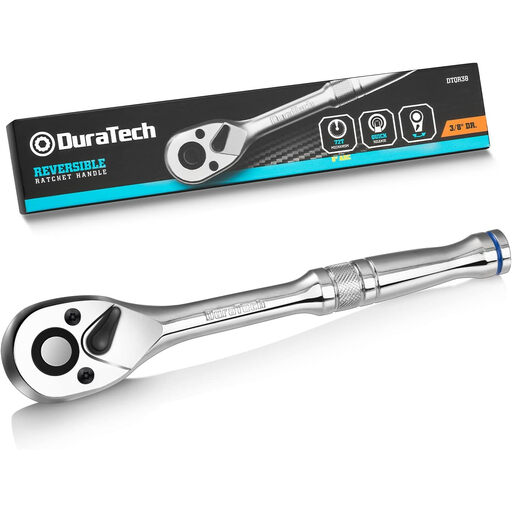
Why this product suits you: The three drive sizes—1/4, 3/8 and 1/2 inch—offer a versatile way to get started with a range of repair and assembly jobs, without having to buy three separate handles straight away.
The separate torque ratings make it clear that each drive size must be used within its limits and for the right task. The 72 teeth and stated 5-degree swing angle help reduce unnecessary movement in tight spaces.
Three popular drive sizes, a 72-tooth mechanism, a 180 mm handle and a CR-MO ratchet head, according to the product details.
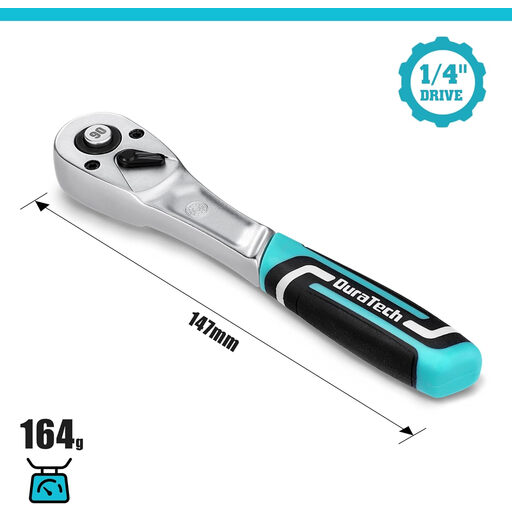
Why this product suits you: For precision work on small fasteners and in confined spaces, this dedicated 1/4-inch ratchet offers finer gearing and a stated 4-degree working angle.
Its dedicated 1/4-inch drive helps avoid using a multi-purpose ratchet for every task. According to the product description, the quick-release button makes it easier to change sockets.
90 teeth, a 4-degree working angle, a quick-release button and a chrome vanadium steel handle, according to the product details.
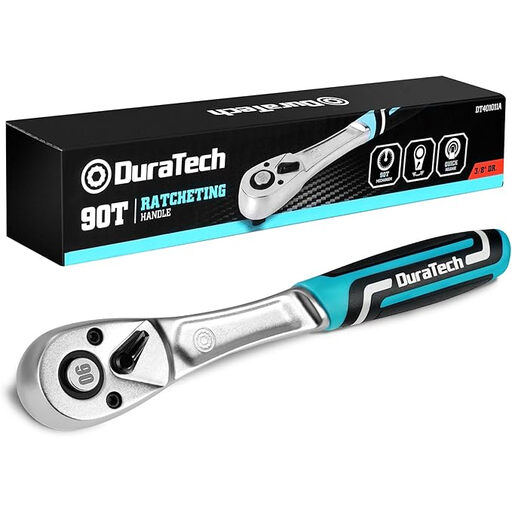
Why this product suits you: Car mechanics and frequent users who mainly work with 3/8-inch sockets get a reversible ratchet designed for this size, suitable for vehicle, machinery and assembly work.
The fixed 3/8-inch drive avoids the need for unnecessary adapters, reducing the number of connection points. According to the product details, the reversing lever lets you switch between directions.
90-tooth mechanism, a 4-degree working angle, quick-release function and chrome vanadium steel, according to the product description.
We’ve put together a comprehensive, regularly updated list of products that meet these strict selection criteria and fully comply with the safety regulations in force in the EU.
According to the product details, it’s suitable for repairs to cars, motorcycles, machinery and household appliances, as well as furniture assembly and general maintenance. Be sure to use the right socket and stay within the load limit for the drive size you’re using.
A 72-tooth ratchet may be suitable for tight spaces thanks to its stated swing angle of around 5 degrees. Whether it will actually fit also depends on the ratchet head, socket, extension and available working space.
Use a suitable torque wrench whenever a connection needs to be tightened to a specified torque. A ratchet is primarily designed for loosening and tightening; its maximum torque ratings don’t automatically set a precise tightening torque.