
Lieferung heute & morgen

Qualitätsgarantie

Willkommens-Angebote freischalten: KOSTENLOSE Lieferung | Bis zu 80 % RABATT | Kostenlose 30-Tage-JoyPlus-Testphase
App herunterladen
An electric fan heater can warm a work area, bedroom or small room for a short time. The choice may seem straightforward at first glance: compare wattage, choose your preferred colour and you’re done. In practice, however, several common marketing claims can lead to the wrong purchase.
A 2,000-watt appliance can heat the air quickly, but at full power it also uses 2 kWh per hour of operation. An energy-efficient fan heater does not automatically produce heat using less energy. The main potential for saving comes from a thermostat, adjustable heat settings, ECO mode and timer. These features prevent the appliance from running for longer or at a higher output than necessary.
Specifications such as ‘for 20 m²’ depend on insulation, ceiling height, outdoor temperature and the desired room temperature. A poorly insulated older property may require more heating power than a small, well-insulated room. A fan heater is therefore primarily intended as supplementary heating or for quickly warming limited areas, rather than as a blanket replacement for a building’s main heating system.
A fan heater with overheat protection and tip-over protection reduces certain operating risks. It must still not be covered, placed directly next to curtains or operated unattended. Even an apparently water-resistant design is not a free pass for use close to a shower, bath or washbasin. The instructions supplied with the appliance are the deciding authority.
For smaller rooms and targeted warmth, 1,200 to 1,500 watts may be sufficient, depending on the situation. Appliances with 1,800 to 2,000 watts offer more capacity for larger or more thoroughly chilled areas. However, multiple settings are crucial, such as 750, 1,500 and 2,000 watts. This allows the output to be adjusted to the room size and heating requirement.
A PTC ceramic heater regulates its electrical resistance according to the temperature. Ceramic fan heaters often contain one or more PTC elements. However, this does not automatically mean lower electricity consumption: at the same output, a ceramic fan heater generally requires a comparable amount of energy to other electric direct-heating appliances.
A fan heater with a thermostat switches the heating function on or off depending on the set target temperature. Look for a clearly defined temperature range and an easy-to-read display. A fan heater with a timer can switch off after a set period. This is useful when only a short warm-up phase is required.
An ECO mode can automatically reduce the output or switch between settings. The actual saving depends on the room, insulation, target temperature and duration of use. Manufacturer claims such as ‘up to 40 per cent’ should therefore be understood as product-specific marketing information, not as a guaranteed figure for every household.
For bedrooms, children’s rooms or offices, a quiet fan heater is a sensible choice. Decibel values should be listed in the specifications, although measurement conditions may vary. Oscillation through 70, 90 or 120 degrees distributes the airflow across a wider angle. It does not replace suitable positioning with sufficient clearance from furniture and textiles.
A remote control and display make it easier to operate the appliance from a distance. For tenants and students, a portable, lightweight housing with a carry handle is also useful. Check whether the appliance is designed for a German socket with the appropriate voltage. Only use extension leads if their load capacity is suitable for the stated output.
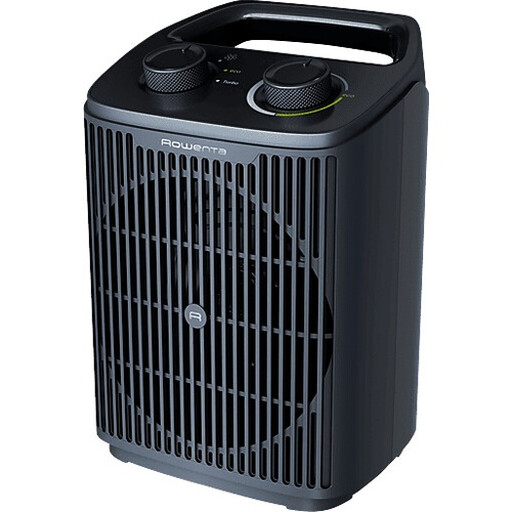
Why this product suits the profile: This compact appliance is ideal for anyone looking for straightforward, portable supplementary heating for a living room, bedroom or office.
The design focuses on simple operation; the safety instructions explicitly require unobstructed air inlets and outlets, as well as clearance from water and flammable materials.
2,000-watt heat output, compact format and portable design with easy-to-use controls.

Why this product suits the profile: If you are looking for temperature control, convenient features and safety equipment in one compact appliance, this model offers a comprehensive range of functions.
The adjustable thermostat from 5 to 35 °C, ECO mode and 24-hour timer help prevent unnecessary continuous operation. A tip-over switch and overheat protection are also specified.
Four operating modes, remote control, oscillation and, according to the product specifications, three noise settings down to 38 dB.
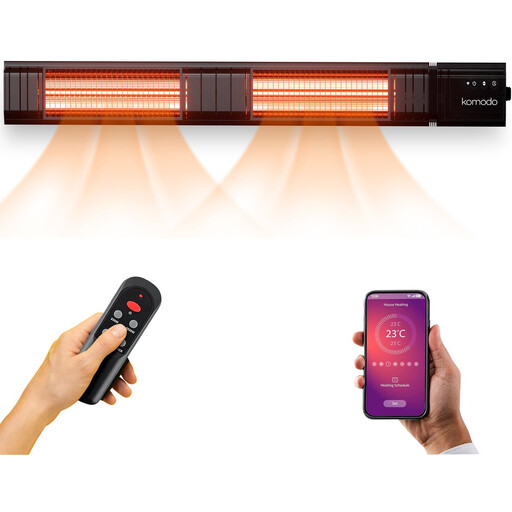
Why this product suits the profile: This infrared heater is an interesting option for anyone who needs a directed heat source for larger indoor or outdoor areas.
The nine power settings allow finer adjustment than an appliance with just one heat setting. For outdoor use, the IP rating, power connection and positioning instructions in the manual must be observed.
3,000 watts, 180-degree oscillation, remote control and app control; according to the product description, it is intended for areas of up to 35 m².
We have put together a complete, regularly updated list of products that fully meet these strict selection criteria and the safety regulations applicable in the EU.
Running costs can be estimated roughly as follows:
Power consumption in kW × operating time in hours × electricity price per kWh = cost
A 2,000-watt fan heater uses 2 kWh per hour when operating at full power. Thermostat operation and lower power settings can reduce the actual running time. Before buying, check whether the appliance can be used with a wall socket that has a sufficient load rating. Multi-socket adapters and unsuitable extension leads can heat up.
At least the following rules apply for safe operation:
This depends on the selected output and the operating time. An appliance rated at 2,000 watts uses 2 kWh after one hour of continuous operation. In thermostat or ECO mode, the heater may switch off temporarily. Nevertheless, the fan and heating function should only run for as long as supplementary heat is actually needed.
There is no one-size-fits-all service life. It depends on the number of operating hours, exposure to dust, the quality of the power supply and how well the appliance is maintained. Unrestricted airflow, regular cleaning and following the operating instructions can reduce the strain on the appliance. If there is visible damage or unusual noise, stop using it.
A stable, dry surface with sufficient clearance from flammable objects is suitable. Bathrooms, damp rooms and areas close to water are only permitted if the instructions expressly allow it and all protection requirements are met. A portable fan heater should never be covered or left switched on unattended during a prolonged absence.