
Lieferung heute & morgen

Qualitätsgarantie

Willkommens-Angebote freischalten: KOSTENLOSE Lieferung | Bis zu 80 % RABATT | Kostenlose 30-Tage-JoyPlus-Testphase
App herunterladen
An electric heater can be a practical choice when individual rooms need additional heat only occasionally—for example, a home office, bedroom, office or small living area. The selection ranges from fan heaters and ceramic fan heaters to oil-filled radiators and permanently installed electric radiators. Differences in heat distribution, noise levels, controls and safety determine whether a device is genuinely suitable for everyday use.
A 2000-watt heater delivers more maximum output than a 1200- or 1500-watt model. At full power, however, it also consumes more electricity. Running time is another decisive factor when it comes to operating costs.
The basic calculation is:
Power in kilowatts × operating hours × electricity price = electricity cost
A 2 kW device running for two hours theoretically uses 4 kWh. The actual cost depends on the applicable electricity tariff and the control system. A thermostat or ECO mode does not reduce the energy required to produce a given amount of heat, but it can prevent unnecessarily long heating periods.
A convection heater and an oil-filled radiator generally operate without a fan. An electric fan heater, by contrast, distributes heat using a fan. For bedrooms or workspaces, a specific noise rating in dB should therefore be available. Terms such as “whisper-quiet” or “low-noise” are of limited value without details of the measurement conditions.
Overheating protection, tip-over protection and automatic shut-off are important features. They do not, however, make it safe to operate a portable electric heater under furniture, beside curtains or on soft textiles. Heaters must not be covered. In damp rooms, also check whether the specific model is expressly suitable for such environments and correctly marked accordingly.
An electric heater with a thermostat can regulate its output according to the selected target temperature. It is important to check whether the temperature can actually be set or whether you can only choose between fixed power levels.
A heater with a timer switches off after a defined period or, in programmable models, follows a schedule. An electric heater with remote control is convenient when the device is positioned in a bedroom or under a desk. Also look for display shut-off, child lock and the remote control’s range.
Manufacturer specifications for room size—for example, 10–20 m² or 15–25 m²—depend on insulation, ceiling height, outdoor temperature and the desired room temperature. They should therefore be treated as guidance rather than a guarantee.
For devices rated at around 1800 watts or more, a suitable wall socket is important. Depending on their design, extension cables and multi-socket adapters may be unsuitable. Check the user manual, the 220–240 V, 50 Hz mains specifications and the relevant product’s safety and conformity markings.
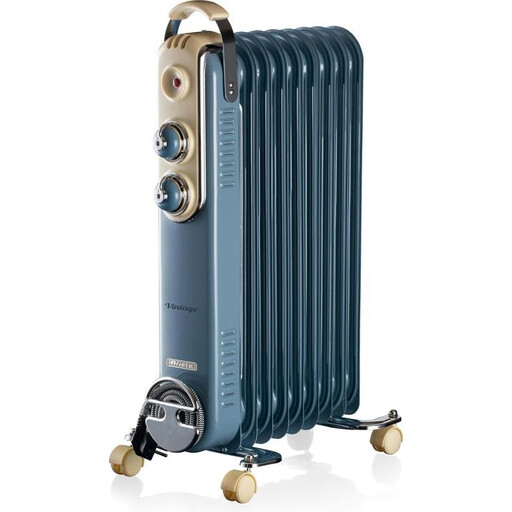
Why it fits: For households looking for a portable oil-filled radiator for a hallway or living area with three power settings.
The stated output, three heat settings, overheating protection and automatic shut-off are clearly specified.
2000 W maximum output, nine heating elements, 6.6 kg weight and portable placement.
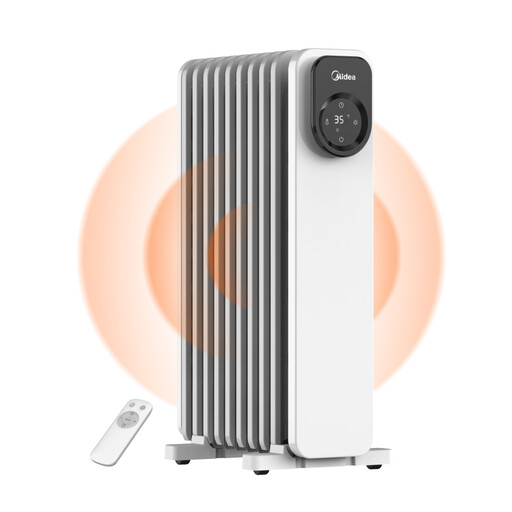
Why it fits: For living rooms, bedrooms or home offices where quiet operation and remote control are priorities.
The product description highlights thermostat control, four modes, as well as tip-over and overheating protection. The device is specified only for well-insulated rooms or occasional use.
2000 W, nine fins, LED touchscreen, remote control and silent operation without a fan.

Why it fits: For bedrooms, home offices or personal spaces with a timer, remote control and oscillation.
Four operating modes, including ECO mode, and a 1–12-hour timer are specified. Use is limited to hard, level surfaces and indoor spaces.
750 W and 1500 W settings, LED display, remote control, oscillation, plus tip-over and overheating protection.

Why it fits: For smaller rooms of 10–20 m² according to the manufacturer, where compact dimensions and low noise levels matter.
The product specification states 25–42 dB, an adjustable temperature range of 5–35 °C and several safety functions. Energy savings of up to 40% should be understood explicitly as a manufacturer claim.
Compact dimensions of 15.8 × 15.4 × 25 cm, 12-hour timer, remote control, plus CE and CB markings according to the product description.
The category features additional heaters for bathrooms and indoor spaces. Before buying, check the output, placement, safety functions and the information in the user manual.
Consumption depends on the heater’s output and operating time. A 1500-watt heater theoretically uses 1.5 kWh during one hour at full power, while a 2000-watt heater uses 2 kWh. A thermostat, timer and ECO mode can reduce operating time. They do not, however, fundamentally make direct electric heating cheaper than other heating methods.
Depending on your priorities, a quiet oil-filled radiator or a quiet fan heater with a documented dB rating may be suitable for a bedroom. A timer can limit the operating time. The device must stand securely, must not be covered and should not be left unattended while in operation.
Service life depends on usage time, dust exposure, storage conditions and build quality. Clean the air inlet and outlet only as instructed, disconnect the device from the power supply before cleaning and move it only once it has cooled down. If the cable is damaged or you notice an unusual smell, smoke or visible damage, stop using the electric heater.