
Lieferung heute & morgen

Qualitätsgarantie

Willkommens-Angebote freischalten: KOSTENLOSE Lieferung | Bis zu 80 % RABATT | Kostenlose 30-Tage-JoyPlus-Testphase
App herunterladen
An electric fan heater heats individual rooms quickly and flexibly. In the bedroom, home office or living room, it can be used as a portable supplementary heater when the existing heating system is not sufficient or you only want to warm a particular area. However, choosing the right model is often more complicated than it first appears: high wattage, “Eco” programmes and especially low decibel ratings alone say little about how practical a heater will be in everyday use.
A 2,000-watt appliance can heat a room quickly, but at full power it also uses 2 kWh per hour of operation. An energy-saving fan heater does not automatically use little electricity simply because it has an Eco mode. What matters is short operating times, a suitable room size, precise temperature control and an appropriate power setting.
Manufacturer specifications such as 15 to 25 m² refer to particular conditions. Ceiling height, insulation, window area, outside temperature and open doors all affect the actual heating performance. In a poorly insulated room, a small fan heater may not provide enough heat even if the stated floor area appears suitable.
An electric fan heater with tip-over protection and overheat protection provides additional safety mechanisms, but it does not eliminate risks caused by blocked air outlets, flammable fabrics or an unsuitable socket. A timer and remote control also do not automatically make continuous unattended operation safe.
For smaller personal areas, 750 to 1,500 watts may be sufficient. Models rated at 1,800 to 2,000 watts are often offered for medium-sized rooms. Also look for several heat settings. A heater that can switch between low and high power is easier to adapt to the room size and how you use it.
A PTC heater, also known as a ceramic fan heater, uses a ceramic heating element with a positive temperature coefficient. The element’s electrical conductivity changes as its temperature rises. This gives it a design-related temperature-limiting property; however, the actual safety level still depends on the overall construction of the appliance and how it is used.
An electric fan heater with a thermostat should have a clearly readable temperature setting and, where possible, small adjustment increments. Models with a range of 5 to 35 °C offer more flexibility than appliances with just two fixed settings. An electric fan heater with a timer can limit the operating time, for example when preheating a home office.
Fan heaters with oscillation distribute warm air across a wider angle. Specifications such as 70° or 90° describe the sweep range and do not automatically mean that the entire room will be heated evenly. The position of the heater and the air circulation also need to be suitable.
A quiet fan heater is a sensible choice for bedrooms and offices. However, decibel ratings should always be considered in relation to the power setting being used. A rating of 34 dB may refer to a particular operating mode, while higher settings can be considerably louder.
With 1,500 or 2,000 watts, using a suitable wall socket is important. Do not use a multi-way adaptor or extension lead unless it is explicitly rated for the required power. Check the rating plate, operating instructions and available conformity information before using the appliance.
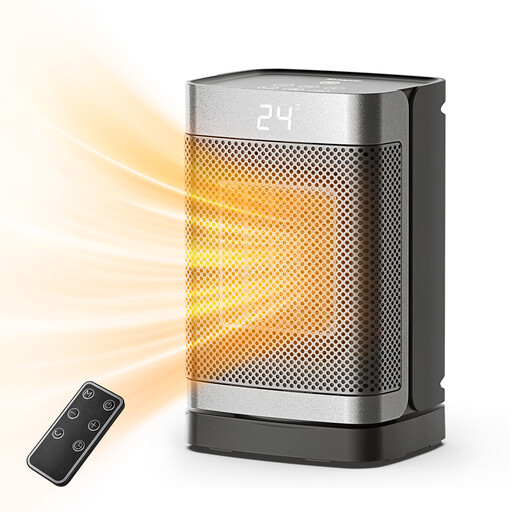
Why this product suits the profile: This compact model is designed for users who want to heat a bedroom, home office or personal area flexibly. The remote control, LED display and 12-hour timer make it easy to operate.
Two heat settings and an adjustable temperature help prevent the heater from running continuously at maximum power. Tip-over protection and overheat protection are listed as safety features.
1500-watt class, 12-hour timer, remote control and oscillation in a portable housing.

Why this product suits the profile: For medium-sized rooms, the supplier states a heating coverage of 15 to 25 m². According to the manufacturer, the temperature can be set between 5 and 35 °C; a DC motor and remote control support comfortable operation.
The power control and thermostat can help reduce unnecessary operation at full power. According to the product data, the stated noise level of 25 to 42 dB applies to different operating conditions.
2000 watts, 70° oscillation, 12-hour timer and, according to the manufacturer, eight levels of safety protection.

Why this product suits the profile: According to the product data, this compact appliance is designed for 10 to 20 m² and weighs 1.44 kg. The stated operating noise level is between 25 and 42 dB; a timer and remote control support use at a desk or in the bedroom.
The lower power class is better suited to smaller rooms. The 12-hour timer limits operating time; according to the manufacturer, tip-over protection and overheat protection are integrated.
Compact dimensions, 1500 watts, thermostat range of 5 to 35 °C and, according to the manufacturer, up to 34 dB in the relevant mode.
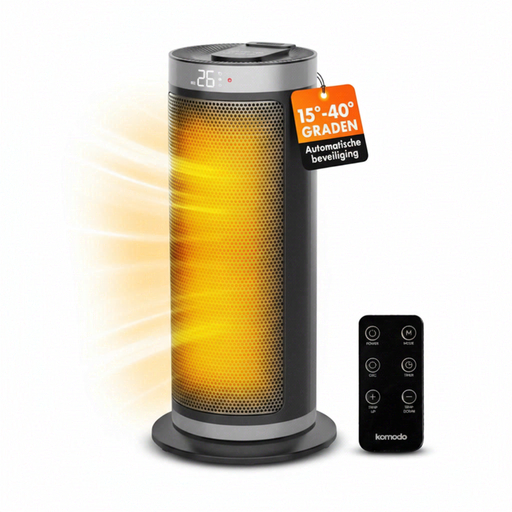
Why this product suits the profile: The selectable settings of 750, 1500 and 2000 watts are suitable for changing room sizes and usage times. The thermostat, Eco mode, remote control and 90° oscillation are designed for regular use.
The flexible power selection prevents small rooms from always being heated at 2000 watts. In damp areas, the heater may only be used if its IP rating, positioning and operating instructions explicitly permit it.
Three power settings, Eco mode, 90° oscillation and, according to the product information, IP66.
We have put together a complete, regularly updated list of products that fully meet these strict selection criteria and the safety regulations applicable in the EU.
An appliance rated at 2,000 watts uses 2 kWh per hour at full power. At 1,500 watts, it uses 1.5 kWh per hour. Actual consumption falls when the thermostat, power settings or Eco mode switch the heating element off temporarily. For a realistic estimate, multiply the power rating by the operating time and your electricity tariff.
A timer and overheat protection can reduce the risk, but they do not replace the manufacturer’s instructions. Check the operating manual, position the heater in a clear space and do not leave it running unattended. For bedrooms, a low noise level and a reliable automatic shut-off function are particularly important.
Its service life depends on operating time, exposure to dust, storage conditions and build quality. Clean the air intake according to the instructions, avoid moisture and only store the appliance once it has cooled down completely. You cannot determine a general service life based solely on the wattage or ceramic technology.